Popup Title
Physics I - Mechanics
These notes were made by KEMO to help his members on the STEM Help! Discord server. If you wish to join, here is the server invite: https://discord.gg/f2V6GUwE2V
I will try to go into enough depth to help you understand exam questions and the typical things you need to know, but not into too much depth. Refer back to your syllabus to make sure you're covering everything you need to cover.
If you see that a word is highlighted, that means I wrote down a simplified definition to help you understand what it means. Put your mouse over the highlighted word to see its definition.
Introduction
Think of this topic as your investigation regarding what forces are on an object and what they do.
Kinematics
We will first look at moving objects. There are a few things to consider regarding the object:
- Its displacementDisplacementHow far the final position of the object is from its starting position. Displacement doesn't care what happens in the middle of your journey. For example, if you travel 10 meters to the right and then $10$ meters left, you would've simply returned back to your starting position, so your displacement is $0-0=0$ meters, even though your distance travelled is $10+10=20$ meters. Note, your displacement could be negative, because displacement cares about direction. (x). Measured in meters ($m$). (You must know the difference between displacement and distanceDistanceDistance can only be a positive measurement. Distance doesn't care about direction. Think of it as how many steps you took, regardless of where you are going. If you travel $10$ meters to the right and then $10$ meters left, then your distance travelled is $10+10=20$ meters. You travelled a total of $20$ meters.).
- Its initial velocityVelocityIt's very similar to speed, but it also cares about direction. For example, a red car is moving $30$ mph to the west and a blue car is moving $30$ mph to the east. These 2 cars have the same speed ($30$ mph) but they have different velocities (they are going in different directions). 2 objects going in opposite directions = their velocities will have opposite signs (one will be positive and the other is negative). This is unlike speed, which can only be positive. ($v$$i$). Measured in meters per second ($m/s$).
- Its accelerationAccelerationThis refers to how quickly something is changing its velocity. The greater the magnitude of acceleration, the greater the object is changing its velocity. If acceleration is negative, the object is slowing down (can also be called deceleration). If the acceleration is positive, the object is speeding up. ($a$). Measured in meters per second-squared ($m/s²$)
- Its final velocity ($v$$f$).
- The time period related to all these 4 aspects ($t$). Measured in seconds ($s$).
Watch out! Since we are dealing with vectors (things that depend on direction), you must always define which direction is positive and which direction is negative before you start working.
Before we continue, it's important to discuss the things we measure stuff in.
Mass (will be defined later) is measured in kilograms ($kg$).
Distance is always measured in meters ($m$).
Time is always measured in seconds ($s$).
Forces are measured in newton ($N$).
All other measurements, such as acceleration, velocity, momentum, etc. will be dependent on these units. If you change the units, you will get the wrong answer.
Position-Time graph
I will now show you a graph of an object's position over some time period.
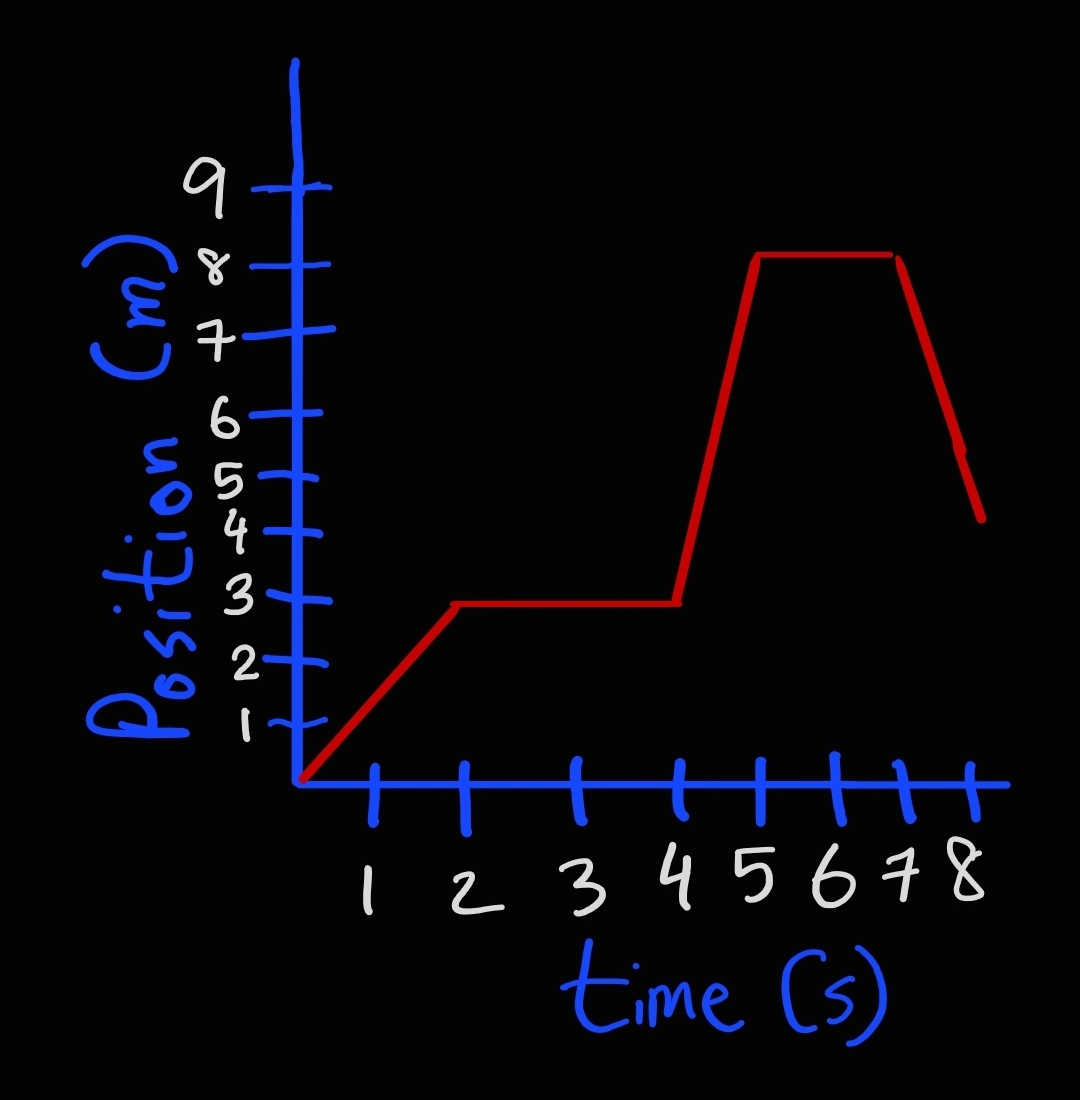
How do you interpret this graph? I will color code it for you and break it down for you.
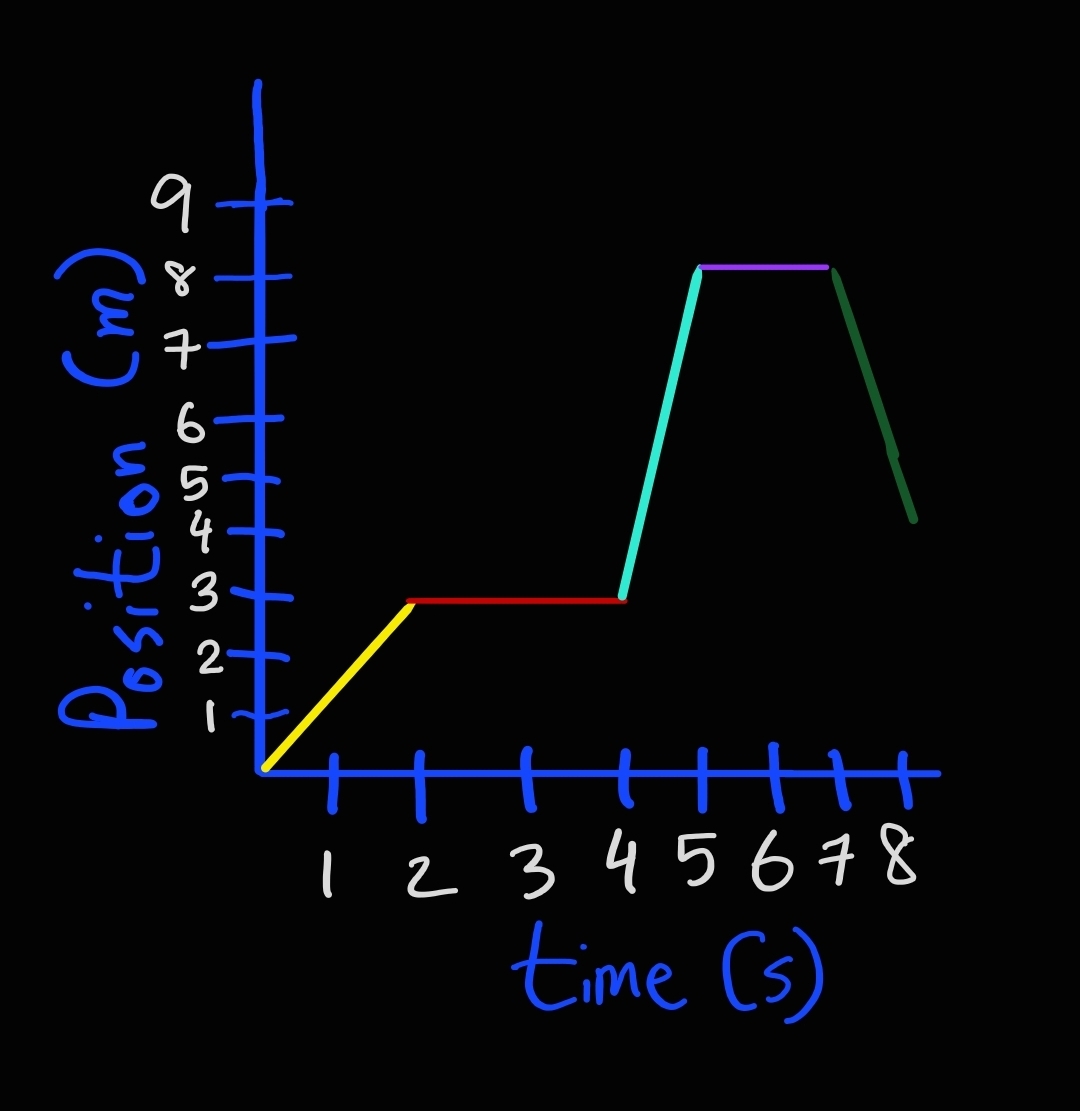
Each different color represents a different stage (notice how I pick each stage: it is when the behavior of the line changes).
- The first stage is from second $0$ to $2$, the object travels $3$ meters (from its starting position of $0$ to $3$ meters away from it).
- The second stage is also $2$ seconds long (the second stage started at time = $2$ seconds, and ended at time = $4$ seconds. Hence, $4-2=2$ seconds). In this stage, the object didn't move at all (the line is horizontally flat. It didn't move from the $3$ meter point) and stayed stationary for those $2$ seconds.
- The third stage is $1$ second long (it started at time = $4$ seconds and ended at time = $5$ seconds. Hence, $5-4=1$ second). The object in this stage continued moving away from the starting point. It moved from the $3$ meter point to the $8$ meter point. So in this stage, it moved a total of $8-3=5$ meters.
- The fourth stage was $2$ seconds long (it started at time = $5$ seconds and ended at time = $7$ seconds. Hence, $7-5=2$ seconds). The object was completely stationary in this stage, as shown by the horizontal flat line).
- The last stage was $1$ second long (it started at time = $7$ seconds and ended at time = $8$ seconds. Hence, $8-7=1$ second). In this stage, the object is coming closer to its starting point (in other words, it is moving in the opposite direction it was originally moving throughout its journey). In this stage, it moved from the $8$ meter point to the $4$ meter point. So in this stage, it moved a total of $4$ meters backwards.
Using this analysis, you can be asked a few things regarding the object.
- Its displacement after those $8$ seconds are over.
- The distance it travelled.
- Its velocity in each stage.
Let's answer each part below.
Displacement ▼
As we said, displacement doesn't really care about what happened in between the start and the end. Just look at what value did you start on when time = $0$ seconds, and then what value did you finish on when time = $8$ seconds.
When time = $0$ seconds, the object was at the $0$ meter point. When time = $8$ seconds, the object was at the $4$ meter point. Hence, its displacement is $+4$ meters.
Distance Travelled ▼
This one only cares about how many steps you took. Look back at each stage and see how many meters we travelled in each stage.
Stage 1: $3$ meters
Stage 2: $0$ meters
Stage 3: $5$ meters
Stage 4: $0$ meters
Stage 5: $4$ meters
Now add them all up. $3+0+5+0+4=12$ meters
We moved a total of $12$ meters.
Velocity in each stage ▼
How do we figure this one out? We have 2 methods, I will show you both.
Method 1: Use the formula of velocity.
The formula is $\text{Velocity} = \frac{\text{distance}}{\text{time}}$.
For each stage, we have the distance we travelled and we also have how long each stage was.
I will use this method to find the velocity in the first 2 stages.
- Stage 1: Distance = $3$ meters. Time = $2$ seconds. $\text{Velocity} = \frac{\text{distance}}{\text{time}} = \frac{3}{2} = 1.5 m/s$
- Stage 2: Distance = $0$ meters. Time = $2$ seconds. $\text{Velocity} = \frac{\text{distance}}{\text{time}} = \frac{0}{2} = 0 m/s$
Method 2: Finding the slopeSlopeHow steep the line is on the curve. The greater magnitude (magnitude means I'm not referring to positive or negative signs. Just the number itself) the slope, the greater the steepness. If your slope is a negative value, that means that the line is going down. If your slope is a positive value, that means the line is rising up. of the line/curve (can sometimes require calculus). Velocity is equal to the slope of a position vs. time graph.
This is a more reliable method. It just takes some time to master.
Right now, we have a straight line (not a curve) so we can use the formula $\text{slope} = \frac{\text{rise}}{\text{run}}$.
To use it, simply pick 2 points on the line and read the x and y coordinates for each point. Let's call the coordinates for the first point $(x_1, y_1)$ and the coordinates for the second point $(x_2, y_2)$. Note, the first point must be to the left of the second point. Here's a picture of what I mean:
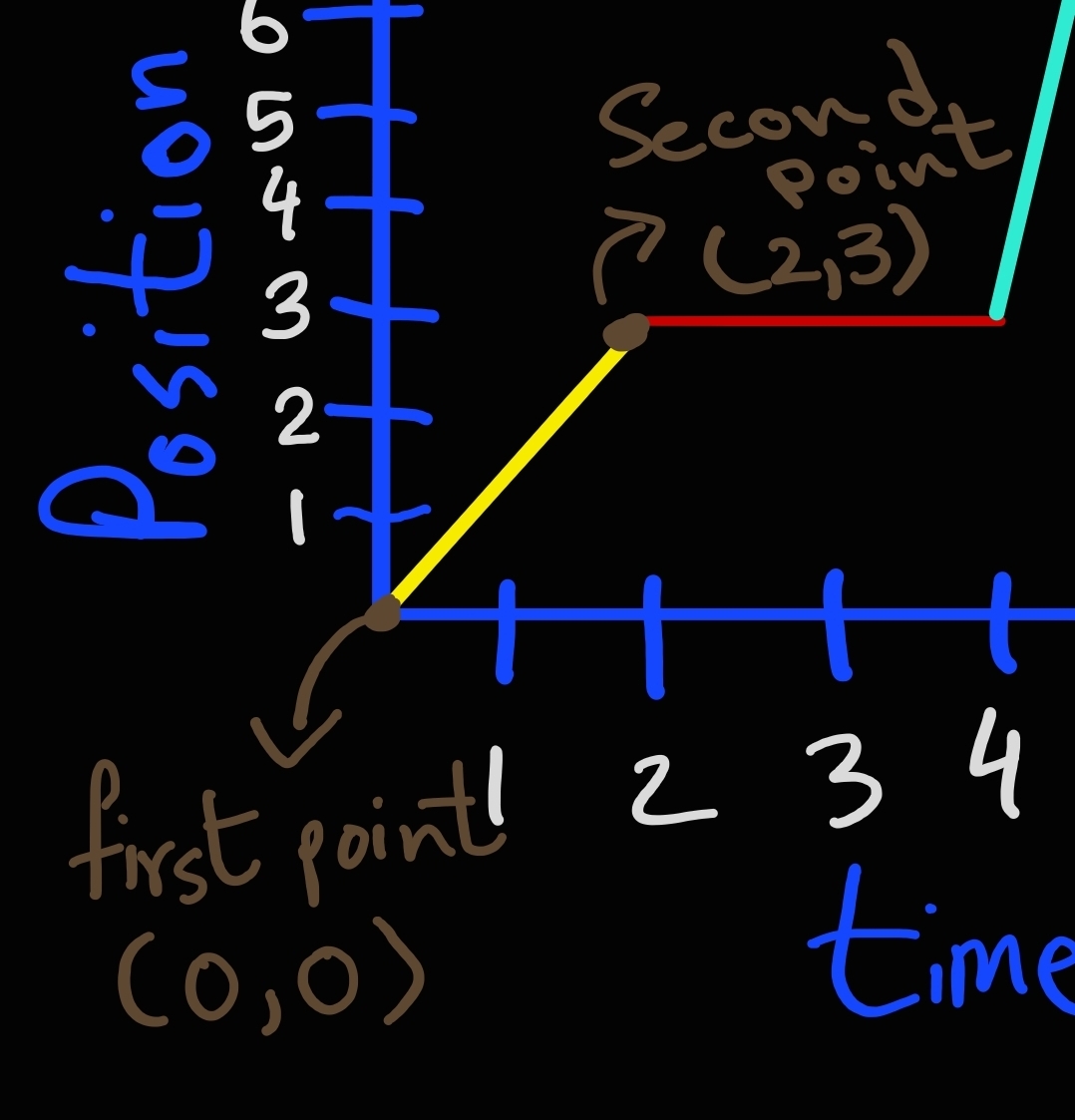
Then do this:
$$\text{slope} = \frac{y_2 - y_1}{x_2 - x_1}$$So, $(x_1, y_1) = (0, 0)$ and $(x_2, y_2) = (2, 3)$. Input the corresponding values into the formula.
$$\text{slope} = \frac{3 - 0}{2 - 0} = \frac{3}{2} = 1.5$$Hence the velocity for the yellow line is $1.5 m/s$, which is the same result we got previously.
Final notes:
- if your graph is showing you a negative position/displacement, it means the object is going backwards (Assuming you made forward positive).
- If your position-time graph shows is changing linearly, then velocity is a constant, flat, horizontal line.
- If your position-time graph is not linear (there's a curve or something), then velocity is changing, either in a linear or non-linear fashion.
Velocity-Time graph
These graphs tell you
- How the velocity of an object changes over time.
- The displacement (also known as, the change in position) of an object over some time interval.
- The acceleration of an object.
Let's see how to read a velocity vs. time graph:
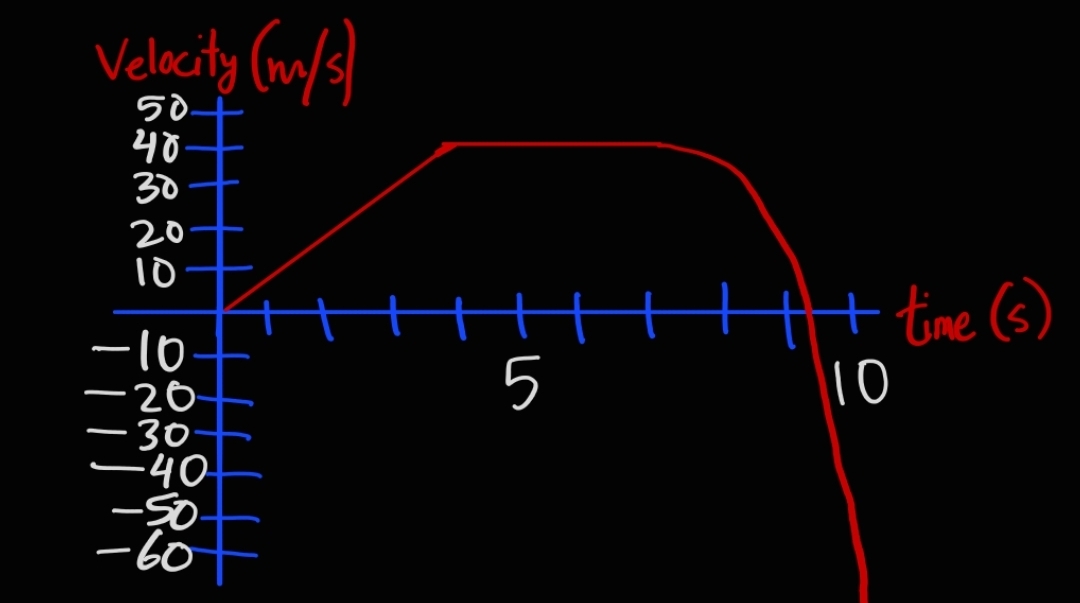
- You read the velocity the same way you read a graph. For example, when time = $1$ second, the velocity seems to be just a little below $10 m/s$. Throughout the time interval $t=4 \to 7$ seconds, it seems like the object had a constant velocity of $40 m/s$ (don't confuse this with a position-time graph, where a flat horizontal line means the object stopped moving).
Let's focus a little bit on the time interval $t=7 \to ~9$. The line is going down. Does this mean that the object is going in the opposite direction now? No. The line is still above the 0 point, so it is still going in the same direction but much slower. It only starts going backwards once it crosses the 0 point and gets into the negative portion of the graph. - How do you read the displacement? Displacement is the area under the line/curve.
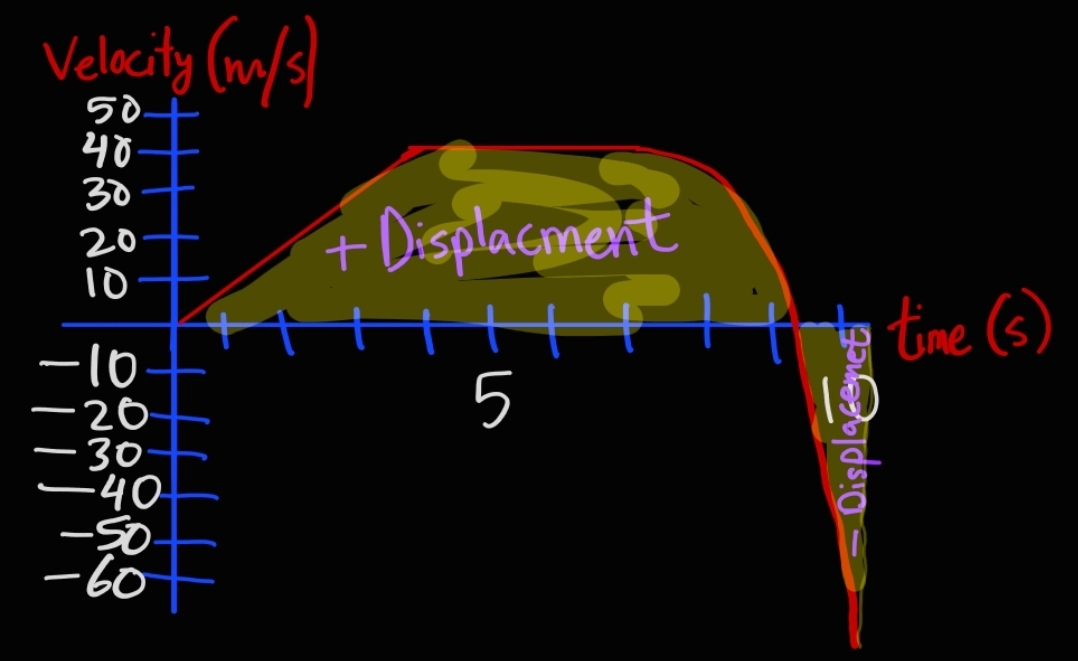
If the shaded region (the area) is in the positive portion, you have positive displacement. If the shaded region is in the negative portion, you have negative displacement. To find the total displacement, add up your positive and negative displacements.
Finding the area under the graph can sometimes require calculus, and other times just the formula of different shapes (most common shapes are triangles and rectangles/squares)
For example, let's focus on the positive displacement portion. Hopefully you can notice that the area under the graph can be broken down into 3 parts: a triangle, a rectangle/square, and some abnormal shape:
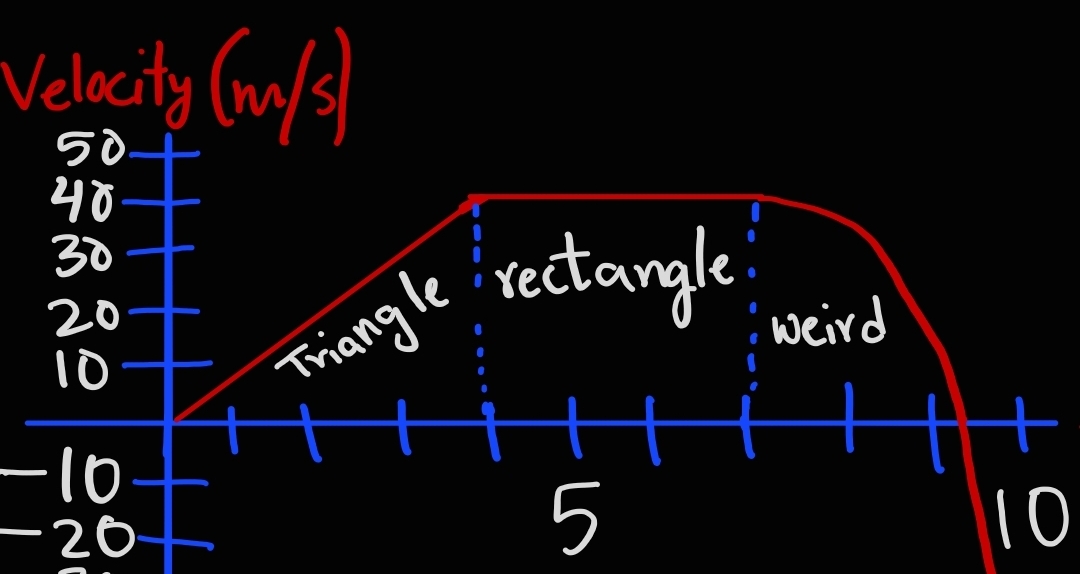
For simplicity, I will only find the total displacement from $t=0 \to 7$ seconds.- Area of a triangle $= \frac{1}{2} \cdot b \cdot h$
Our base is 4, and the height of the triangle is 40. So the area under the triangular portion is $\frac{1}{2}(4)(40) = +80$ m - Area of a rectangle $= b \cdot h$
Our base is $(7-4)=3$ and our height is 40. So the area under the rectangular portion is $3 \cdot 40 = +120$ m - Total displacement $= 80 + 120 = 200$ m
- Area of a triangle $= \frac{1}{2} \cdot b \cdot h$
- How do you find the acceleration of the object? Acceleration = slope of a velocity-time graph. The method of finding the slope is the same as before (in the position-time graph example). If the graph is a curve (such as in this velocity-time graph from $t=7$ and beyond), you will have to use calculus.
Final note:
- If your velocity is changing in a linear fashion, then your acceleration is a constant, flat, horizontal line.
- If your velocity is changing in a non-linear fashion, then your acceleration is changing in either a linear or non-linear fashion.
Acceleration-Time graph
These tell you:
- The acceleration of an object. The greater the magnitude of the slope, the greater the change in acceleration (unlike the others, the slope doesn't tell you a new property)
- The change of velocity (area under the graph)
General Kinematics equations
Keep these in mind, you may sometimes use them in the most unexpected places to reach your answer. I'm saying this from experience.
To decide which equation to use, you generally need 3 known variables to find your unknown variable. Keep in mind that there's a total of 5 variables, so you'll usually have 1 variable that the problem never mentioned and never gave you a way to figure out from the start.
- $v_f = v_i + at$ (use this if you don't have $x$ and don't need it)
- $v_f^2 = v_i^2 + 2ax$ (use this if you don't have $t$ and don't need it)
- $x = v_i \cdot t + \frac{1}{2}at^2$ (use this if you don't have $v_f$ and don't need it)
Always make sure your units are in the standard units we described in the beginning, or you will get the wrong answer no matter what.
General tips when solving kinematics:
- Draw a picture
- Define your positive and negative directions
- Look for what you know, not what you don't.
- If the question doesn't give you numbers, then perhaps there's a keyword (for example, "starting from rest" means the initial velocity is $0 m/s$. "Constant speed/velocity" means: acceleration is $0 m/s²$ AND final and initial velocities are the same. If your question says your object stops, that means your final velocity is $0 m/s$)
- Try to see how you can use what you know to reach your goal.
- You can sometimes break down a problem into several parts on your own and tie them together in the end. Diagrams will help you figure out if you can do that or not.
- Don't start plugging in numbers too early. Sometimes, you can cancel stuff out.
Rules to keep in mind:
- In free fall (when something is falling freely through the air) —
- the acceleration will always be equal to the acceleration of gravity ($9.8 m/s²$). This is ignoring air resistance.
- The weight of the object WILL NOT make your object fall any faster.
- If you throw an object upwards, it will have no velocity (velocity = $0 m/s$) at the top.
- If you throw an object upwards, time to reach the top = time to fall back down.
- If you throw an object upwards, the speed it had going up at a certain point = the speed it has going down at that same point (just obviously opposite directions)
Observe the below example to practice problems regarding free fall.
Question: You throw a ball straight up with a velocity of $10 m/s$.
Part 1: What is the maximum height it reaches? ▼
Before you start the question, define your directions. I will make up positive and down negative.
Now, it is always best to draw a diagram to help you imagine the question.
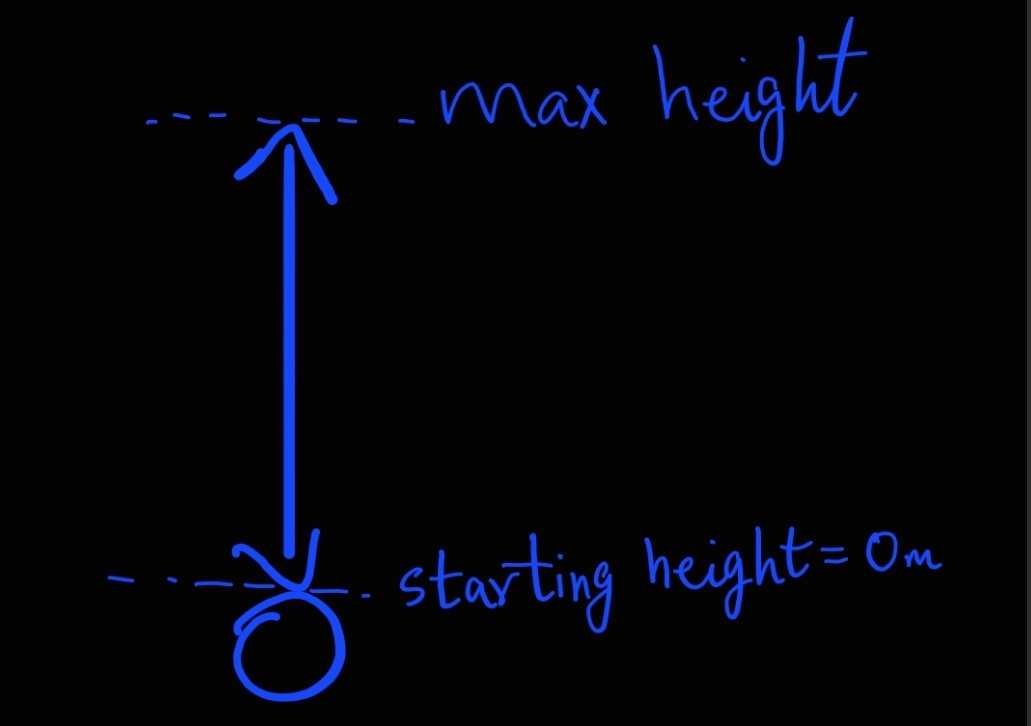
Ask yourself, what do we need? Well, we are given the initial velocity of the ball to be $v_i = 10 m/s$.
Since this ball is in free-fall, we also know the acceleration is equal to the acceleration to gravity. But is the acceleration going down or up? Gravity brings things down, so acceleration of gravity is going down. In this problem, I made down negative, so $a = -9.8 m/s²$
What else do we know? Well, remember, at the max height, velocity is $0 m/s$. So we now know that $v_f = 0 m/s$.
We are ready to start solving. We have 3 known variables ($v_i$, $a$, $v_f$) and now we need to find x. Which equation do we use? We should use the equation that doesn't require anything about time, since we didn't find it.
Used equation: $v_f^2 = v_i^2 + 2ax$
First, separate x.
- We can turn $v_f^2$ into 0.
$0 = v_i^2 + 2ax$ - $-(v_i^2) = 2ax$
- $\frac{-(v_i^2)}{2a} = x$
Now we are ready to input our values.
- $\frac{-(10)^2}{2(-9.8)} = 5.1$ m
Our answer is positive, which means the ball went upwards, which is what we expect, so we did it correctly!
Part 2: How much time does it take to return back to the starting position? ▼
First: You should not change your reference system (up is positive/down is negative) half way through the question. Since we said that up is positive in part a, then we must stick with it throughout the entire question.
Now, there's 2 ways to solve this question. I will show you both ways.
Method A: Find the time it takes to reach the top then multiply by 2.
Remember the rule: If you throw an object upwards, time to reach the top = time to fall back down.
So for example, if it took $5$ seconds to reach the top, then it would also take $5$ seconds to reach the bottom again. So the total time would be $5+5$ or $5*2=10$ seconds.
We can use the same 3 known variables in part a, but now instead of looking for x, we would be looking for t.
Which equation should we use that has $t$, $v_i$, $v_f$, and $a$? it would be this one:
$v_f = v_i + at$
Let's first solve for t before inputting the values.
$0 = v_i + at$
$-v_i = at$
$\frac{-v_i}{a} = t$
Now input the values:
$\frac{-10}{-9.8} = 1.02$ seconds.
So the total time would be $1.02 \cdot 2 = 2.04$ seconds.
Method 2: use the rule: If you throw an object upwards, the speed it had going up at a certain point = the speed it has going down at that same point (just obviously opposite directions)
How can we use this rule? Well, the question is asking us how long it takes for the ball to return back to the point you threw it from. Well, ask yourself: what was the ball's velocity at that point when it was going up? From the question: the ball's velocity was $10 m/s$. So, when the ball returns to that point, it would have the same velocity but it would be negative. Hence:
$v_i = 10 m/s$
$v_f = -10 m/s$
$a = -9.8 m/s$
$t = ?$
We will use the same equation.
$v_f = v_i + at$
$v_f - v_i = at$
$\frac{v_f - v_i}{a} = t$
Input the values:
$\frac{-10 - (10)}{-9.8} = 2.04$ seconds.
Same answer, different rule used.
Forces, Laws, and FBD
Imagine there's a big brick block in front of you that needs to be moved. Will it move on its own? No. So what do you do?
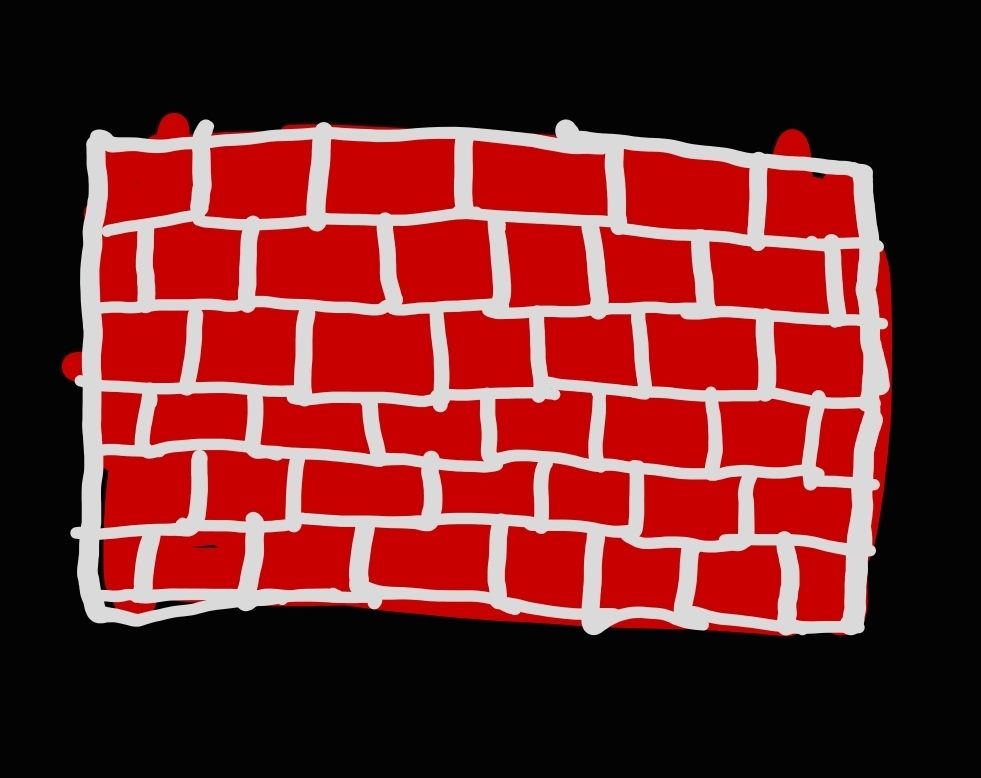
You generally start pushing it forward.
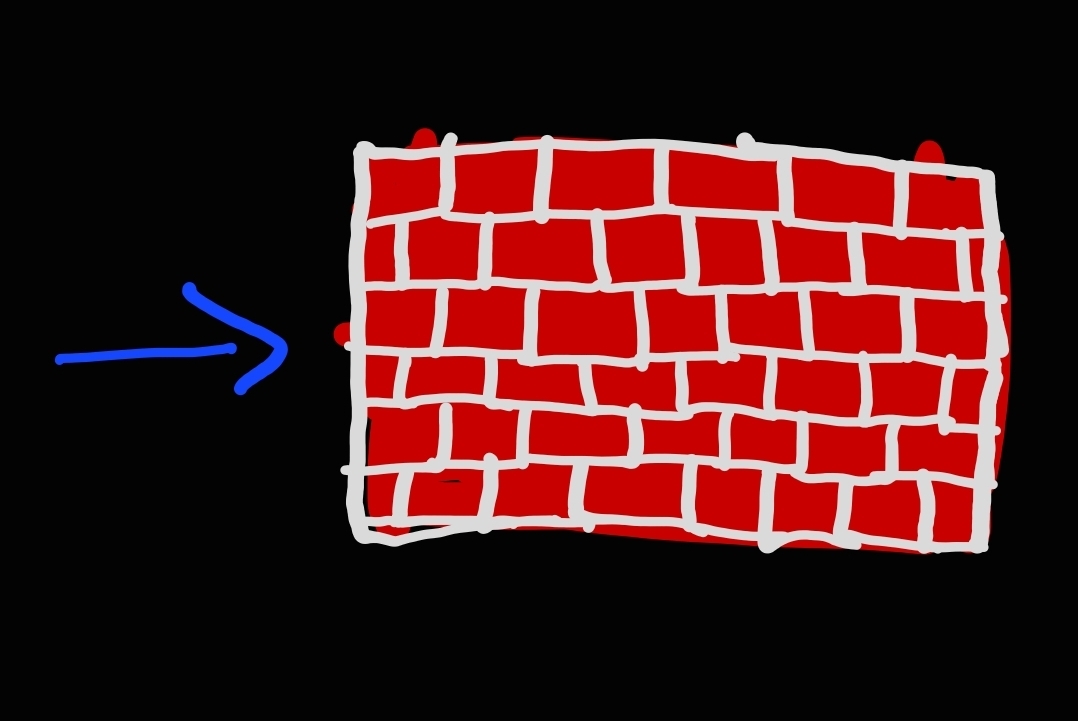
Congrats, the block is now moving.
Let's look at another example.
If there's a book just sitting on a table, do you expect the book to suddenly start moving without anyone touching it? No. It will remain where it is.
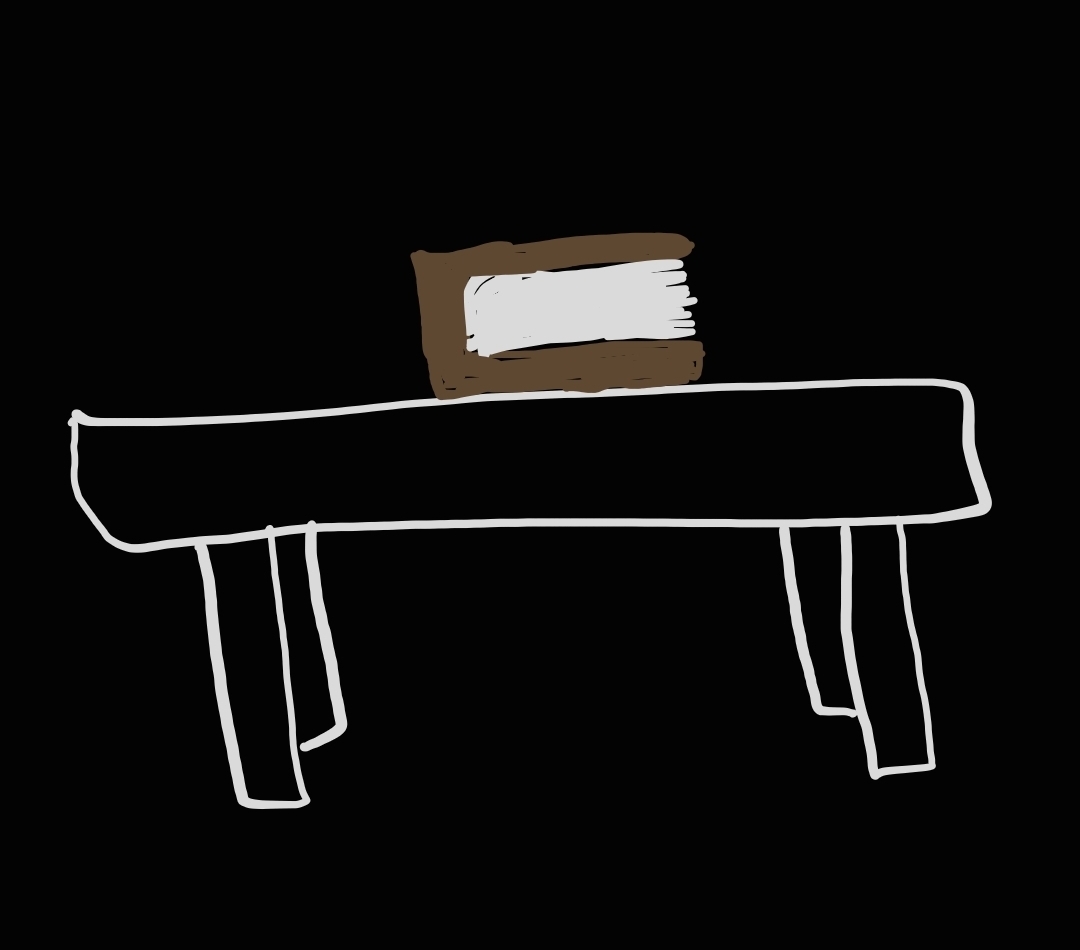
Does this mean the book has no forces acting on it - because it's not moving? No.
Let's ask some questions:
- Does the book have weight? Yes. Then the book has a downward force pulling it down towards the table. This is known as the weight force.
- However, if the book only had a downward force acting on it, that means it will be moving downward. What is preventing the block from going downward? It's the table. The table's surface must be applying some upward force on the book that cancels the book's weight force. This force is called the normal force.
Let's go through another example.
Imagine you and your friend are standing on some ice. Your friend gives you a strong push, making you slide away on the ice. If you have ever been on ice, you know that you would continue sliding for quite some time even after your friend has stopped pushing you.
These examples will help you imagine Newton's first lawNewton's first lawAn object at rest will remain at rest, and an object in uniform motion will remain in motion, unless acted upon by a net external force..
Let's go through it one by one.
- an object at rest will remain at rest — Think of the book or the block I just mentioned. They were not moving when you found them, and they were never going to move on their own.
- and an object in uniform motion will remain in motion — Think of the example where your friend pushed you on ice and you continued moving even after he stopped pushing you. After the initial push, there are actually no forces that are pushing you forward or slowing you down (assuming there is no friction on ice, because friction is a force that slows things down). Hence, even though an object may currently have no forces currently acting on it that cause it to move, 1) it may still be moving and 2) it will continue to move at a uniform pace.
- unless acted upon by a net external force — In the example of the brick block, when did it start moving? When you applied a force on it by pushing it. Does this mean that anything that has forces acting on it must be moving? No. Look at the example of the book. Was it moving? No. Did we prove that it has forces acting on it? Yes. But these forces were cancelling each other! This is why the law states a "net external force." It requires that your forces shouldn't cancel each other completely.
How do we relate an object's movement to the force acting on it? Using Newton's second law.
$$F_{total} = ma$$- $F_{total}$ is the total force acting on the object.
- $m$ is the massMassIt is the amount of matter in an object. The mass of an object remains the same regardless of gravity. Keep in mind: mass is not a force!of the object. (mass is related to weightWeightThe force exerted by the mass of the object because of gravity. This gives you the very-important weight force formula Weight = mass × gravity.)
- $a$ is the acceleration of the object.
Important note: If you have forces acting in both of your axes, then you will have to use $F_{total} = ma$ for each axis separately. Never combine forces from two different axes into your equation. Here is a practice problem with this concept included, but I recommend reading until you reach it.
Before we practice using Newton's second law, we need to know what a Free Body Diagram (FBD) is, because we will use it a lot, and I always recommend using one before solving such questions.
Let's go back to the picture we had of our heavy brick block being pushed.
It will be tedious to draw such diagrams every time we want to look at the forces acting on an object. Because of this, we will utilize what is known as the center of massCenter Of MassIn simple terms, it is an imaginary point that represents the entire object. In a more formal definition: It is the point from which all the mass of the object is equally distributed. If you balance the object on a pin that's going through its center of mass, it will perfectly balance. Forces that go through the center of mass will cause the entire object to move. Forces that don't go through the center of mass will cause the object to rotate..
Forces that go through the center of mass will cause the entire object to move. Forces that don't go through the center of mass will cause the object to rotate.
Hence these 2 diagrams are equal
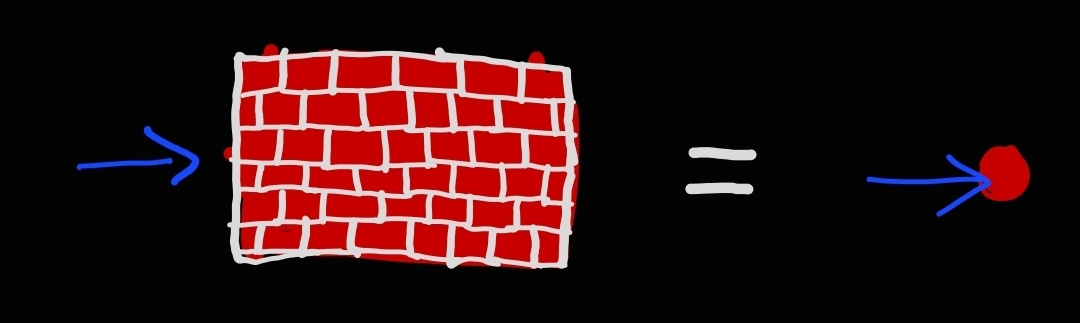
When you are using the center of mass to draw your diagram, this is called a Free Body Diagram. Another thing you need in your Free Body Diagram is a frame of reference. You have to decide which direction is positive and which direction is negative. Perhaps this isn't very useful in our simple example, but it will be crucial when things get complicated.
Lastly, try to follow some approximate proportions for your force arrows. If you know Force 2 is twice as big as Force 1, then the arrow for Force 2 should be approximately twice as big as the arrow for Force 1.
For now, I choose to make going rightward as positive.
Note: Free body diagrams only show the forces acting on the object. If the object is performing some force, that WILL NOT be shown in the free body diagram of the object.
Now, let's use $F_{total} = ma$ for the following questions.
Question 1: Assume that the mass of the block is $10 kg$ and it has an acceleration of $3.5 m/s²$. How much force are you exerting on the block? (I'm referring to the brick block I drew above. You can use the FBD above.) ▼
We have:
$a = 3.5 m/s²$
$m = 10 kg$
We need: $F_{total}$. Which is also our force, since we only have 1 force in this problem.
We can use the formula $F_{total} = ma$
$F = (10)(3.5) = 35 N$. Don't forget your units.
Question 2: You are pushing a $25kg$ block on a horizontal surface with friction, causing it to accelerate $2 m/s²$. The force of friction on the block is $21 N$. How much force are you exerting on the block? ▼
First let's draw a diagram of the block and then we will add forces to it.
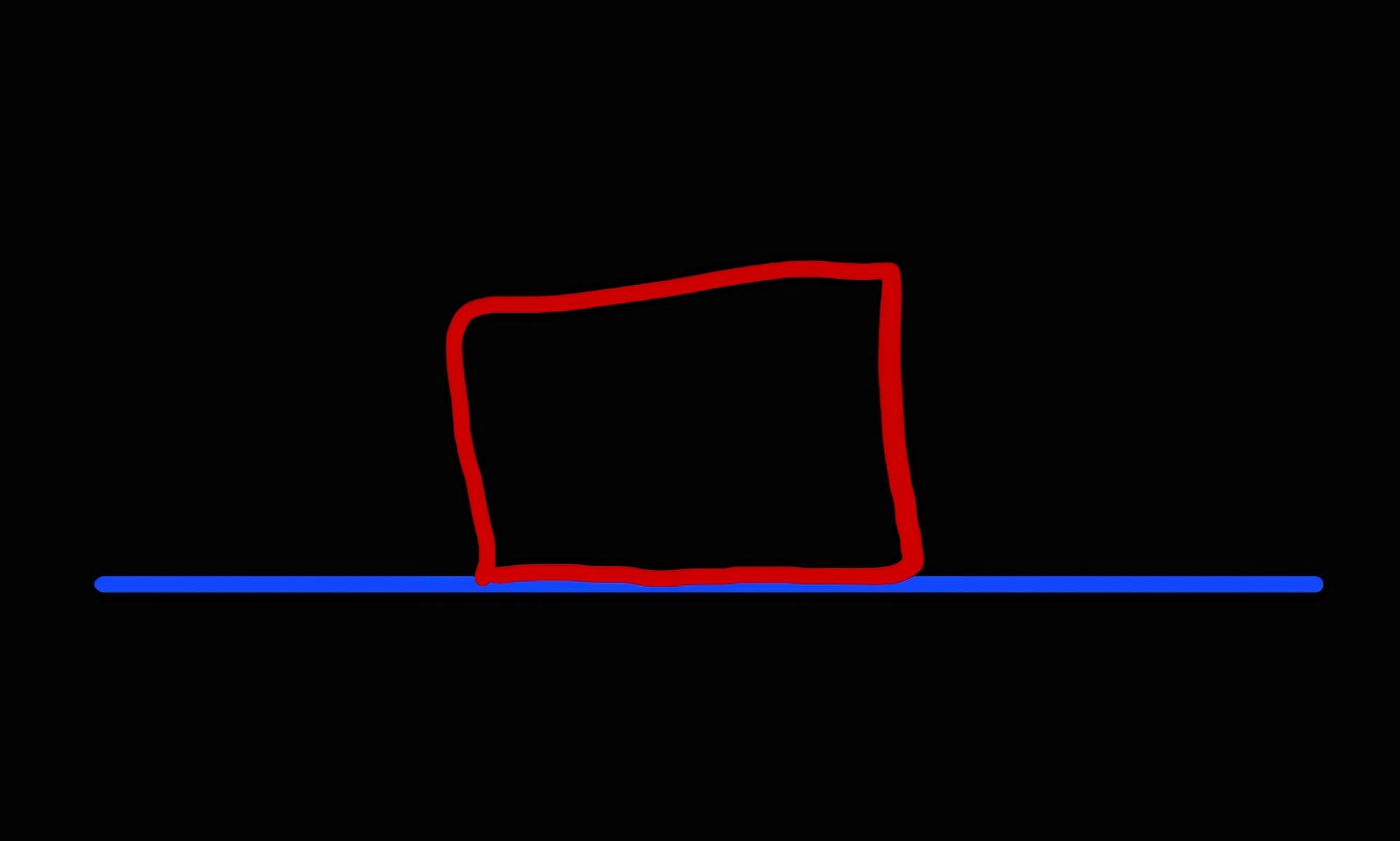
What are the forces relevant to us (there are other forces that you don't need to solve this problem, such as the weight force)? Well, it will be the forces causing the block to accelerate (or move). These forces are:
- Your pushing force (I will give it the notation $F_p$)
- The frictional force (I will give it the notation $F_{fr}$)
Let's say that you are pulling the block to the right. In which way will the frictional force act?
This is a rule: Friction will act parallel to the surface and opposite to the direction of motion.
If the block is moving to the right, then friction must be acting towards the left. Notice that when deciding the direction of the frictional force, I only care about the direction the object is moving (or "wants" to move).
Now, here's our complete free body diagram and regular diagram (The thing on the right is our coordinate reference axis. I made up positive and right positive.)
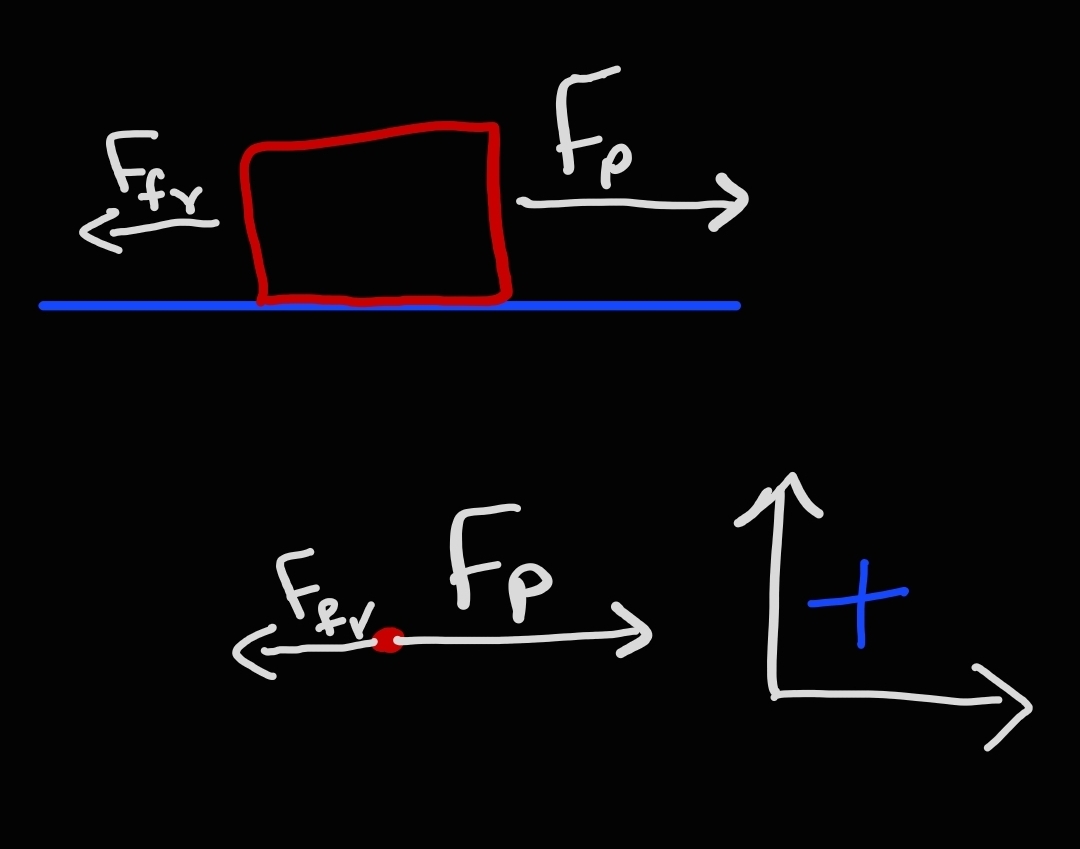
Finally, we are ready to start solving.
We know:
$a = 2 m/s²$
$m = 25 kg$
$F_{fr} = 21 N$
We need to find: $F_p$
We have the equation $F_{total} = ma$
We know $ma$. Remember, to use this equation, we must add the forces. Using the coordinate system I gave above, I made your pushing force positive and the frictional force negative.
So $F_{total} = F_p - F_{fr}$
Our equation becomes $F_p - F_{fr} = ma$
Let's separate $F_p$
$F_p = ma + F_{fr}$
Let's plug in the numbers.
$F_p = (25)(2) + 21 = 50 + 21 = 71 N$
Types of forces
Here are the most forces you will see.
- Applied force (F) - For example, a pull or push. Typically something given to you in the question or something you will figure out using Newton's laws.
- Tension force (T) - This is when you have a string/rope pulling on the object. Forces are transmitted completely through ropes/strings, and the force is the same on both ends of the string.
For example, if you attach a rope around an object and you start pulling the start with $30N$, the tension force on the object will be $30N$. Nothing is lost. - Weight force (W) - Formula: $\text{Weight} = \text{mass} \cdot \text{gravity}$ or more commonly known as $W = mg$
Note, this force will always point completely downwards, no matter what. - Normal force (Fn) - This is the force preventing your object from falling through the floor. You will see this force A LOT. It is typically equal to your downward forces that are trying to push your object down through the floor.
Important note: The normal force will ALWAYS be perpendicular to the surface the object is on. For example, look at these pictures:
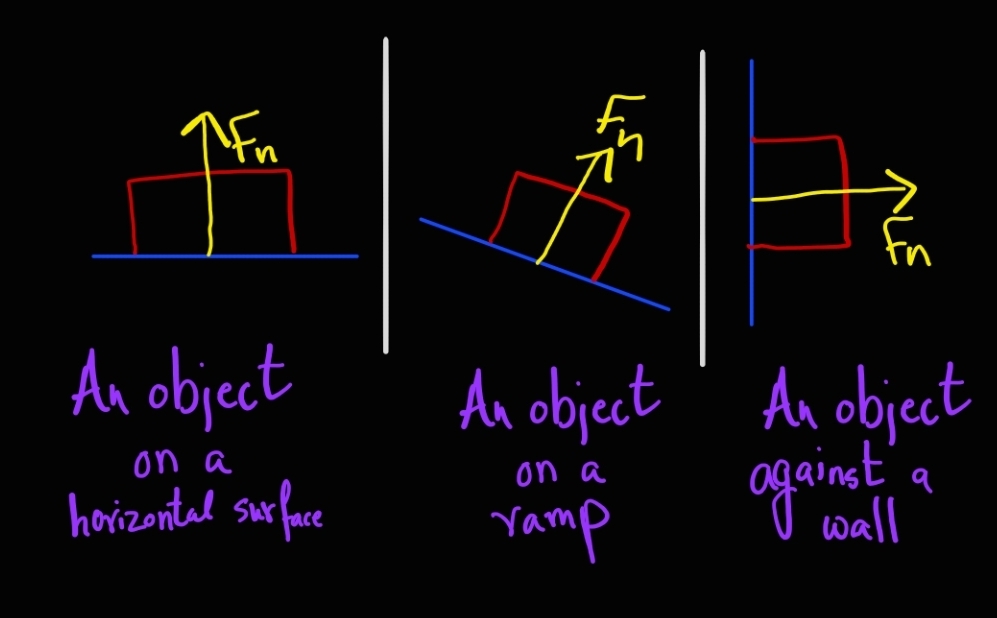 As you can see, the normal force (yellow) is not always perfectly vertical, but it is always perpendicular to the surface. Another thing to note, generally, it will be pointing away from the surface (it won't be sucking the object inwards)
 - Frictional force (Ffr) - Formula for the frictional force $= \mu \cdot F_n$. Let's explain what it means:
$\mu$ is known as the coefficient of friction. The greater the value of $\mu$, the greater the force of friction.
$F_n$ is the normal force. The greater the normal force, the greater the force of friction. This makes sense because $F_n$ is related to how hard the object is pushing down against the surface. If you are trying to move an object but someone is pushing it down into the ground very hard, this will intuitively cause more friction between the surface and the object by increasing $F_n$, since $F_n$ is the surface preventing the object from breaking through the floor.
Friction opposes motion. If the object is going to the left, the frictional force would go to the right. If the object is going to the right, the frictional force would go to the left. Another important thing to consider is that it will always be going parallel to (or going along) the surface. For example, look at the below image:
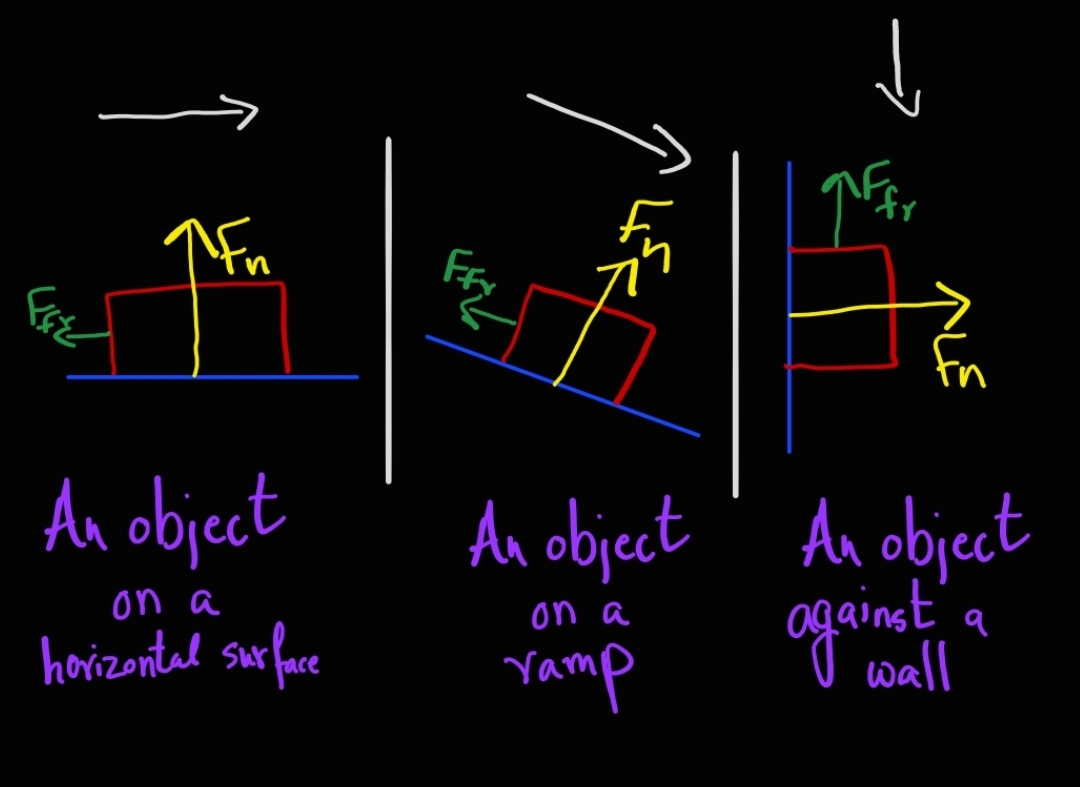
The white arrow indicates the general direction the object is going. The green arrow indicates the frictional force. Notice that the frictional force is always opposite to the direction the object wants to move and it is always parallel to the surface.
Another thing to consider about friction: there are 2 types of frictional forces:- Static friction: This type of friction is present when the object is not currently moving. For example, imagine you have a very heavy desk in front of you on some frictional surface (a heavy desk = a big $F_n$ and hence a big frictional force in general). To just get it to start moving you have to apply a huge forward force. Why? Why can't you apply a very small force? Because of static friction. Static friction can "absorb" your forward force until a certain extent. To help clarify this, let's use some numbers:
- What if you applied a force of $50 N$ (or any force less than $117.6N$)? Static friction will apply a force of $50 N$ but in the opposite direction in order to cancel your forward force and prevent the drawer from moving.
- Kinetic friction: Once your object starts moving, static friction disappears and now you have kinetic friction. The idea of kinetic friction is to slow your object down by opposing its motion. Kinetic friction has the same formula as static friction, but it usually has a lower frictional coefficient (which means less friction. This is why it's easier to push things that are already moving as opposed to stationary objects). Kinetic friction will continue acting on the moving object until it stops moving.
Scenario: You have a wooden $40kg$ drawer that you are trying to move. It is on a frictional surface, and the coefficient of static friction is 0.3. What is the minimum forward force you must apply to the drawer to get it to start moving?
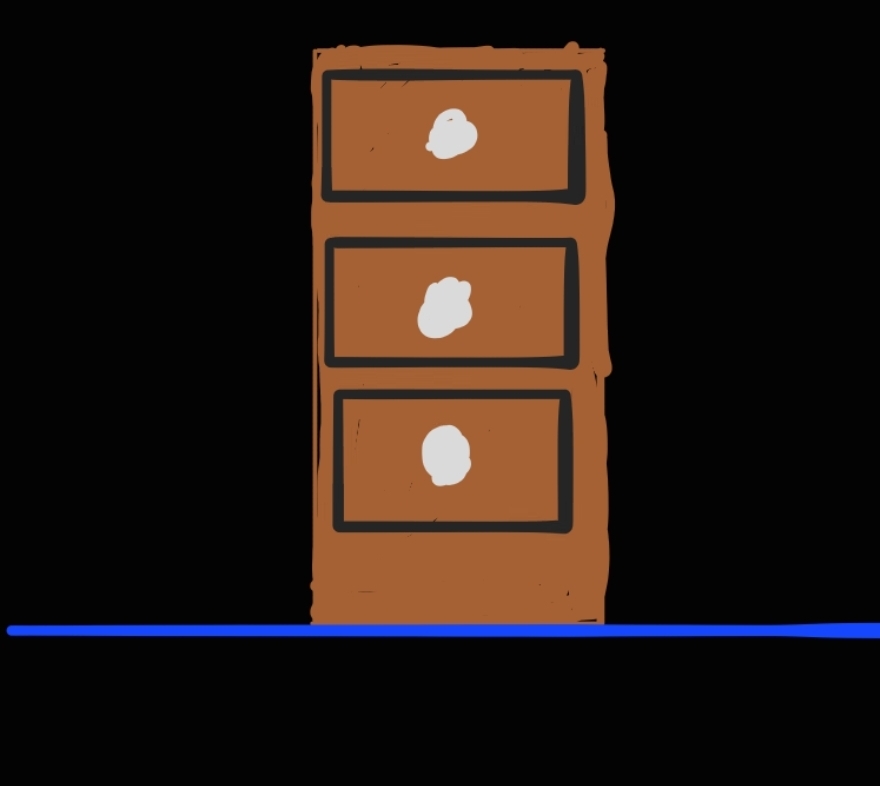 ▼
▼
First, let's see what's the maximum force that static friction can "absorb." We know that the formula for friction is $F_{fr} = \mu \cdot F_n$.
Well, we have the coefficient from the question, but what's $F_n$?
To find $F_n$, we will start by drawing a free body diagram and then use Newton's second law.
Before we start, I'll let up be positive and down be negative.
We know that the drawer has mass (which is equal to $40kg$), so it must have a weight force. $\text{Weight} = \text{mass} \cdot \text{gravity} = 40 \cdot 9.8 = 392 N$ (an important note: DO NOT make the acceleration of gravity negative when you are finding your numbers, as that will likely result in you double-counting your negative sign. The free body diagram will tell you what should be negative and what should be positive based on the direction of the arrow and your pre-decided reference. Generally, when drawing the free body diagram, I never saw a negative number on the diagram, instead, the arrows told me whether my number is negative or positive)
Moreover, we know that this will point perfectly downwards.
Now, what is preventing the drawer from breaking the floor? The normal force. We are ready to draw our free body diagram (generally, your free body diagram should include all the forces acting on the object, which in this case includes the frictional force and your pushing force. I'm not adding those forces right now just for simplicity. In future examples, I will add all acting forces):
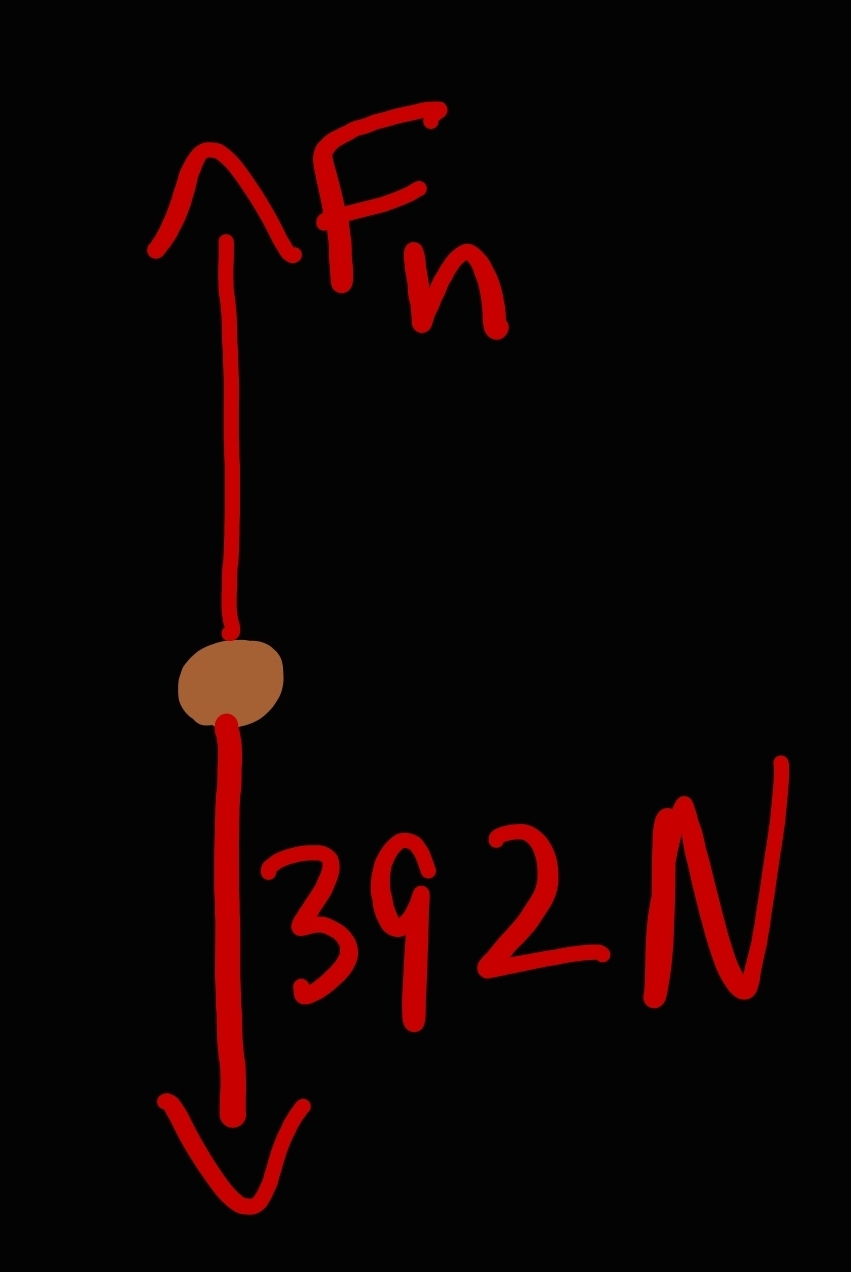
Let's now make our $F_{total} = ma$ equation. We know that the drawer is not moving, which means acceleration is $0$ (hence the entire right hand side is $0$). So we have
$F_{total} = 0$
$0 = F_n - 392$
Solve for $F_n$.
$F_n = 392 N$.
We are now ready to find our maximum static friction force. Let's plug our values in the formula
$F_{fr} = \mu \cdot F_n = 0.3 \cdot 392 = 117.6 N$
What does this mean? This means that you must apply a forward force greater than $117.6 N$ for your drawer to just start moving.
Question: You begin pulling a $10kg$ block (which was originally at rest) via a string across a horizontal surface with friction for $10$ seconds with a non-uniform speed. The static frictional coefficient is $0.1$, the kinetic frictional coefficient is $0.05$, and your pulling force is equal to $11 N$. After those $10$ seconds, you let go of the block and let it slide on its own until it comes to a complete stop. How far does the block travel after letting it go?
▼
Before we begin solving, we must understand the problem:
It seems like there are 2 sections to this problem
- The first section is when we are pulling the block.
- The question said "non-uniform speed", which means there is some kind of acceleration as we are pulling it.
- This acceleration lasted for $10$ seconds.
- The block was originally at rest, which means it had an initial velocity of $0$.
- Our pulling force is equal to $11 N$.
- The static and kinetic coefficients are given in the question
- The second section is when we stopped pulling the block
- We let it slide until it comes to a stop
- This means we have a new acceleration than the one calculated in section 1, since your force is now removed.
- If the block comes to a stop, then it means it has a final velocity of 0.
- We want to know how far it travels.
It's always good to ask yourself "How can I reach my answer? What do I have?" The question seems to be asking about the block's displacement after you leave it $x$. Using a free body diagram and force analysis, we can figure out the acceleration of the block after you leave it via $F_{total} = ma$. From section 1, we can find the block's velocity at the moment we left it, and from the question, we know that the final velocity of the block will be 0 because it says "comes to a stop". Hence, here is our checklist:
$x =$ goal
$v_i =$ velocity of the block once we leave it
$a =$ acceleration from section 2
$v_f = 0 m/s$ (it comes to a stop)
Via this set up, we know we can apply kinematics and Newton's second law to solve the problem. I'm doing this set up to show you that the first step in solving a question is to lay out what you need, what you have, what you can do with what you have until you reach your goal. It is meaningless to just show you random calculations that suddenly allow you to reach the answer.
Now, let's begin by finding $v_i$, the velocity of the block once we leave it. Hopefully you see that you can make another set of kinematics to get this.
$v_i =$ goal. Velocity of the block once we leave it.
$t = 10$ seconds. time we were pulling the block
$a =$ acceleration from section 1.
$v_0 = 0 m/s$ (the question says the block was originally at rest). I had to give this velocity a different symbol to differentiate it from other velocities.
We have everything we need except the acceleration from section 1. Let's find it. The only formula right now that can relate the forces acting on the block, the mass of the block, and the acceleration of the block is $F_{total} = ma$. So let's use it by drawing a free body diagram.
I will let the upward and rightward directions be positive.
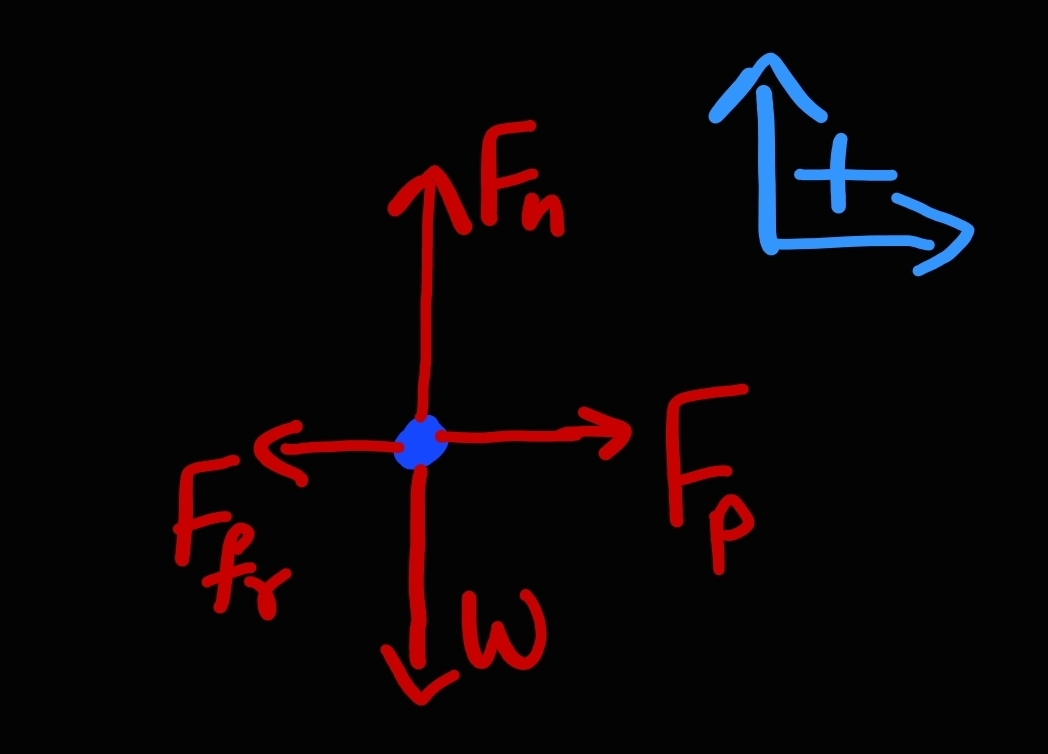
I hope you were capable of figuring out that there are a total of 4 forces acting on the object. They are:
- Weight force (because it has mass)
- Normal force (to prevent it from going through the floor)
- Pulling force $F_p$. You can give it any symbol you want, it doesn't really matter. Anyways, it's your pulling force of $11 N$.
- Frictional force, since the block is on some frictional surface.
Notice how we have forces acting in both the x-axis and the y-axis. We must use $F_{total} = ma$ separately for each axis.
Let's start with the y-axis.
$F_y = ma$
From the question, did it tell you that there was any movement vertically? Nope. We know that the block is simply sliding on a horizontal surface, which means there is no vertical movement. Hence the upward and downward forces must cancel each other.
$F_y = 0$
We only have 2 forces in the y-axis.
$F_y = 0 = F_n - W$
$F_n = W$
Let's find $W$ to find $F_n$. $W$ is the weight force, and we know $W = mg$. So $W = 10 \cdot 9.8 = 98 N$. Hence, $F_n = 98 N$.
We are done with the y-axis. Let's move to the x-axis. From the question, we know there will be some acceleration in the x-axis (question said: "non-uniform speed.") Hence, our equation is
$F_x = ma$
We only have 2 forces in the x-axis, the frictional force and the pulling force.
$F_x = F_p - F_{fr} = ma$
Remember: $F_{fr} = \mu \cdot F_n$
We have $F_n$. But which coefficient of friction should we use? The question is talking about a moving block, so we will use the kinetic coefficient.
So $F_{fr} = 0.05 \cdot 98 = 4.9 N$
We have enough information to find acceleration.
$11 - 4.9 = (10)a$
$6.1 = 10a$
$\frac{6.1}{10} = a = 0.61 m/s²$.
We are finally ready to find the velocity of the block once we let it go. Let me remind you of our kinematics set up for this section.
$v_i =$ goal. Velocity of the block once we leave it. Technically, this is $v_f$ for this section.
$t = 10$ seconds. time we were pulling the block
$a = 0.61 m/s²$ acceleration from section 1.
$v_0 = 0 m/s$ (the question says the block was originally at rest). I had to give this velocity a different symbol to differentiate it from other velocities.
We can use this kinematics equation:
$v_i = v_0 + at$ (I changed the symbols for the velocities to fit this problem)
$v_i = 0 + (0.61)(10) = 6.1 m/s$
We are done with the first section!!
Let's move on to the second and final section. Again, here is the set of kinematics we need to complete:
$x =$ goal
$v_i = 6.1 m/s$ velocity of the block once we leave it
$a =$ acceleration from section 2
$v_f = 0 m/s$ (it comes to a stop)
All we need is the acceleration of the block once we stop pulling it.
Let's see our new free body diagram but without our pulling force.
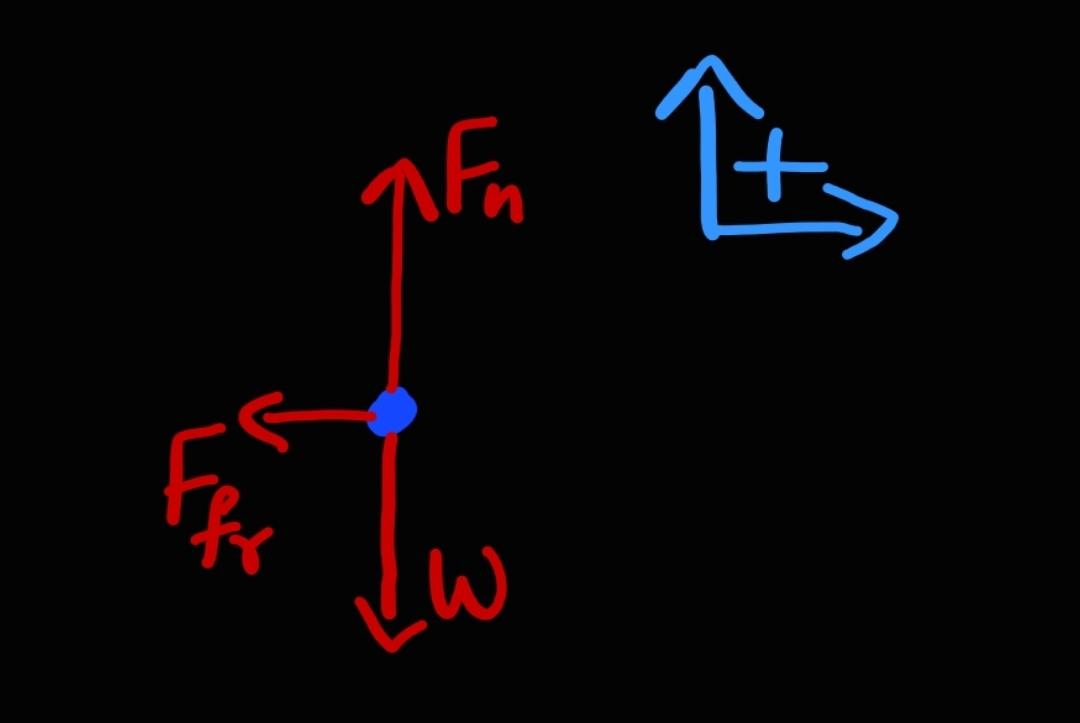
Nothing changes in our y-axis, so we don't have to repeat its calculation. Let's recalculate the acceleration in the x-axis.
$F_x = ma$
$F_x = -F_{fr} = ma$
The frictional force is also the same, because the coefficient and the normal force are the same. So we have
$-F_{fr} = ma$
$-4.9 = 10a$
$\frac{-4.9}{10} = a = -0.49 m/s²$
We are ready to solve this question. Here is our set up:
$x =$ goal
$v_i = 6.1 m/s$
$a = -0.49 m/s²$
$v_f = 0 m/s$
We can use this kinematics equation: $v_f^2 = v_i^2 + 2ax$
Let's separate $x$
$v_f^2 - v_i^2 = 2ax$
$\frac{v_f^2 - v_i^2}{2a} = x$
Now, input the values.
$$\frac{(0^2) - (6.1^2)}{2 \cdot (-0.49)} = 38 \text{ m}$$We finally reached our answer.
Newton's third law
Newton's third lawNewton's third lawEvery action (force) in nature there is an equal and opposite reaction. If object A exerts a force on object B, object B also exerts an equal and opposite force on object A. introduces a new type of force called the "reaction force"
For example, let's suppose we have 2 boxes on top of each other on the floor.
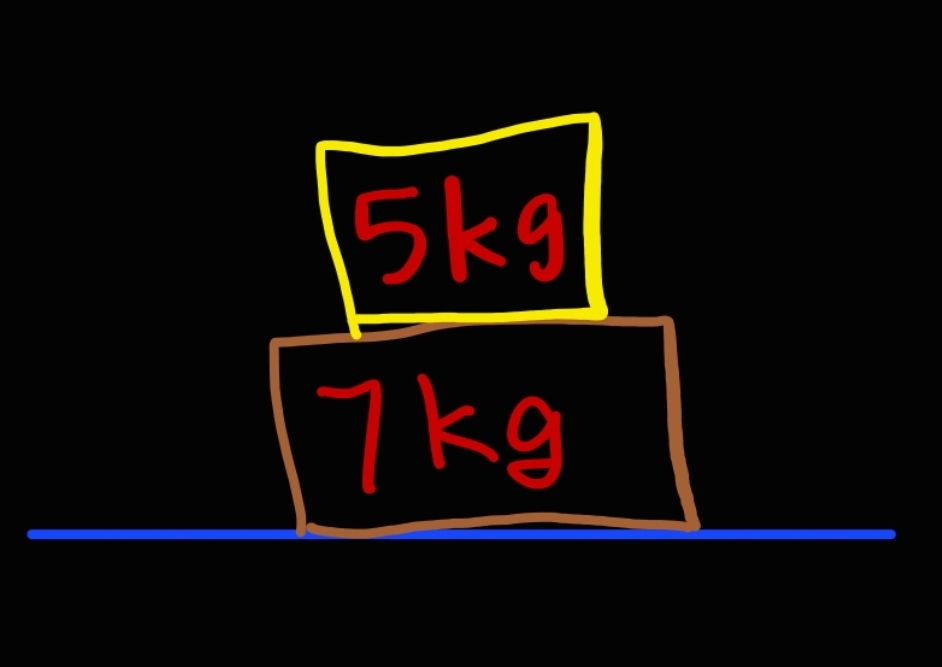
The 2 objects in contact are the brown box and the yellow box.
Let's do a free body diagram for each.
- It's best to start from top to bottom. So let's start with the yellow block. What forces are acting on it?
- Well, its mass is $5kg$, so it will definitely have a weight force going downward.
- According to Newton's third law, since the yellow box is pushing down on the brown box, then the brown box must be applying an equal upward force on the yellow box.
- Finally none of the boxes are moving, so we know that acceleration is 0 and $F_{total}=ma=0$
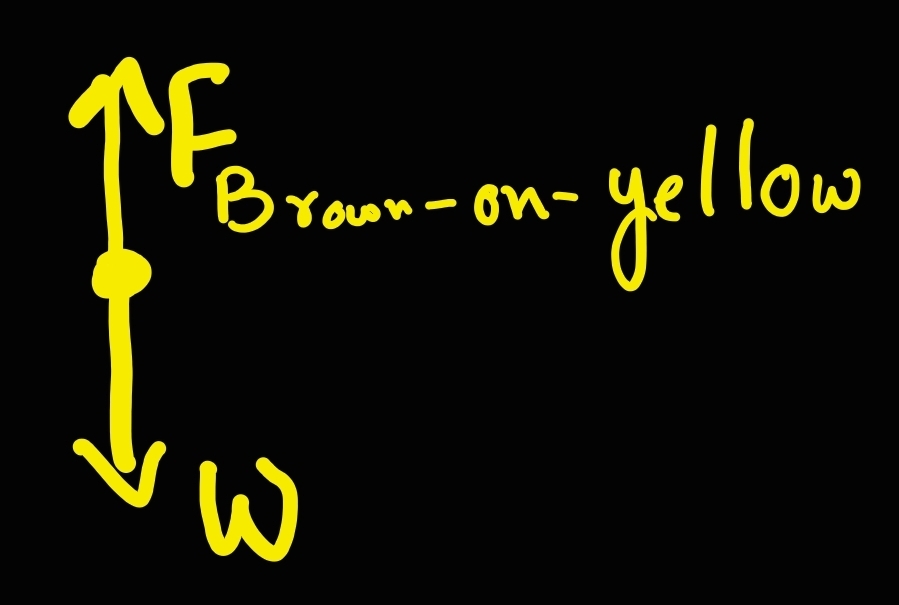
We know that the yellow box is not moving, which means $F_{total}=ma=0$
We only have 2 forces on the yellow, giving us this formula
$F_{total}=ma=0$
$W_{yellow}-F_{brown\ on\ yellow}=0$
$W_{yellow}=F_{brown\ on\ yellow}$
Use the weight force formula. $W_{yellow}=mg=5 \cdot 9.8=49N$
So $F_{brown\ on\ yellow}=49N$. - Let's now do the free body diagram for the brown box. The forces are:
- The weight force
- The reaction force from the yellow box ($F_{yellow\ on\ brown}$). Newton's third law says that this force is equal in strength and opposite in direction to $F_{brown\ on\ yellow}$. Hence, you will have $49 N$ going downwards.
- $F_n$ from the floor to prevent the boxes from breaking through.
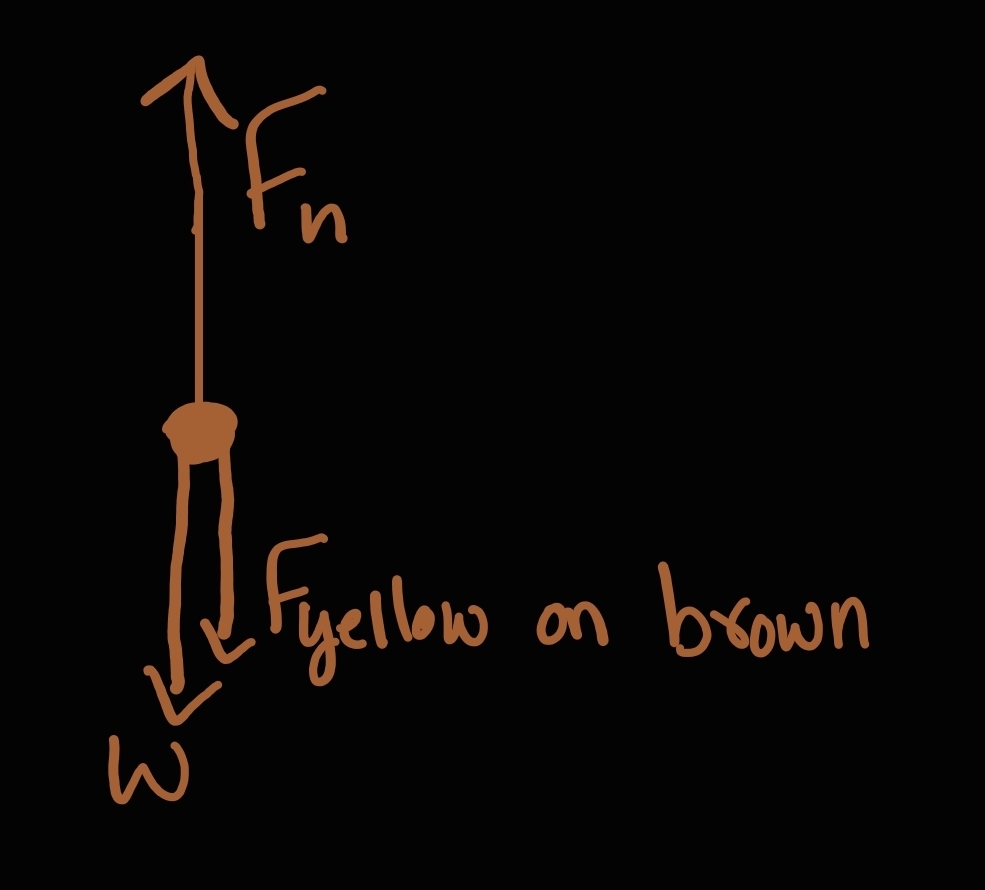
Note: every force shown is still completely acting in the vertical y-axis.
Let's now make our $F_{total}=ma=0$ (remember, up is positive)
$F_n-W_{brown}-F_{yellow\ on\ brown}=0$
$F_n=W_{brown}+F_{yellow\ on\ brown}$
We already know $F_{yellow\ on\ brown}=49 N$ (The minus sign was already included when I made the direction of the arrow go downwards instead of upwards. Be careful to not double count your minus signs)
Weight of the brown box: $W_{brown}=mg=7 \cdot 9.8=68.6N$
Input values in formula:
$F_n=68.6+49=117.6 N$
We finally drew the free body diagrams for each box!
Note: A common issue is that students try to apply this law to basically everything they see when drawing free body diagrams. Just some things to keep in mind: Surfaces, springs, and strings would not give you a reaction force, even if they are touching your object. Surfaces give you the normal force, springs give you the spring force, and strings give you the tension force.
Diagonal Forces and Vectors
All of the forces we dealt with so far were either perfectly horizontal or vertical. What if we have forces that are somewhere in between?
The primary way to overcome this issue is to break down your force into components that fit your axes.
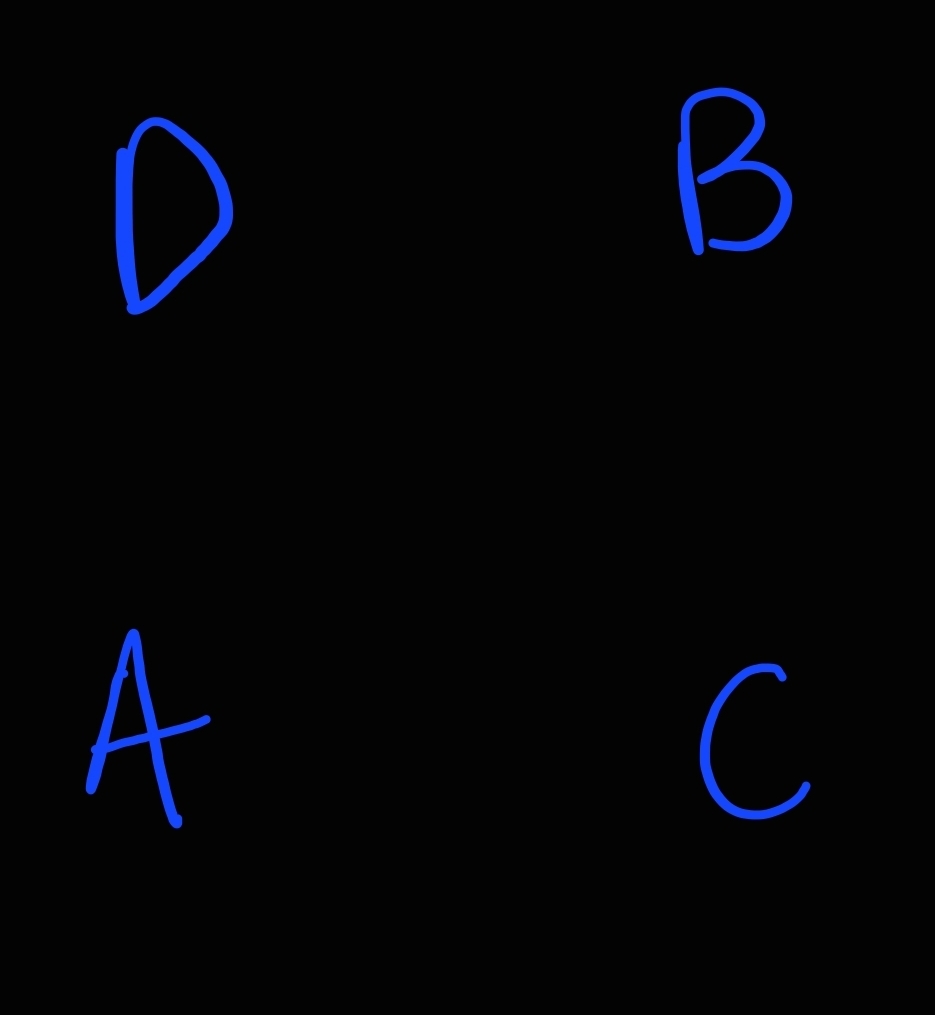
Imagine you want to go from point A to point B. How can you do it? Well, this is the primary, shortest path:
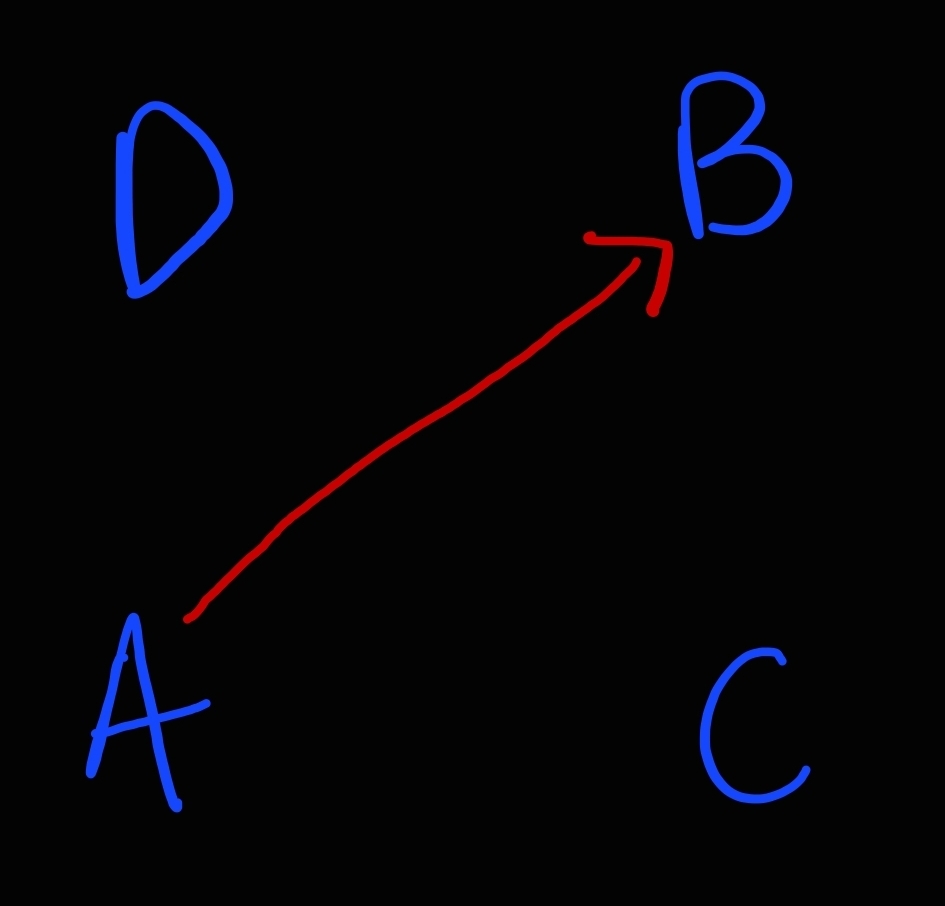
But, is it the only path? Nope. You have 2 other, equivalent pathways you can take:
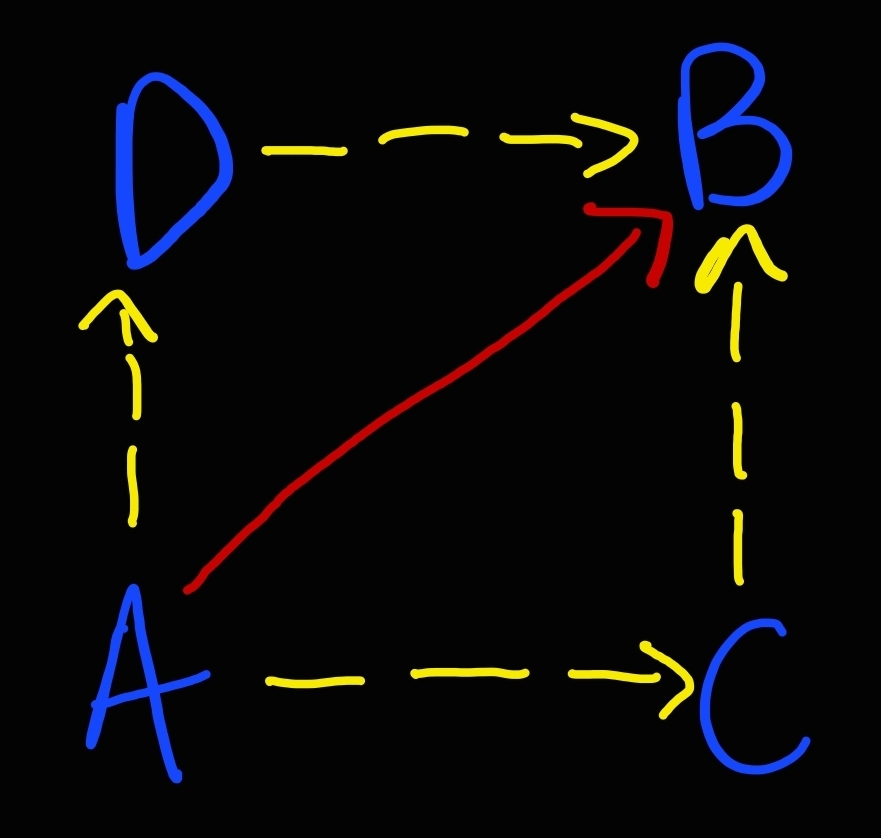
You can either go from AC and then CB or from AD and then DB.
Regardless of which one you pick, do you notice that the yellow lines form a right-triangle with the red line (a right-triangle is a triangle with one of its angles being 90 degrees)? Hence, we can treat the red line as the hypotenuse of the triangle, and the yellow lines as the base and height, connected together by some angle.
Hence, we can use the pythagorean theorem to say
$AB^2=AC^2+CB^2$ or $AB^2=AD^2+DB^2$
Moreover, we can use SOH CAH TOA to find whatever we need from the triangle.
The last thing I will talk about is vectors. Simply put, the vector going from AB can be broken down into its x and y components. AC is the x component and CB is the y component. You should briefly know how to add, subtract, multiply, and divide vectors, but since that is not critical to actually solve problems where forces aren't going according to your axes, I will skip it.
Instead, I will do some simple practice to show you what to do when you have forces not going according to your axes.
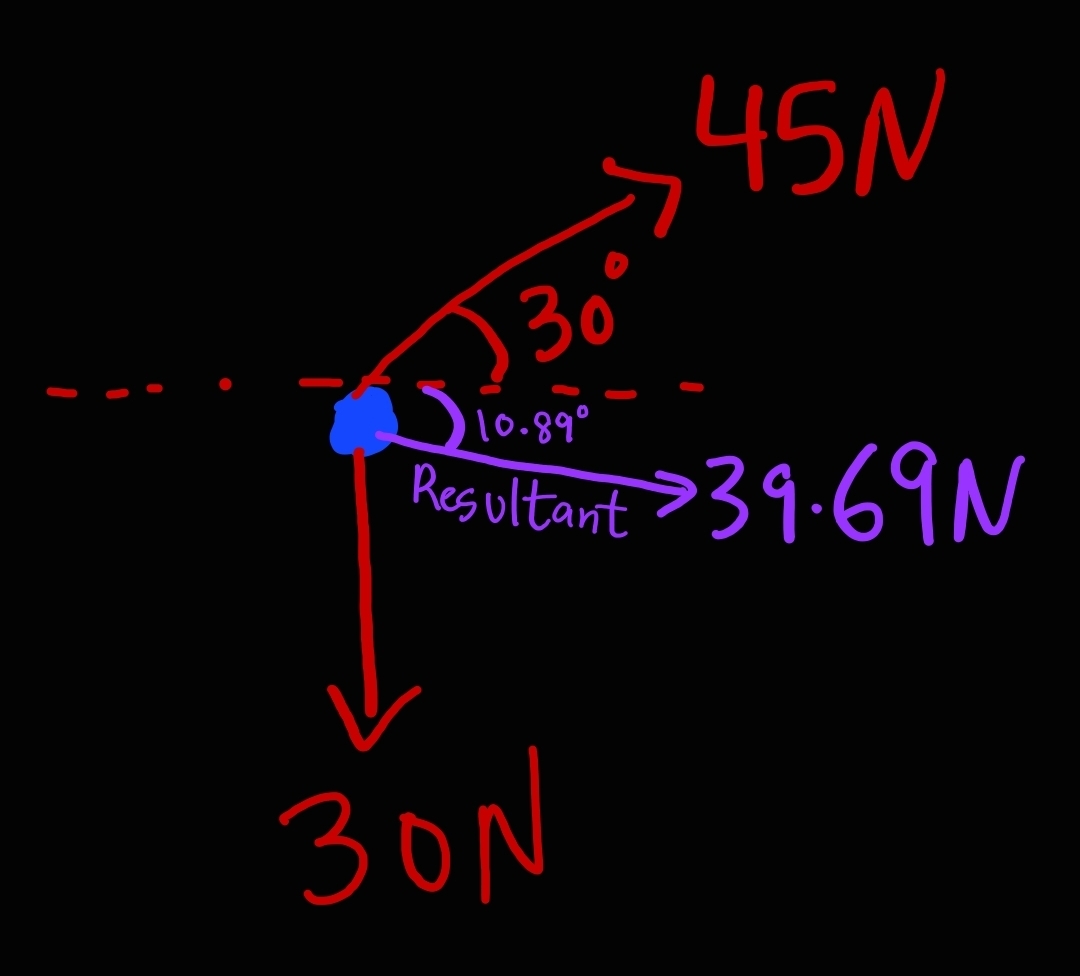
Question: Observe the below free body diagram. Find the magnitude of the resultant (total) force and its direction.
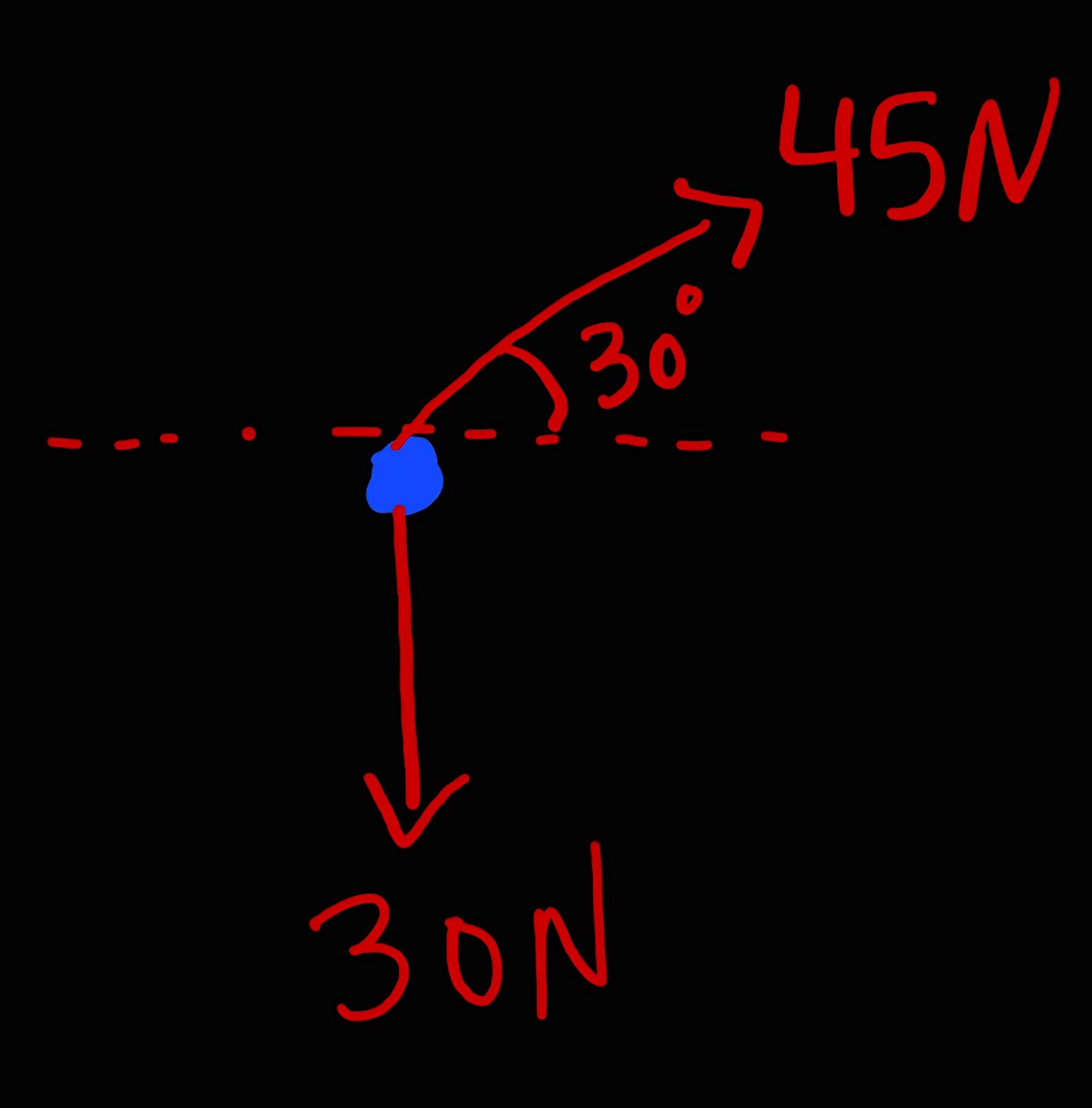 ▼
▼
Let's start by making upward and rightward positive. Since we have a force going at an angle, we need to break it down into its x and y components. Look at the new image:
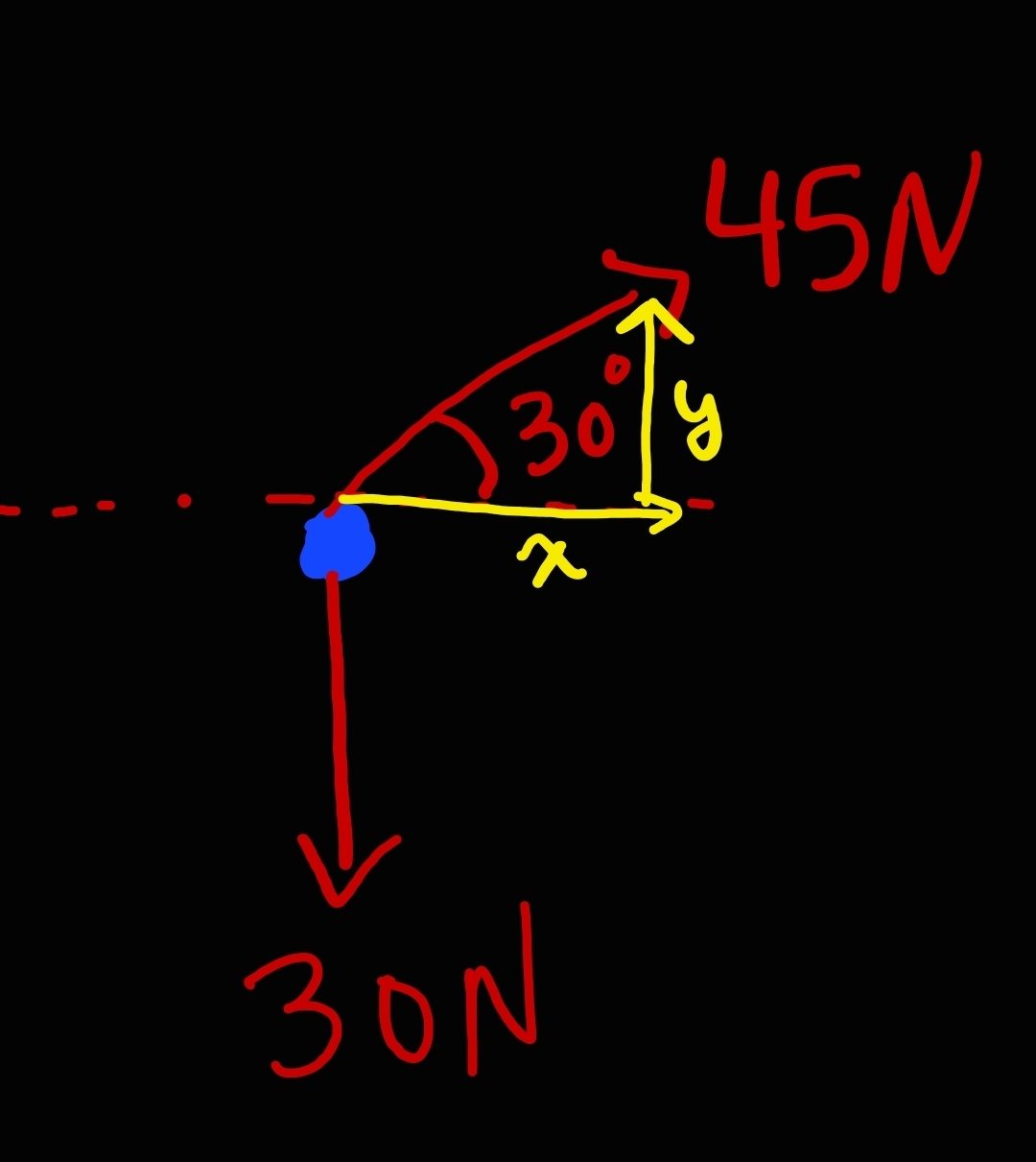
Note: even though the yellow y force is not on the center of mass in the diagram, it is still acting on it. This is because CB and AD are the same. You can also say that the yellow forces I drew are actually imaginary forces that must act on the centre of mass because the real force is acting on the centre of mass.
Now, all our forces fit our axis of vertical and horizontal. But, before we can add forces in the x-axis and the y-axis, we must find what the yellow x and y forces are.
To do this, hopefully you can see that we can use SOH CAH TOA. I won't explain how to use SOH CAH TOA in these notes because that's more related to mathematics. Please ask me for help on the discord server if you don't know how to use it (or maybe by the time you are seeing these notes, I already made some math notes explaining it.)
Moving on, the yellow y force is opposite to our 30 degree angle, so we can use $\sin\theta = \frac{Opposite}{Hypotenuse}$ to get $y=(\sin 30)(45)=22.5 N$.
Moreover, we can notice that our x force is adjacent to our 30 degree angle, so we can use $\cos\theta = \frac{Adjacent}{Hypotenuse}$ to get $x=(\cos 30)(45)=38.97 N$.
So, here is our new free body diagram:
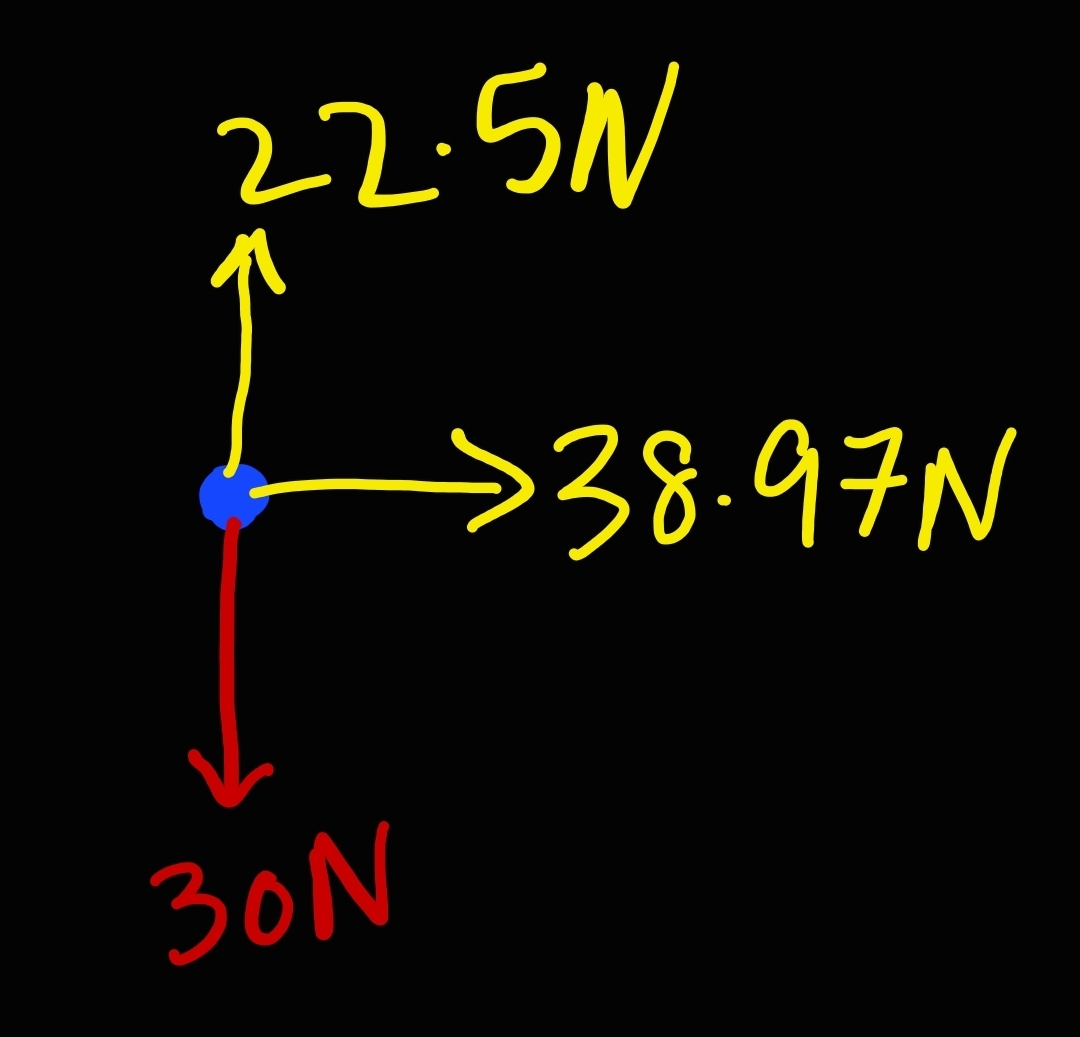
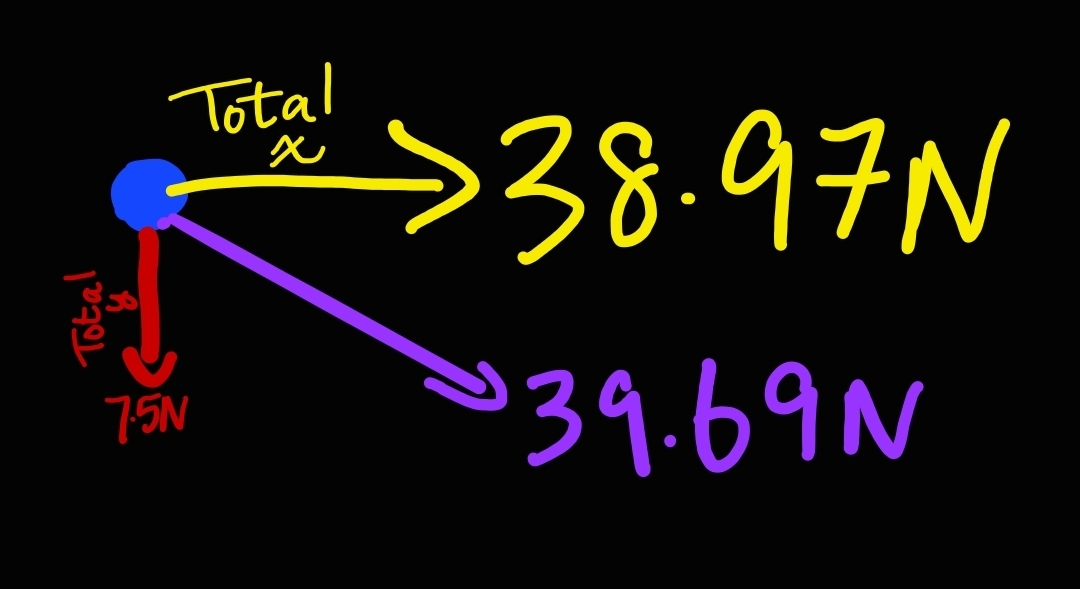
Let's now find the total force in the x and y axes. Hopefully you can see that there is only 1 force in the x-axis, so the total force in the x-axis is $+38.97 N$.
In the y-axis, we have $F_{total-y}= +22.5-30= -7.5 N$
- So, now that we have the components of the total force, we need to use the pythagorean theorem to get the actual total force (or the resultant force/hypotenuse)
So Resultant force $= \sqrt{(38.97)^2+(-7.5)^2}=39.69 N$.
Here is our free body diagram with the arrow of the total x and y forces drawn and their resultant force.
- Let's now find the angle of the resultant force relative to the x axis. To do this, imagine I move the small total y force to form a triangle:
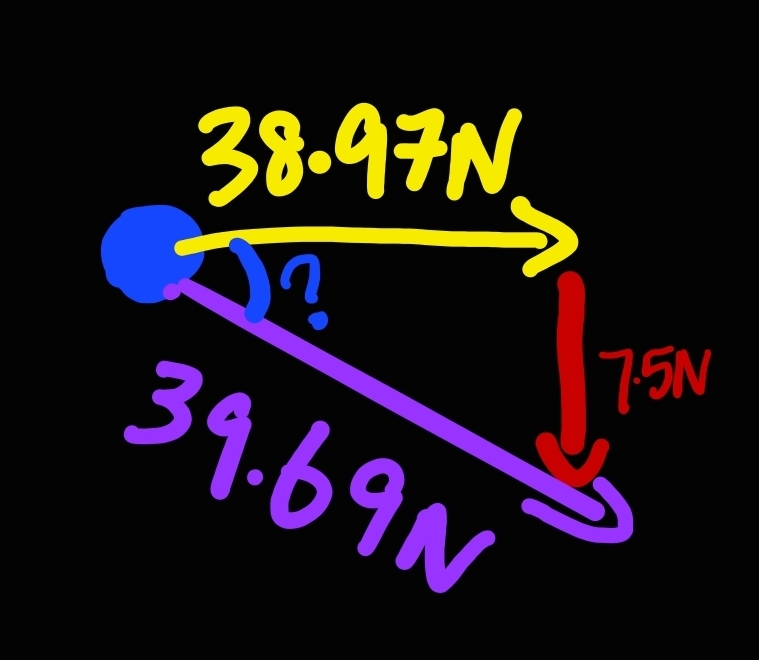
We can use any part from SOH CAH TOA to find the answer, but I typically like using TOA $\tan\theta=\frac{opposite}{adjacent}$.
$\tan\theta=\frac{7.5}{38.97}$ $\theta=\tan^{-1}\left(\frac{7.5}{38.97}\right)=10.89$ degrees.
Hence, if we want to draw our resultant force on our original free body diagram that the question gave us, we get:
Projectile Motion
Remember when we were doing some kinematics about objects in free fall? Most of our objects were simply falling completely vertically. What if the object was also moving forward? How will things change?
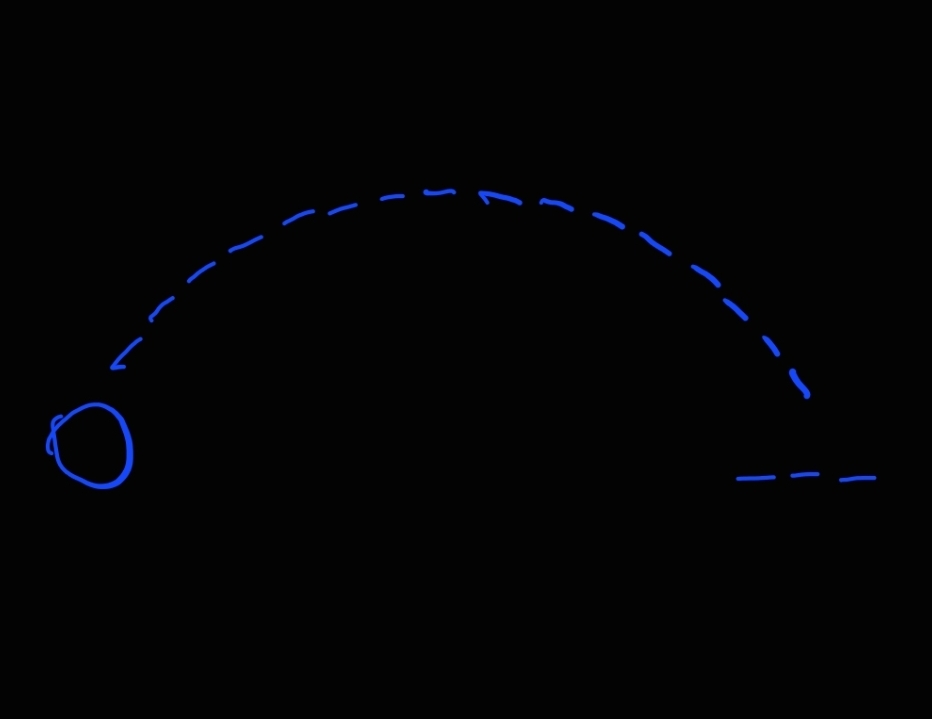
Here are a few things to consider:
- You will have horizontal velocity and vertical velocity
- Your horizontal velocity will never change throughout the journey of your object (it remains a constant value). This means you will have a specific set of kinematic equations for your horizontal dimension.
- Your vertical velocity will decrease due to gravity (remember when we said that an object in free fall will have an acceleration equal to gravity? This also applied here). This means you will have a specific set of kinematic equations for your vertical dimension.
- The only thing connecting your horizontal velocity and vertical velocity is time.
Typically, in these types of problems, you will have to break down your velocity into its horizontal and vertical components.
Let's try a standard question:
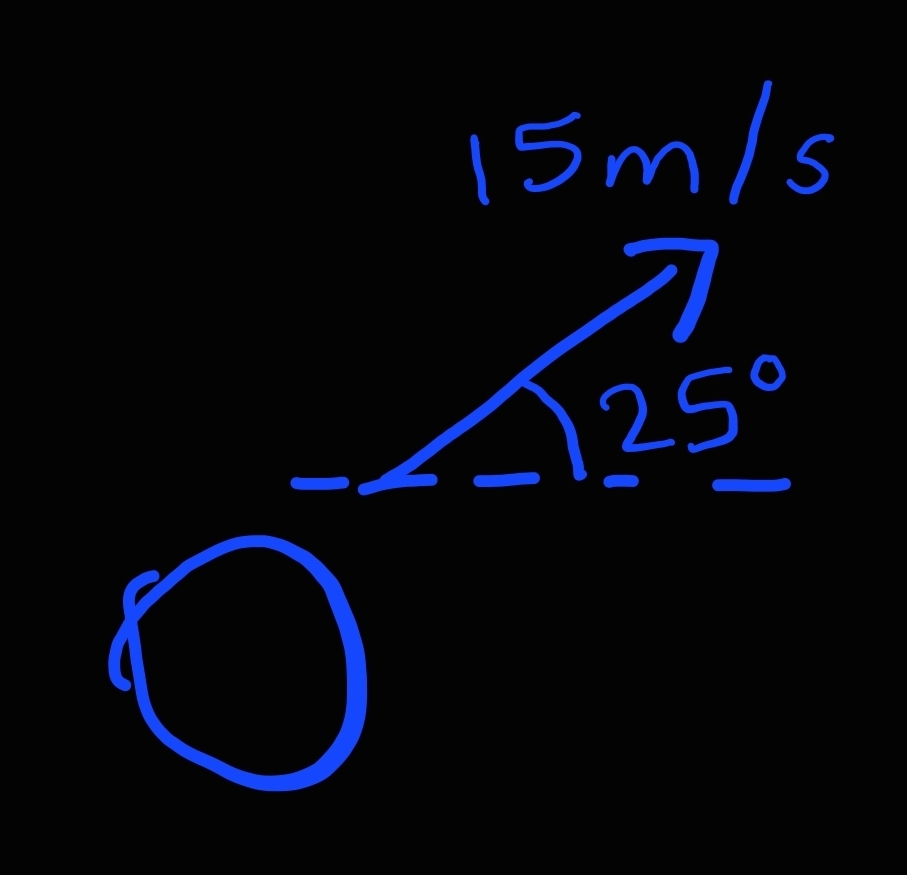
Question: A ball is thrown at a 25 degree angle with $15 m/s$ as shown. Find how far the ball goes.
 ▼
▼
Please also see the comments attached to the video.

Another question: You have a ball thrown in projectile motion. It takes $2$ seconds to hit the ground again and it travels $20$ meters horizontally. What was the initial velocity and the angle the ball was thrown from? ▼
This question wants you to work backwards. Let us set up our typical kinematics equations after drawing a diagram (up is positive, right is positive):
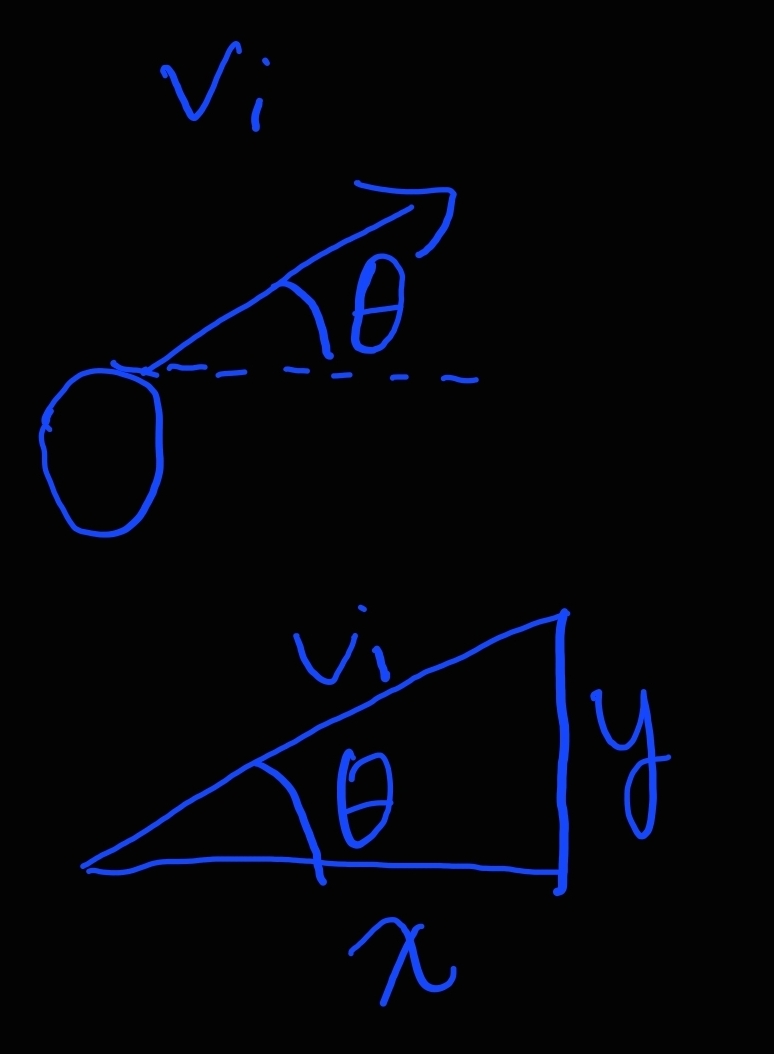
Using SOH CAH TOA, we can see that our:
- Horizontal velocity $= v_i\cos\theta$
- Vertical velocity $= v_i\sin\theta$
Let's now set up our 2 equations:
- $x=v_i\cos\theta \cdot t$
$20=v_i\cos\theta \cdot 2$
$\frac{20}{2}=10=v_i\cos\theta$ This is equation 1. - $h=v_i\sin\theta \cdot t+\frac{1}{2}at^2$
$0=v_i\sin\theta \cdot 2+\frac{1}{2}(-9.8)(2^2)$
$0=2v_i\sin\theta-19.6$
$19.6=2v_i\sin\theta$
$\frac{19.6}{2}=9.8=v_i\sin\theta$ This is equation 2.
We have 2 unknown variables, and we have 2 equations related to both variables. Then, via the mathematical method of simultaneous equations, we can solve this to figure out both the velocity and the angle. I will not be able to go into simultaneous equations in these notes because that's a topic more related to mathematics. Feel free to ask me on my discord or perhaps I already made some notes regarding it.
I will show you the simplest way to solve this via simultaneous equations (there is more than one way).
Let's divide equation 2 by equation 1:
$\frac{Equation\ 2}{1}$:
$$\frac{9.8}{10}=\frac{v_i\sin\theta}{v_i\cos\theta}$$$0.98=\frac{\sin\theta}{\cos\theta}=\tan\theta$ (I cancelled the $v_i$ from the top and the bottom, and then turned $\frac{\sin\theta}{\cos\theta}$ into $\tan\theta$, which is a trick worth knowing)
$\tan^{-1}(0.98)=\theta=44.4$ degrees
We can now input our angle into any of our equations to find the velocity. I will use equation 1.
$10=v_i\cos 44.4$
$v_i=\frac{10}{\cos 44.4}=14 m/s$
We found them both!
Tips:
- Write down your kinematic equations
- Be comfortable doing algebra (could also become solving quadratic equations)
- Know that there are multiple ways to solve the same problem, but that doesn't mean to blindly guess. Always have a small mind map of how to solve the problem before you start solving. If you don't know where to start, list down what you know and what you want.
- Be familiar with the free falling rules, as they become very handy over here.
Ramps
So far, we dealt with objects on horizontal surfaces. However, this won't always be the case. Sometimes, your object will be on an inclined surface. In order to solve problems related to ramps, you need 1) change your standard axes, 2) break down forces into their components.
Here is your standard ramp set up:
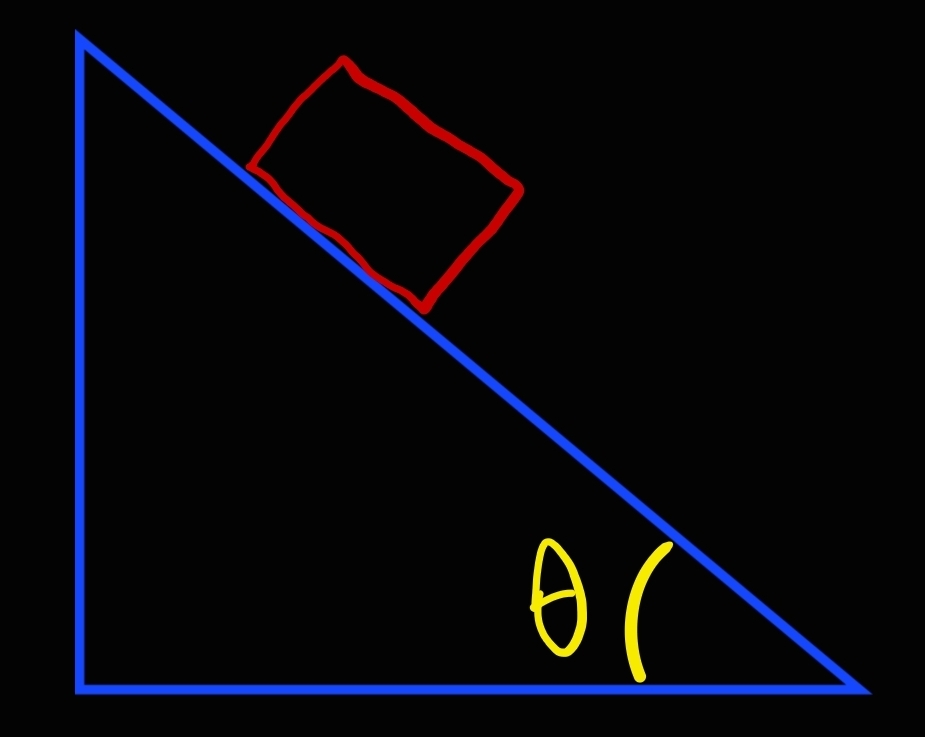
As long as there isn't a lot of friction on the ramp, you should expect the box to go down the ramp. However, you see how the box would be going in a diagonal path (not perfectly horizontal or vertical path)? This will complicate things a lot, since the box will be moving both in the x and y axes. To avoid this, we need to shift our standard axes to fit the path of the ramp. Look at the below image:
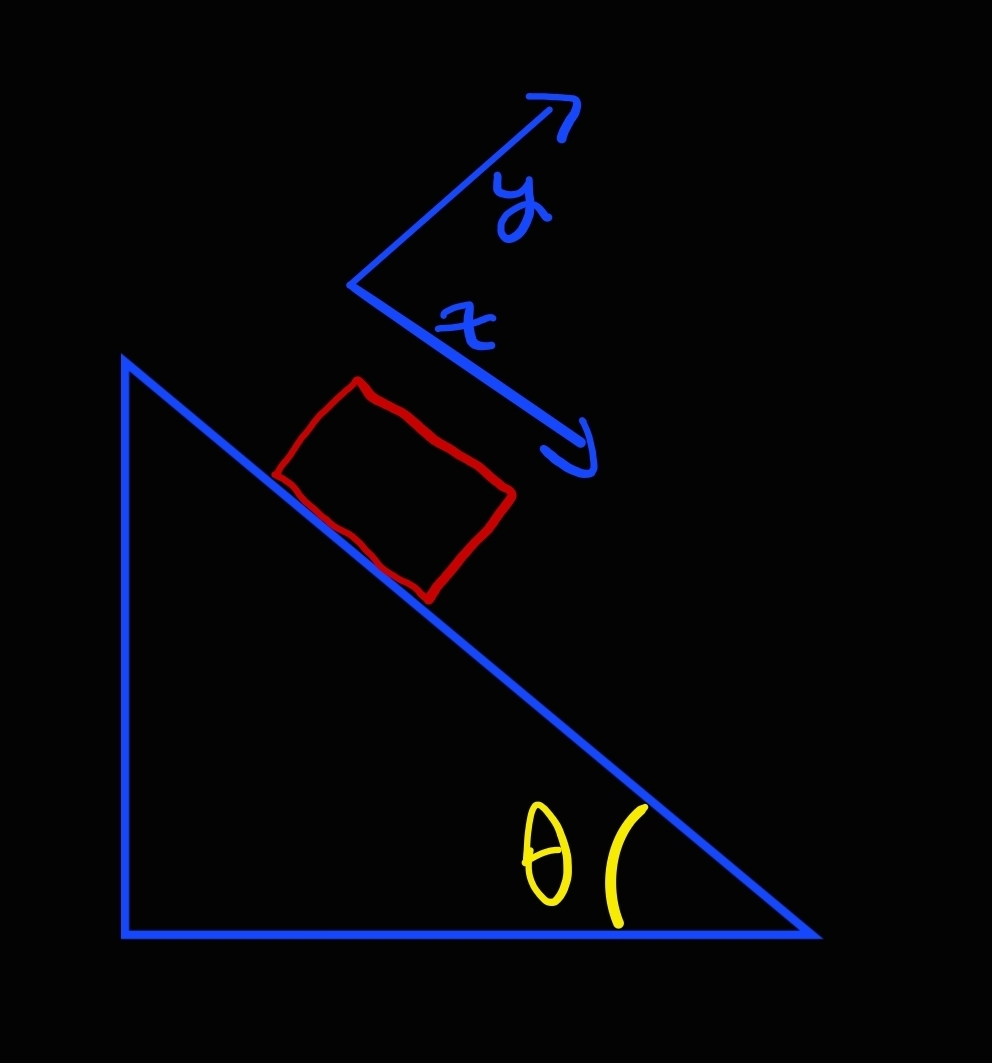
As you can see, our x-axis is now moving along the ramp (up the ramp or down the ramp) while our y-axis is perpendicular to the ramp. This means that as the box slides down the ramp, we will now only have movement in the x-axis, hence simplifying our work. Moreover, forces such as the normal force will be easy to calculate, since they now completely fit the y-axis direction (remember, the normal force is perpendicular to the surface, same way we made our y-axis perpendicular to the surface of the ramp).
Usually, there is only 1 problem to deal with: the weight force. Look at the weight force shown in the image below:
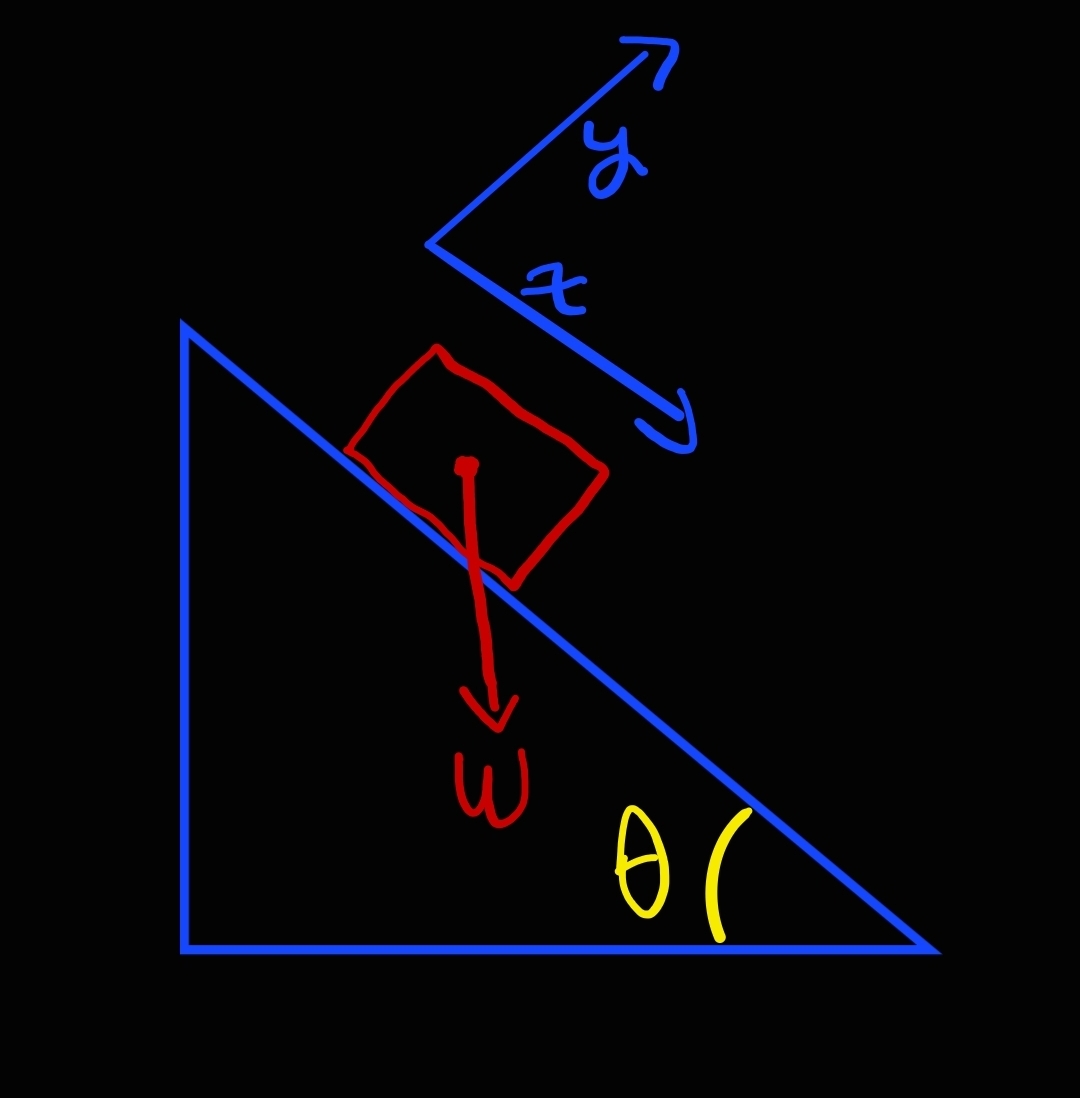
As you can see, our weight force (which always goes completely downwards, regardless of your axes) is not going according to our axes. Hence, we have to break it down into new x and y components. This shouldn't worry you, as you only need to memorize some formula ($\theta$ is the symbol for the angle):
- Weight force in y-axis $= mg\cos\theta$. This formula is also almost always your normal force formula (if you have something pressing down on your object, then $mg\cos\theta$ won't be your normal force. If you have nothing pressing down on your object, which is the most common scenario, then $mg\cos\theta$ is your normal force).
- Weight force in x-axis $= mg\sin\theta$
Note:
- $m$ is the mass in $kg$. $g$ is gravity.
- These formulae are true if the angle you are using is in the same place as shown in the picture above.
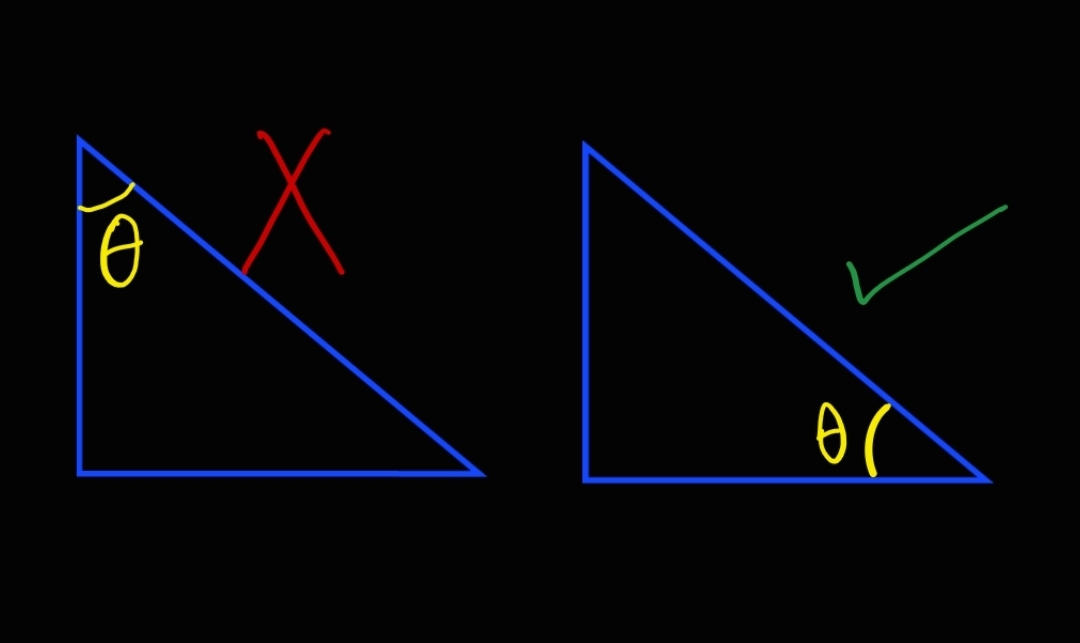
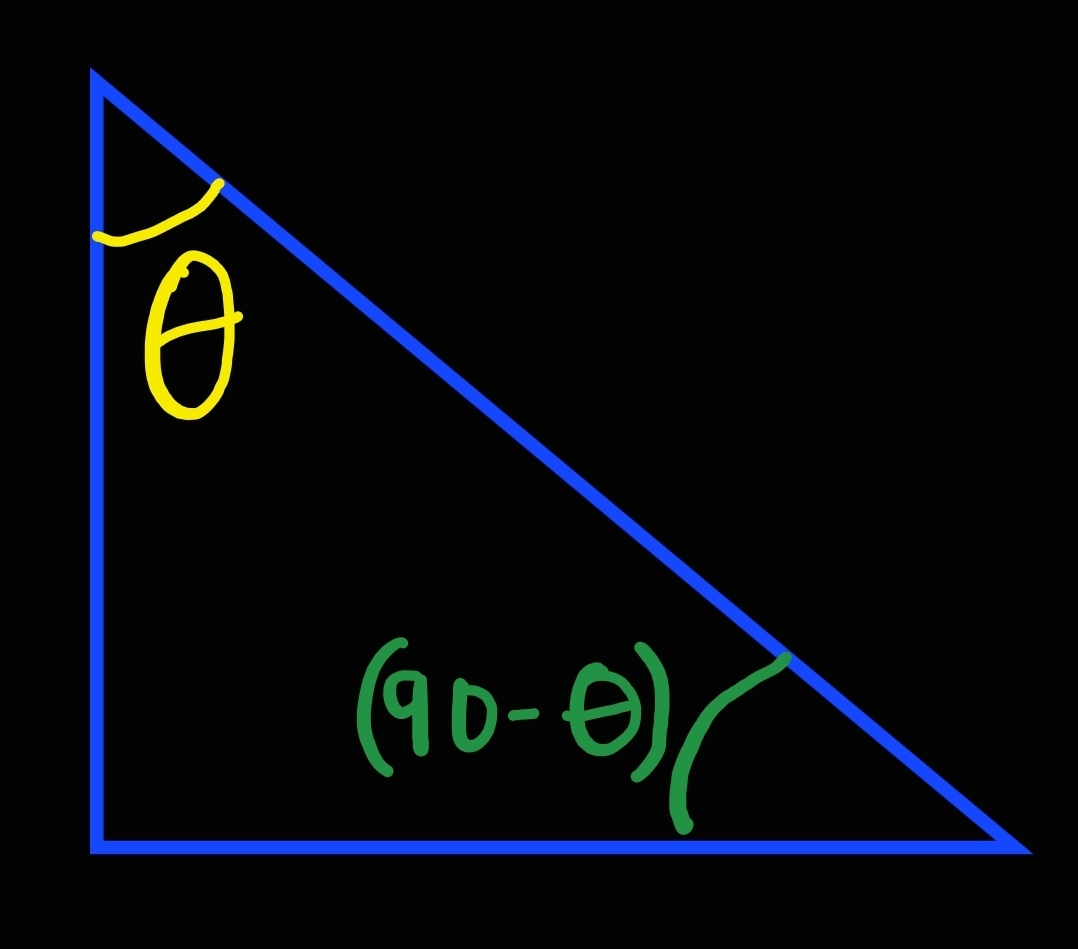
If your question gives you the angle in the wrong place, just do $90-\theta$ and that will be your angle in the right place.
Let's work on a very standard ramp/incline surface problem.
Question: You have a stationary wooden $5kg$ box on a ramp as shown below. The box suddenly starts to move for no reason. Calculate the acceleration of the box. ▼
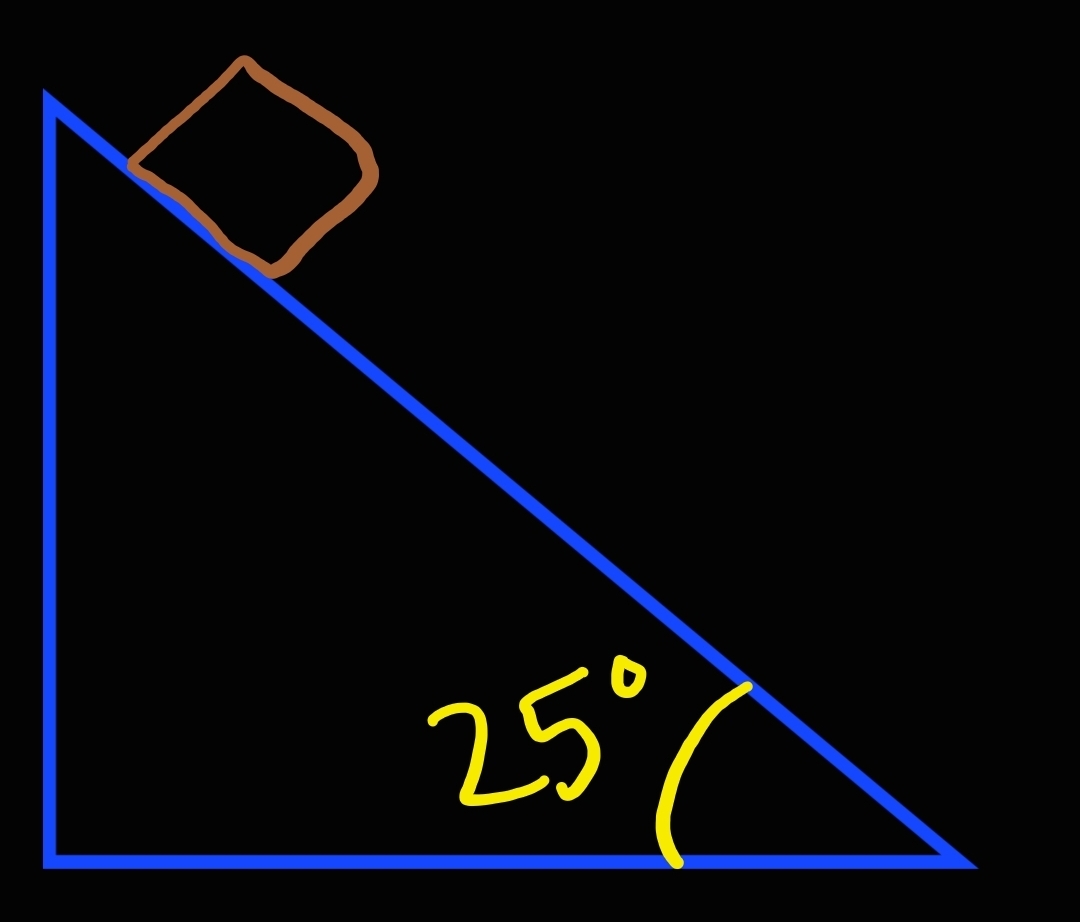
Let's begin by drawing our free body diagram. I will let down the ramp to be positive and the upward y-axis positive (y-axis for the ramp).
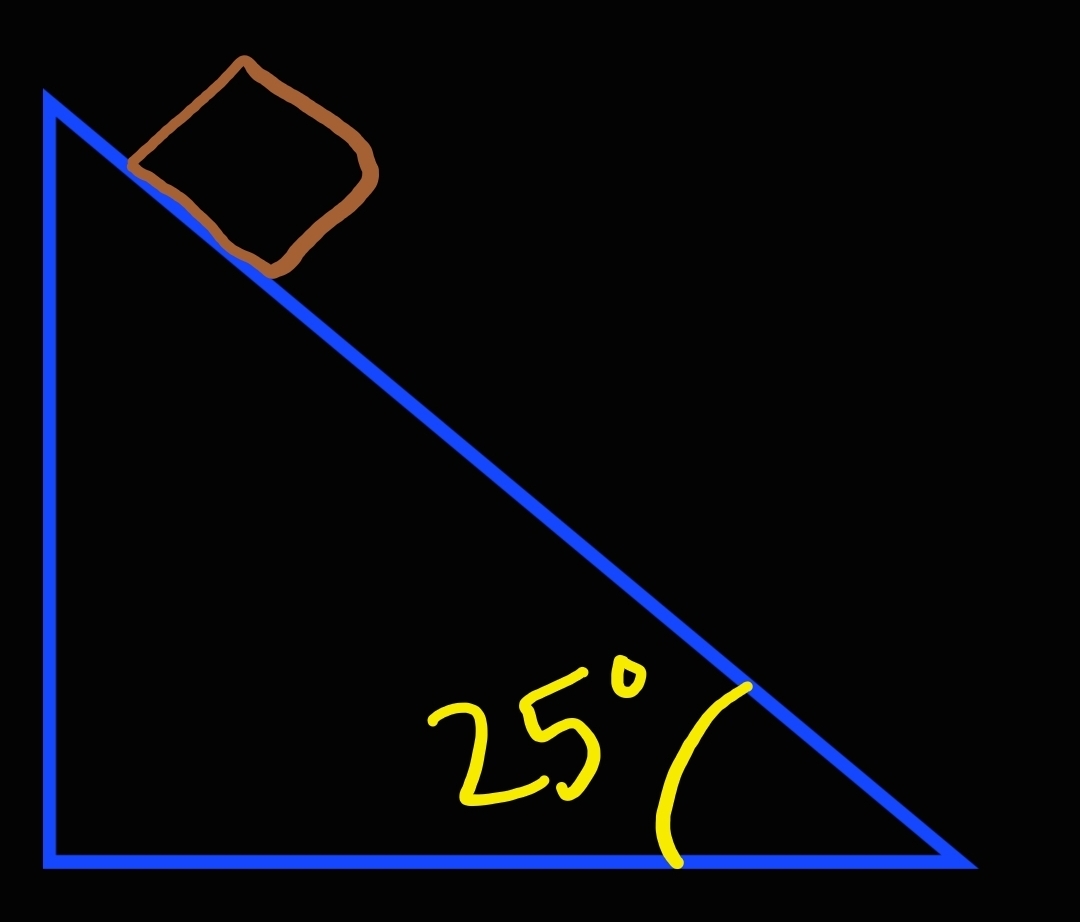
What forces are acting on the box? Well, it must have a weight force (since it has mass) and it also must have a normal force that is preventing the box from breaking through the surface. Here is our free body diagram:
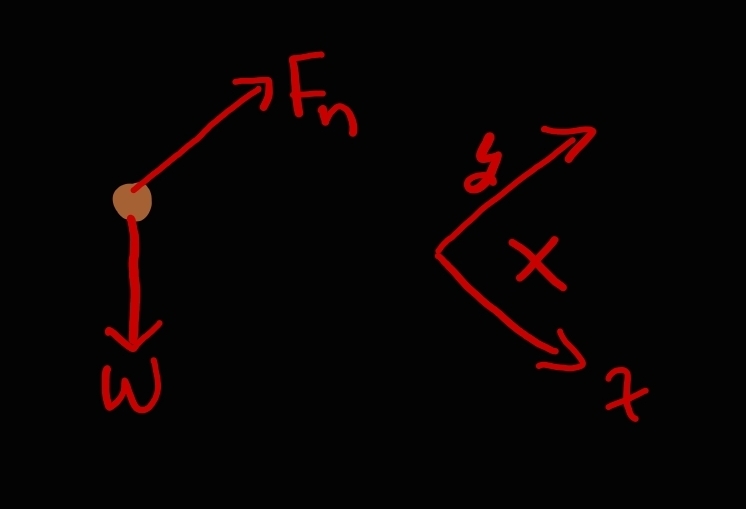
Our normal force is going according to the y-axis. However, we need to break down the weight force. From memory, the y component will be $mg\cos\theta$ and the x component will be $mg\sin\theta$. Observe the broken down weight force on our new free body diagram.
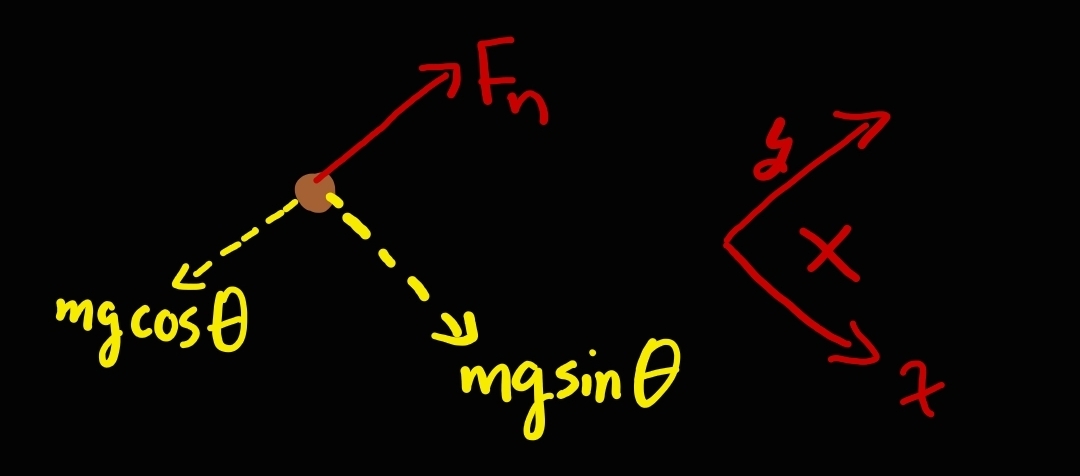
Let's now do force analysis:
- We know that the box is only sliding down the ramp. This means that the forces in the y-axis must cancel each other out (You can skip this section if you wish because we don't need the normal force in our calculations for this question).
$F_y=ma=0$
$F_y=F_n-mg\cos\theta=0$
$F_n=mg\cos\theta$
You can input the values if you wish to get a number. We don't need it for this question though. - In the x-axis, we only have 1 force, which is the x component of the weight force. Since there isn't anything to cancel this force out, we know that there must be some acceleration. Hence:
$F_x=ma$
$F_x=mg\sin\theta=ma$
Since the question is asking us to find the acceleration of the block, we can divide both sides by m to cancel the mass.
$g\sin\theta=a$
We are now ready to find the value of acceleration. Input $g=9.8$ and $\theta=25$
$9.8 \cdot \sin(25)=a=4.14 m/s²$.
We finished our question!
It's very likely that you will see other forces on your ramp, such as friction (most common), tension, or spring forces. Be comfortable dealing with those forces.
Question: Observe the set up below and find the acceleration of the system. There is friction on the ramp, and the coefficient of kinetic friction on the ramp is 0.1. ▼
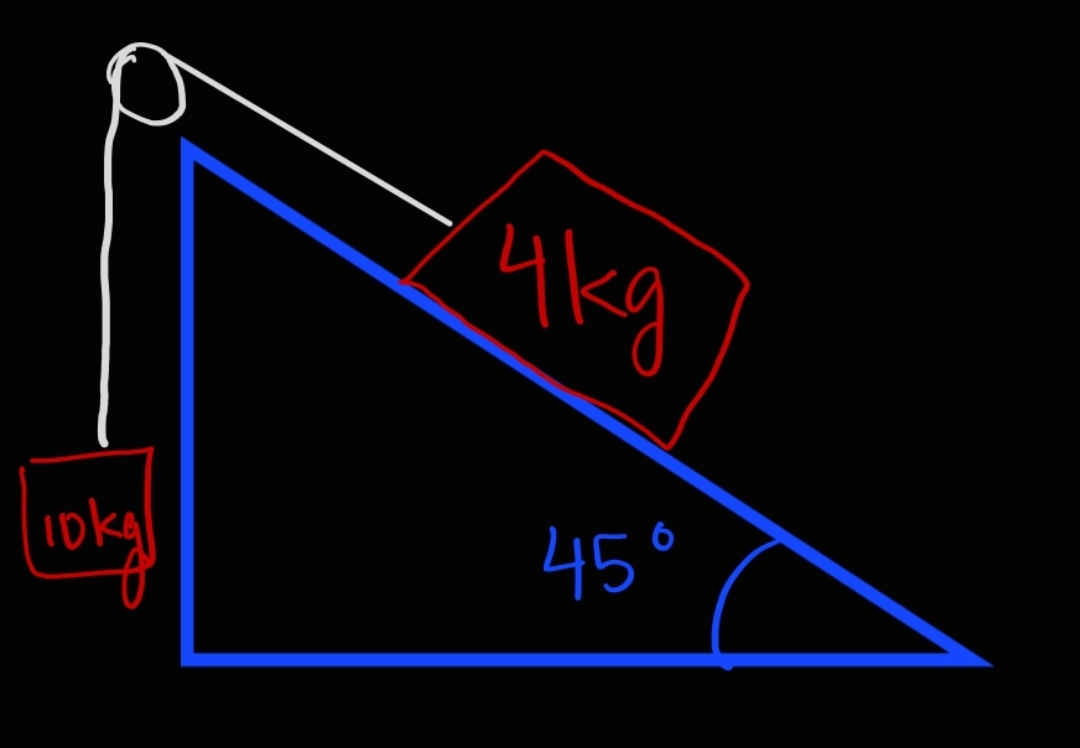
The first thing we should do is try to imagine what's going to happen. Will the block on the ramp go up the ramp or down the ramp? Our best guess is that it'll go up the ramp, since the other block it is connected to is way heavier. This also means that the hanging block will go downward. Another thing to note: they will both have the same acceleration! This is because they are connected together (and it's impossible for one to be going faster than the other).
Since we have two objects, we will need 2 free body diagrams. For the block that is hanging beside the ramp, I will make downward positive (standard axis). For the block on the ramp, I will make "up the ramp" positive (ramp axis).
Notice! I carefully chose my positive directions such that the acceleration for each object has the same sign. It is impossible for one object to have a positive acceleration and the other object to have a negative acceleration since we know that the 2 objects MUST have the same acceleration.
Let's start drawing the free body diagram of the hanging block:
- We know that it will have a weight force, because it has mass.
- We know there will be some tension force acting on it, since it is connected to a string (which has tension from the block on the ramp).
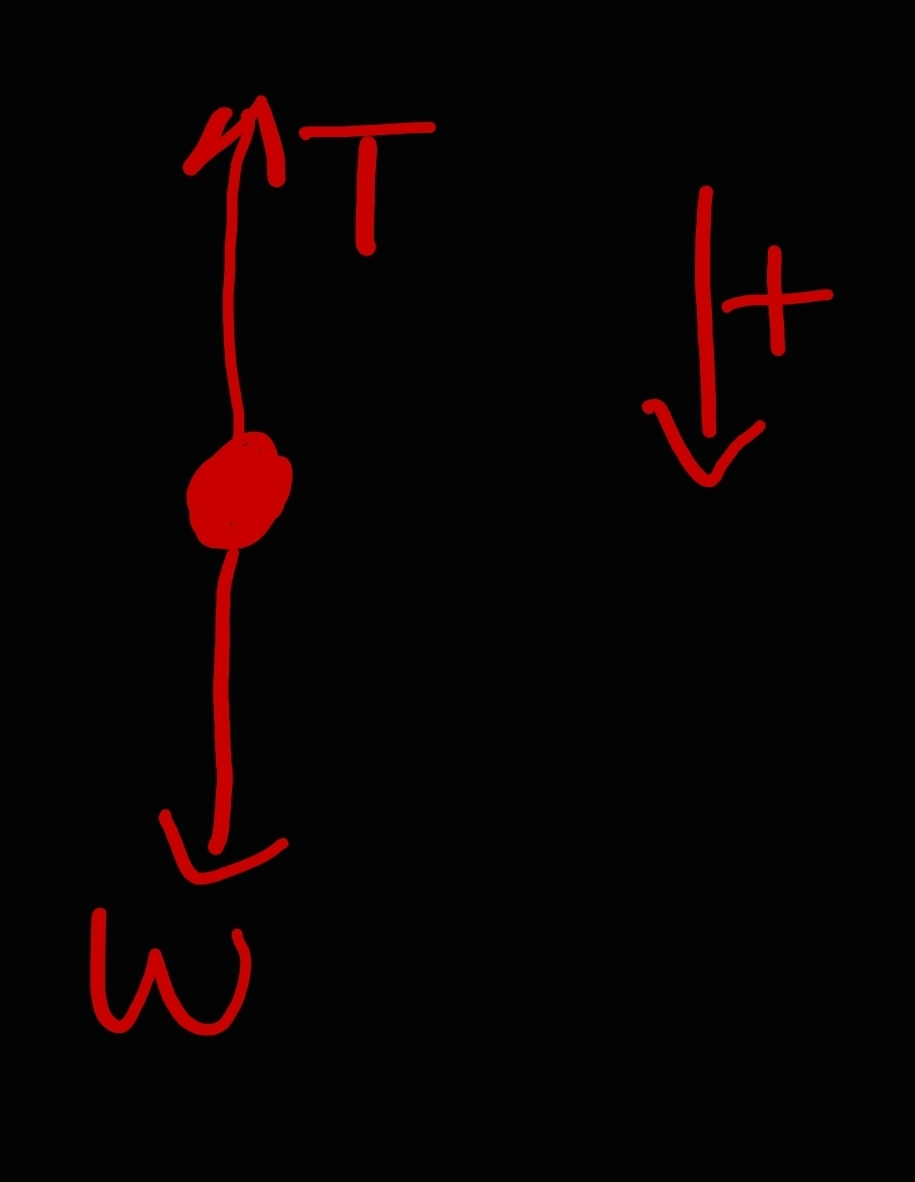
$F_{total}=ma$
$W-T=ma$
$mg-T=ma$
Input the values for the mass of the block and the value of gravity.
$(10)(9.8)-T=10a$
$98-T=10a$ We will call this "equation 1", since we can't figure out tension or acceleration straight away.
Let's see the free body diagram for the block on the ramp.
- We know it must have a weight force going straight down.
- We know it must have a normal force preventing it from breaking through the ramp.
- We know it must have a friction force, because there is friction on the ramp (stated by the question). Notice that the friction force will be going down the ramp, since the block wants to go up the ramp.
- We know it must have a tension force, as the string is pulling it up the ramp (this is the same tension force experienced by the hanging block).
Let us draw these forces on our free body diagram.
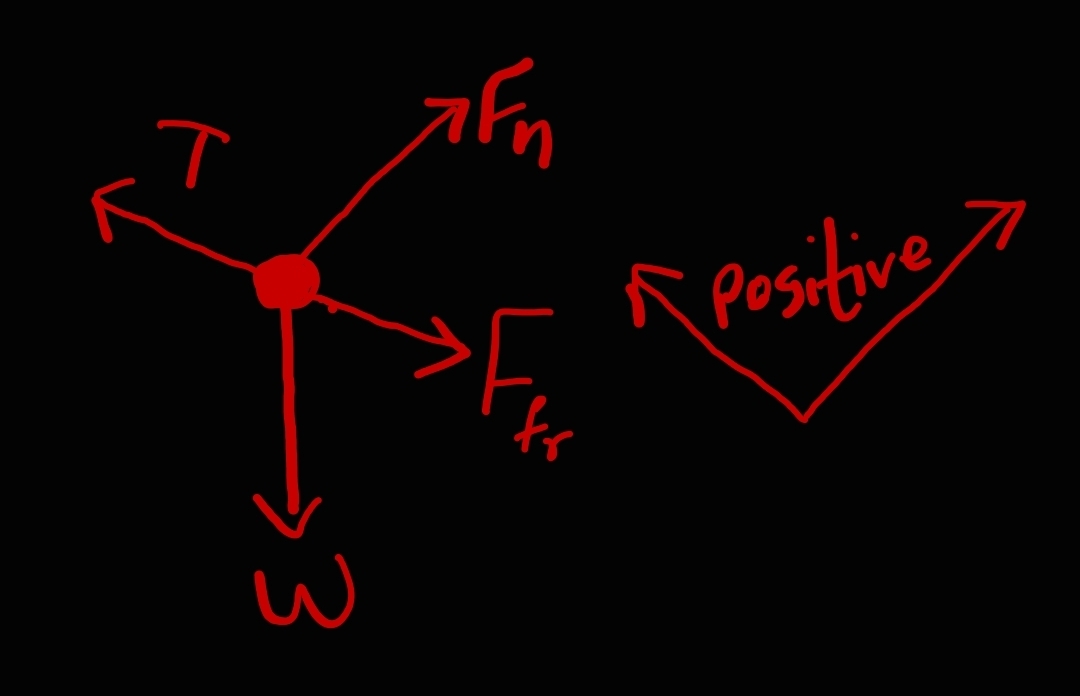
All of our forces are going according to our chosen axes except the weight force. Let's break down the weight force.
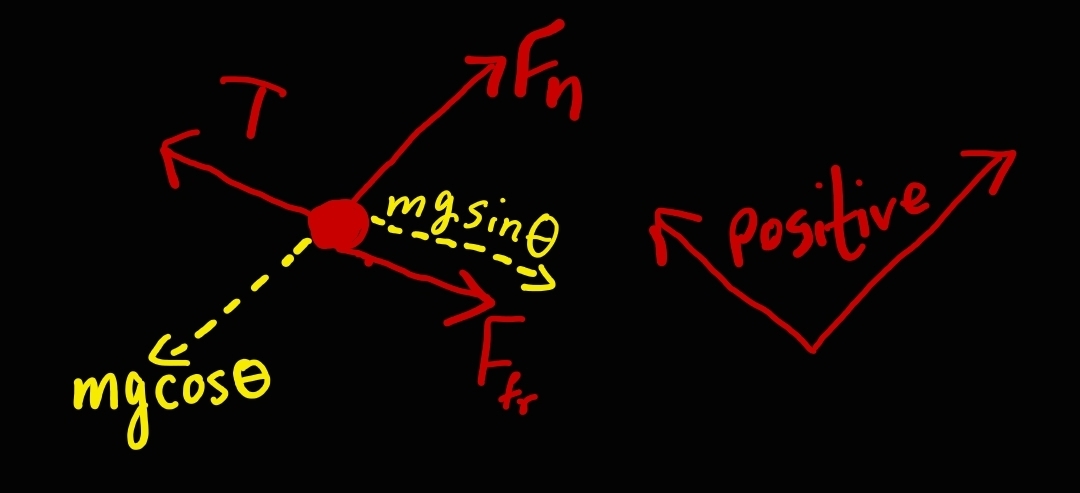
Now everything is going according to our axes. Let's start by analyzing the y-axis. We know that the forces must cancel each other out since the block is simply sliding on the ramp (which is our x-axis).
$F_y=ma=0$
$F_y=F_n-mg\cos\theta=0$
$F_n=mg\cos\theta=(4)(9.8)\cos(45)=27.72 N$
This time, we need the normal force because we need to find the force of friction.
Let us now check our x-axis.
$F_{x-total}=ma$
$T-mg\sin\theta-F_{fr}=ma$
Input the formula for friction.
$T-mg\sin\theta-\mu F_n=ma$
Let's input all the values we know.
$T-(4)(9.8)\sin 45-(0.1)(27.72)=4a$
$T-30.49=4a$ We will call this "equation 2" since we can't figure out tension and acceleration from it alone.
We finished our force analysis and still couldn't figure out acceleration or even tension. What should we do? Well, let's compare our two equations:
$98-T=10a$ Equation 1
$T-30.49=4a$ Equation 2
We have 2 unknown variables, and we have 2 equations related to both variables. Then, via the mathematical method of simultaneous equations, we can solve this to figure out acceleration.
I will show you the simplest way to solve this via simultaneous equations (there is more than one way). We can add equation 1 and equation 2 together in order to cancel the tension force. This will leave us with a third equation that we can solve via normal algebraic rules.
Equation 1+2 =
$(98-T)+(T-30.49)=(10a)+(4a)$
$98-T+T-30.49=10a+4a$
$98-30.49=14a$
$67.51=14a$
$a=\frac{67.51}{14}=4.82 m/s²$
We found the acceleration of the system, so we are done!
Uniform Circular Motion
What if your object is going in circles (with uniform speed)? Then, you will have something called centripetal acceleration and you will have a force known as your centripetal force, related together using this equation:
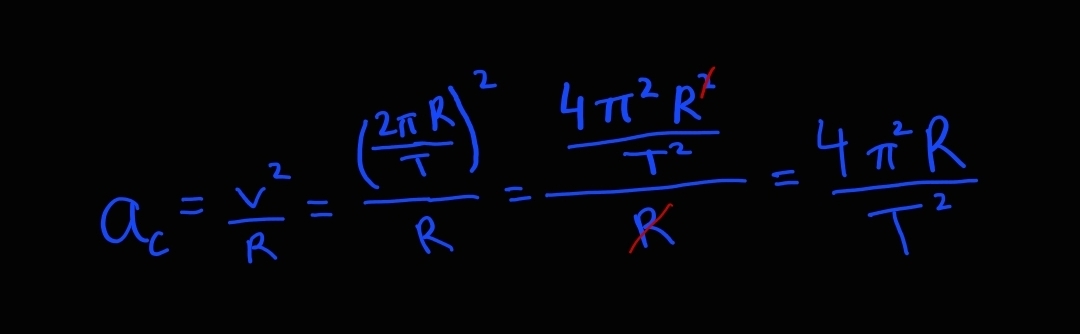
$$F_c = ma_c$$Centripetal acceleration ($a_c$) — An object going in circular motion will always be changing its direction (even though it may have constant speed), and hence it will always be changing its velocity. Since there's a change in velocity, you will have some form of acceleration. In this special case, we call this acceleration "centripetal acceleration" and its formula is: $a_c=\frac{v^2}{R}$ where $v$ is the velocity of the object and $R$ is the radius of the circle.
Note: Sometimes you are not given velocity but instead you are given the radius and the time it took to go around the circle once (called the period, symbol: $T$). Hence you need to let $\text{velocity}=\frac{\text{distance}}{\text{time}}$, and distance = circumference of the circle $= 2\pi R$, hence $v=\frac{2\pi R}{T}$, and when you input this into the formula of centripetal acceleration you get:
Centripetal force ($F_c$) — This is whatever force (or combination of forces) that is pointing directly towards or away from the centre of the circle. Treat this force as a "title" that you grant to some force on your free body diagram.
Something to keep in mind is: The centripetal force changes based on where the object is in its circular path. I will show you a typical example of this:
Question: Suppose you have a $2 kg$ ball attached to a 50 cm string spinning in a vertical loop. Find the centripetal force when the ball is at its minimum velocity that keeps it still in circular motion at the bottom of the loop, the top of the loop, and when the ball is perfectly towards the left or the right.
1. The bottom of the loop ▼
Let's first draw a diagram for us to imagine the situation.
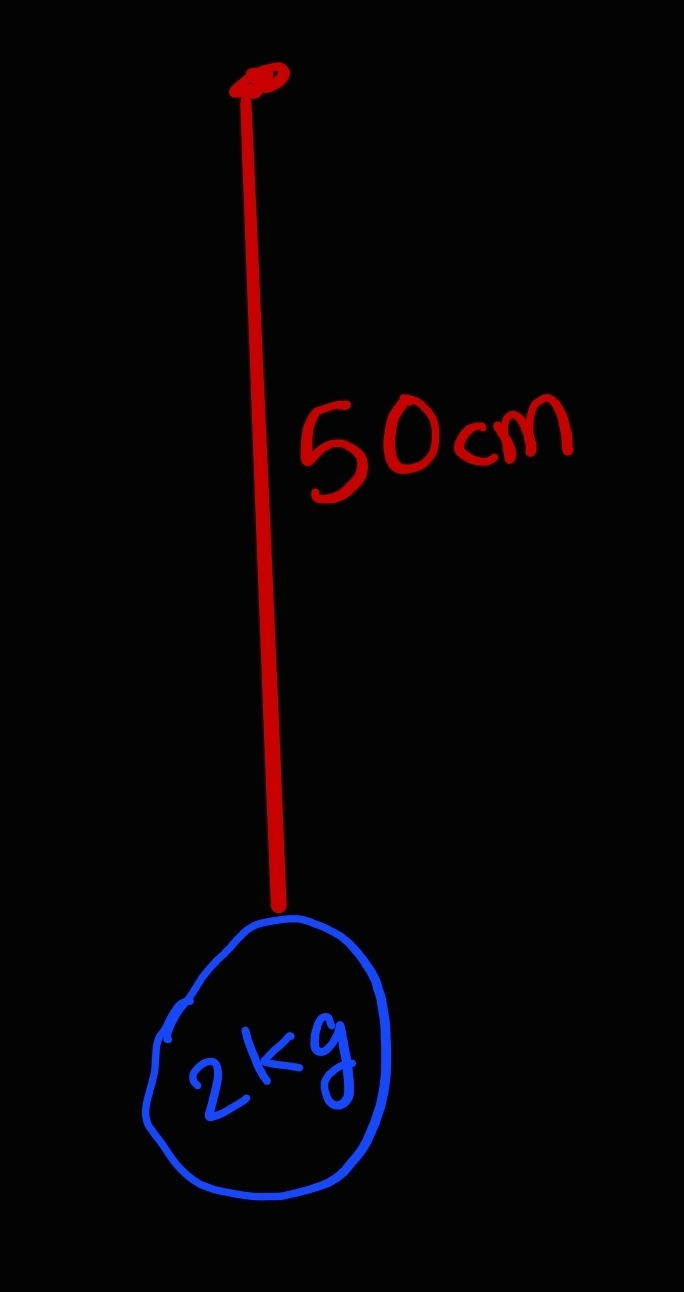
Well, let's draw a free body diagram of the ball.
- It has a weight force (pointing away from the centre of the circle) because it has mass.
- Will it have a tension force since the string is helping the ball go towards the centre.
Here is our free body diagram (I will draw it next to the ball so that you can tell what is pointing away/towards the centre). I will also make the direction towards the centre positive, which in this case is upwards:
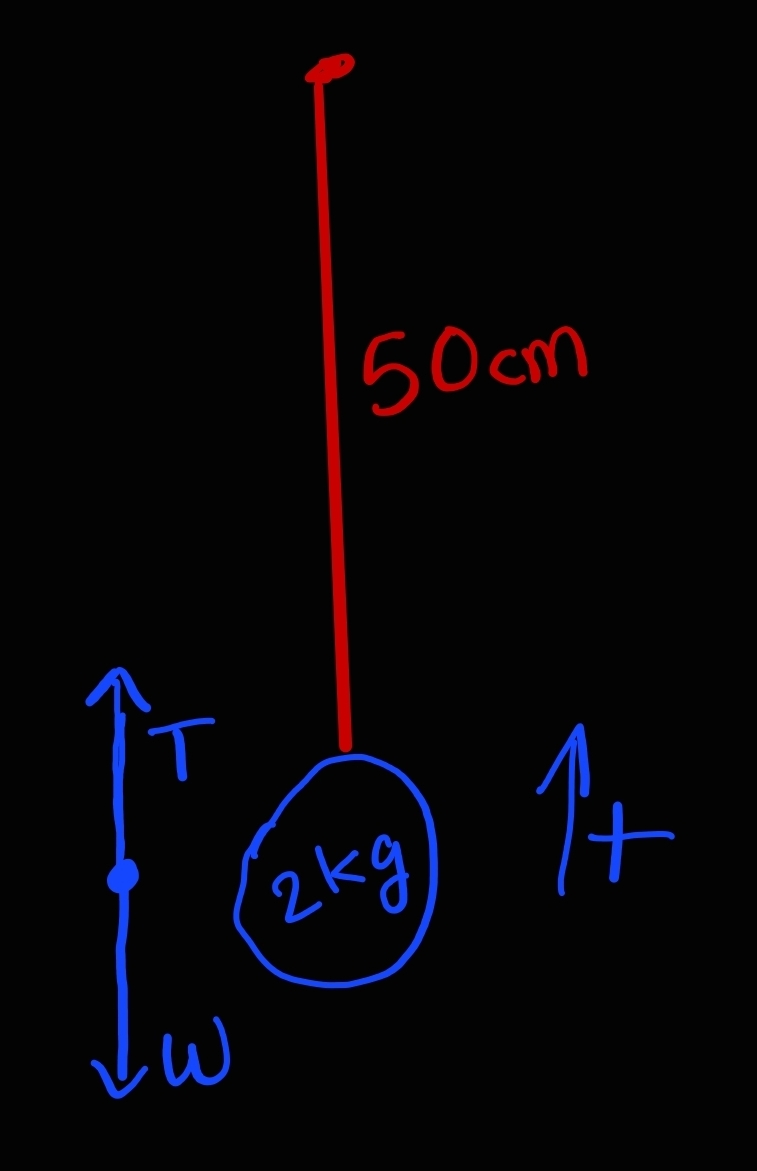
So what forces are pointing either away or towards the centre? Well, our tension force is pointing towards the centre and the weight force is pointing away from the centre. So our centripetal force(s) =
$F_c=T-W$
$T-W=ma_c$
Note: even if you input all your given values, I don't think you can find the tension force of minimum velocity using this equation. Instead, part b will be more useful.
2. The top of the loop ▼
Just like part a, let's start a diagram:
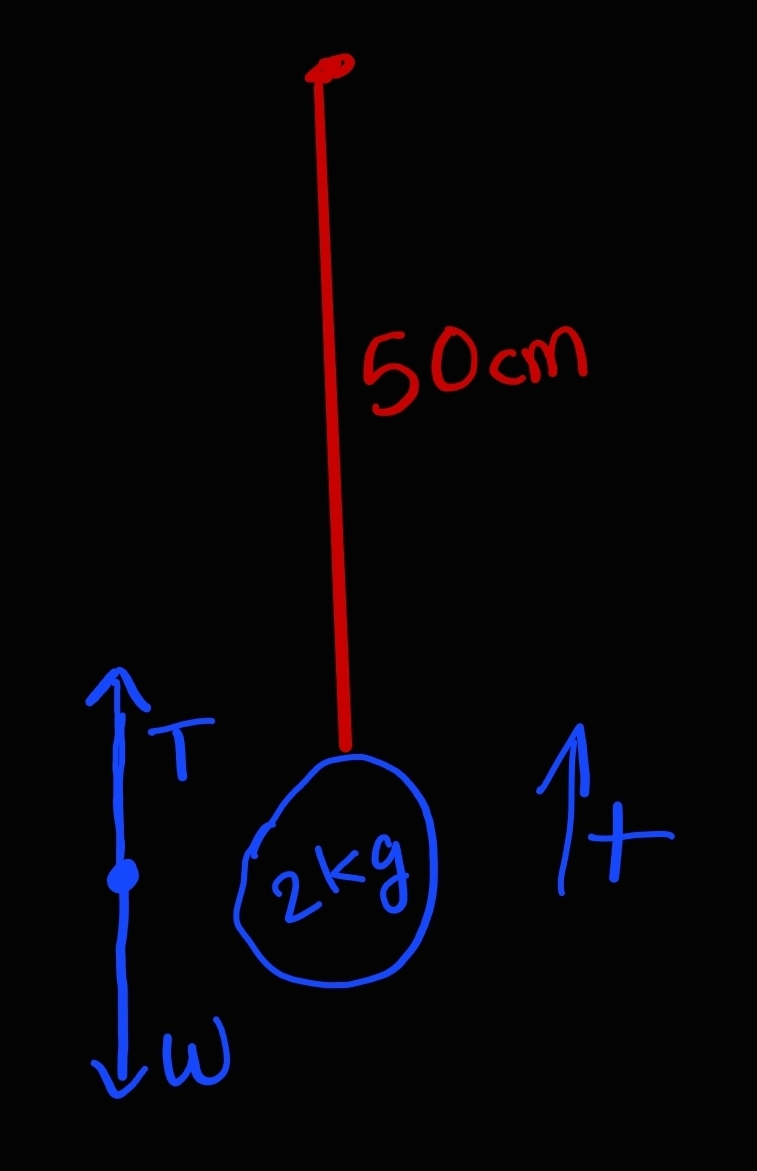
Now, let's make a free body diagram.
- It must have a weight force because it has mass.
- Will it have a tension force? You have to imagine this: If you are spinning a ball in a vertical loop, then as the ball goes slower and slower, the tension in the string will decrease. At the top (and with minimum velocity), the tension of the string will be so small to the point it becomes zero. Hence, there will be no tension force. Try spinning a ball attached to a string, once with high speed and once with slow speed, you will notice that the tension is less with the slower speed, especially at the top.
You can also think of it like this: Does the ball need another force to help it go towards the center, or does the weight force suffice? Since the weight force is already pointing toward the centre, there is no need to have a tension force.
Hence, our free body diagram is just the weight force. I will make the direction towards the center positive, which in this case is downwards.
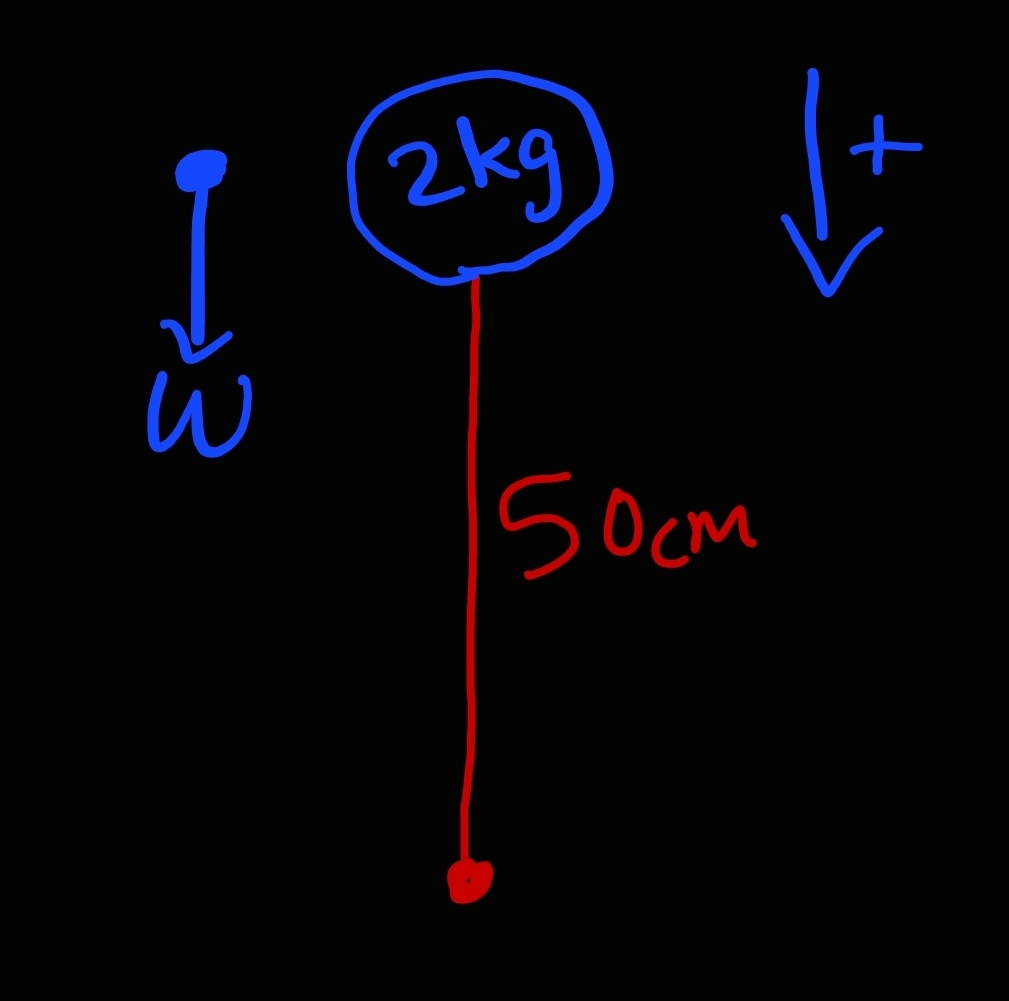
The force going towards the center is our weight force. So,
$F_c=W$
$W=ma_c$
$mg=m \cdot \frac{v^2}{R}$
We can cancel $m$ from both sides.
$g=\frac{v^2}{R}$
$v^2=gR$
$v=\sqrt{gR}=\sqrt{(9.8)(0.5)}=2.21 m/s$
Note: We can use this result to find the tension required in part a or part c (the tension will be different based on where the ball is, same way no tension exists over here when the ball is at the top, but exists elsewhere)
3. The ball is perfectly towards the left or the right. ▼
As always, start by drawing:
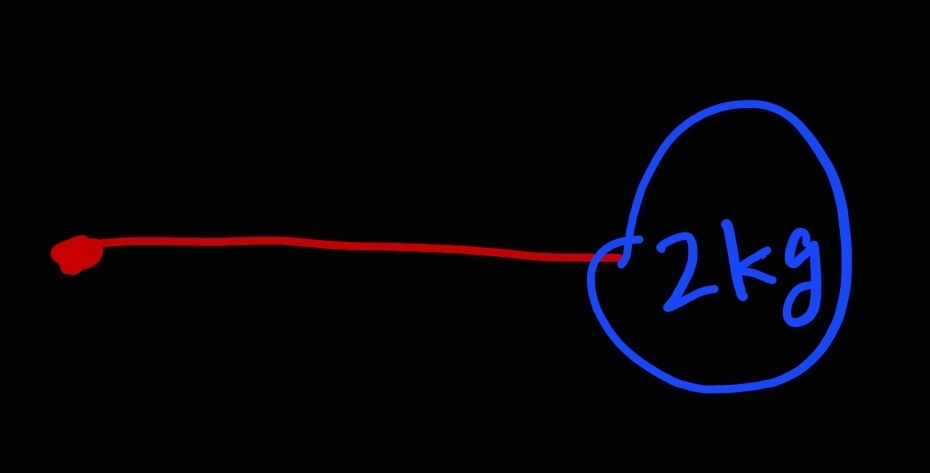
Now, let's draw our free body diagram.
- The ball will have a weight force because it has mass.
- The ball will have a tension force to help it go towards the centre.
Here is our free body diagram. As usual, the direction towards the centre is positive.
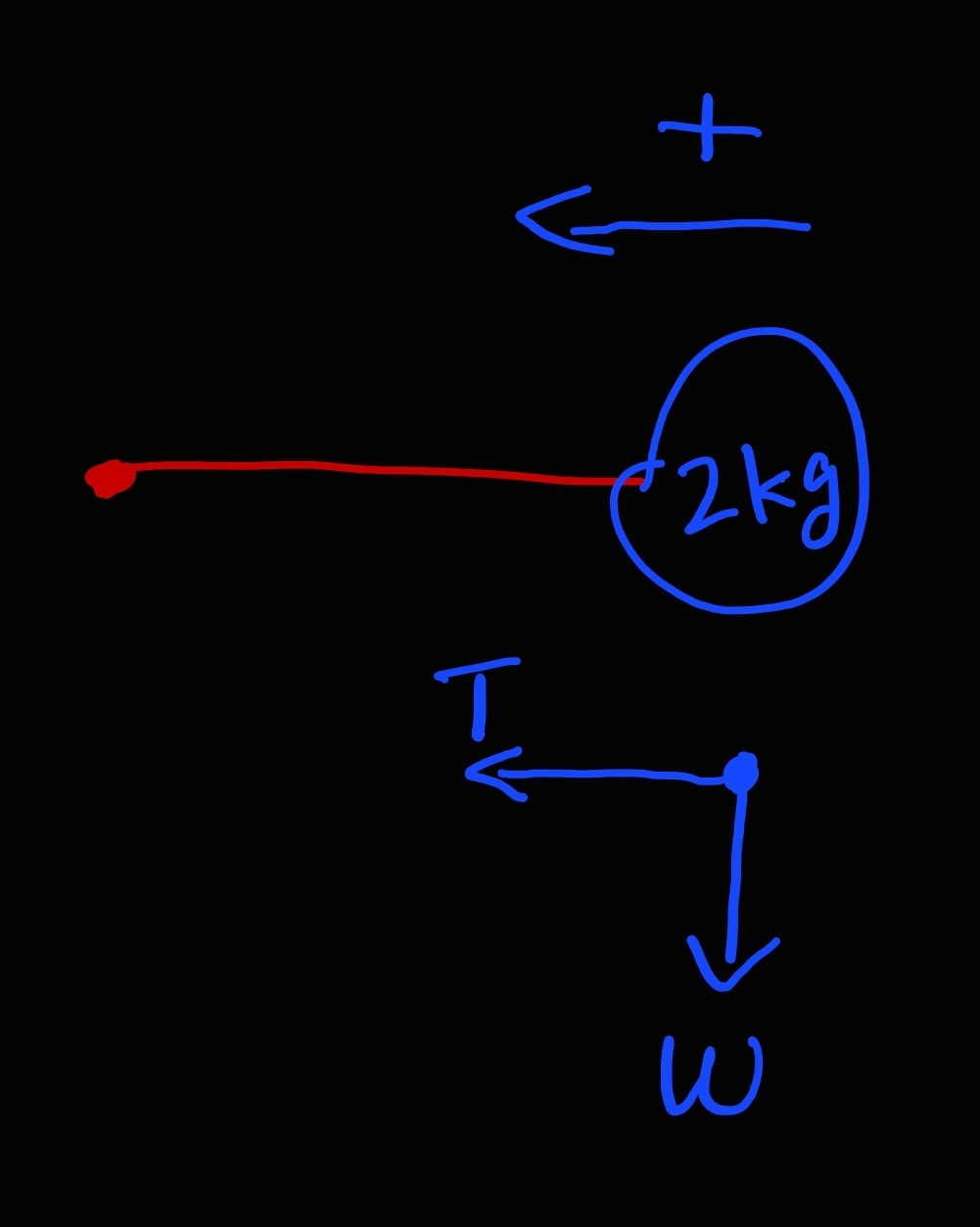
What force is pointing towards the centre? Well it can't be the weight force because it's going downwards. Then it must be the tension force. Hence,
$F_c=T$
$T=ma_c$
$T=m \cdot \frac{v^2}{R}$
We can input the value of velocity that was obtained in part b and find out the tension if we wish.
Note: if the ball was to the left of the circle instead of being to the right, it wouldn't make any difference.
4. Where is tension the greatest? ▼
If you wish, you can input numerical values in part a, b, and c to check it out yourself, but there's another way to answer this.
- In part a, tension was fighting the weight force to pull the ball upwards (you had $F_c=T-W$).
- In part b, you had no tension force.
- In part c, tension was fighting nothing ($F_c=T$).
In every case, the centripetal force must equal the same numerical value. In other words, the centripetal force in part a must equal the centripetal force in part c. So, the tension in part a must be stronger than part b, because in part a: tension needs to overcome the weight force, while in part b, tension doesn't need to overcome anything.
I recommend finding the value of tension in part a and also in part c to understand what I'm saying. If you need help finding the values, feel free to message me in discord.
Let's try another question that may not immediately appear like a centripetal force question.
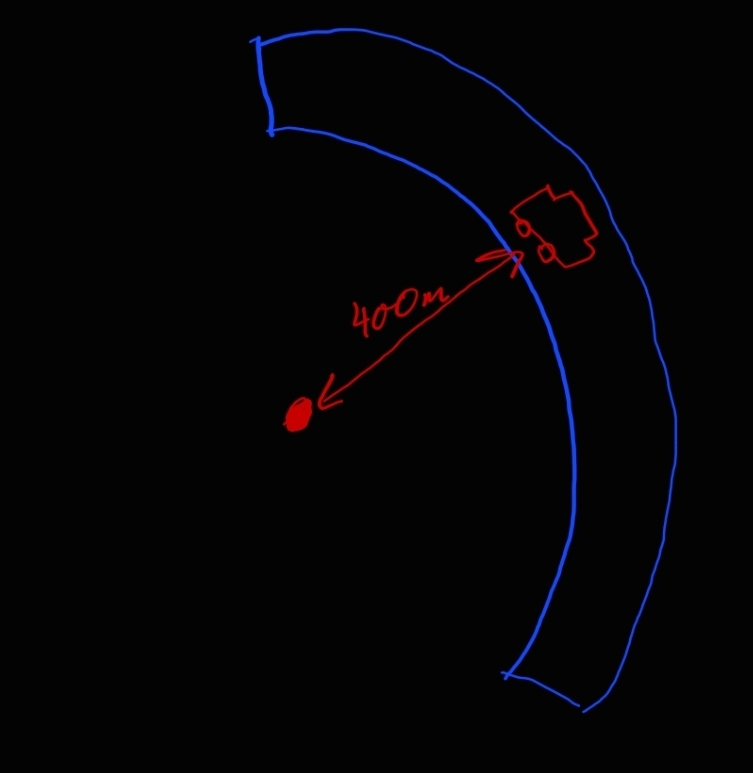
Question: You have a $150kg$ car driving on a banked curve (the road is not flat. It has an incline) as shown in the image below. The coefficient of static friction is 0.1. What is the maximum velocity of the car to remain in uniform circular motion (assuming the circle has a radius of $400$ meters)? (If my art skills are too good for you, the car is looking at you)
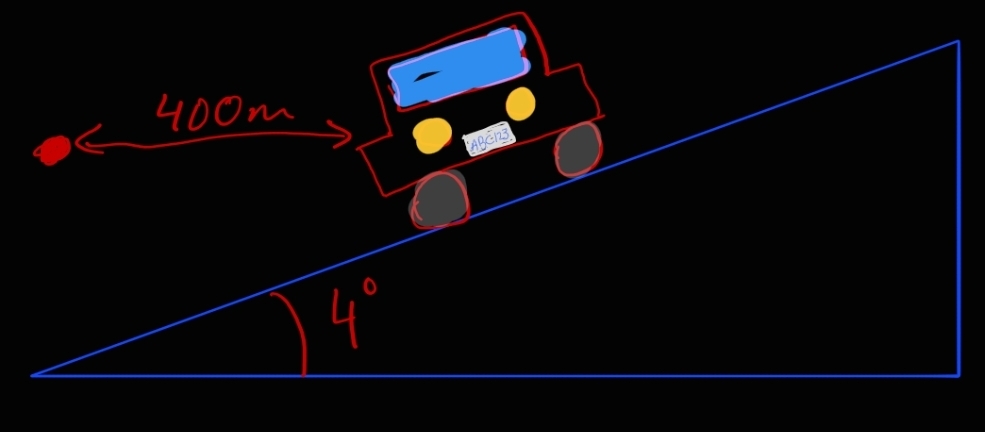
Picture from above:
 ▼
▼
Driving through a curve is like the car is in circular motion, as you can see from the images. We want to make our axes such that they correspond to the direction that points towards the center. Hence, from the first image, it is best to use the standard x and y axes, even though we have an inclined plane.
What forces do we have?
- We have the weight force, because the car has mass
- We have the normal force that prevents the car from breaking through the ground
- We have the static friction force that allows the wheels to not slide down/up the incline.
But which way is the friction force pointing? Up or down the incline? There is a hint in the question: it is asking about the maximum velocity of the car.
Let me show you what will happen if the car is driving very slow, and if it is driving very fast:
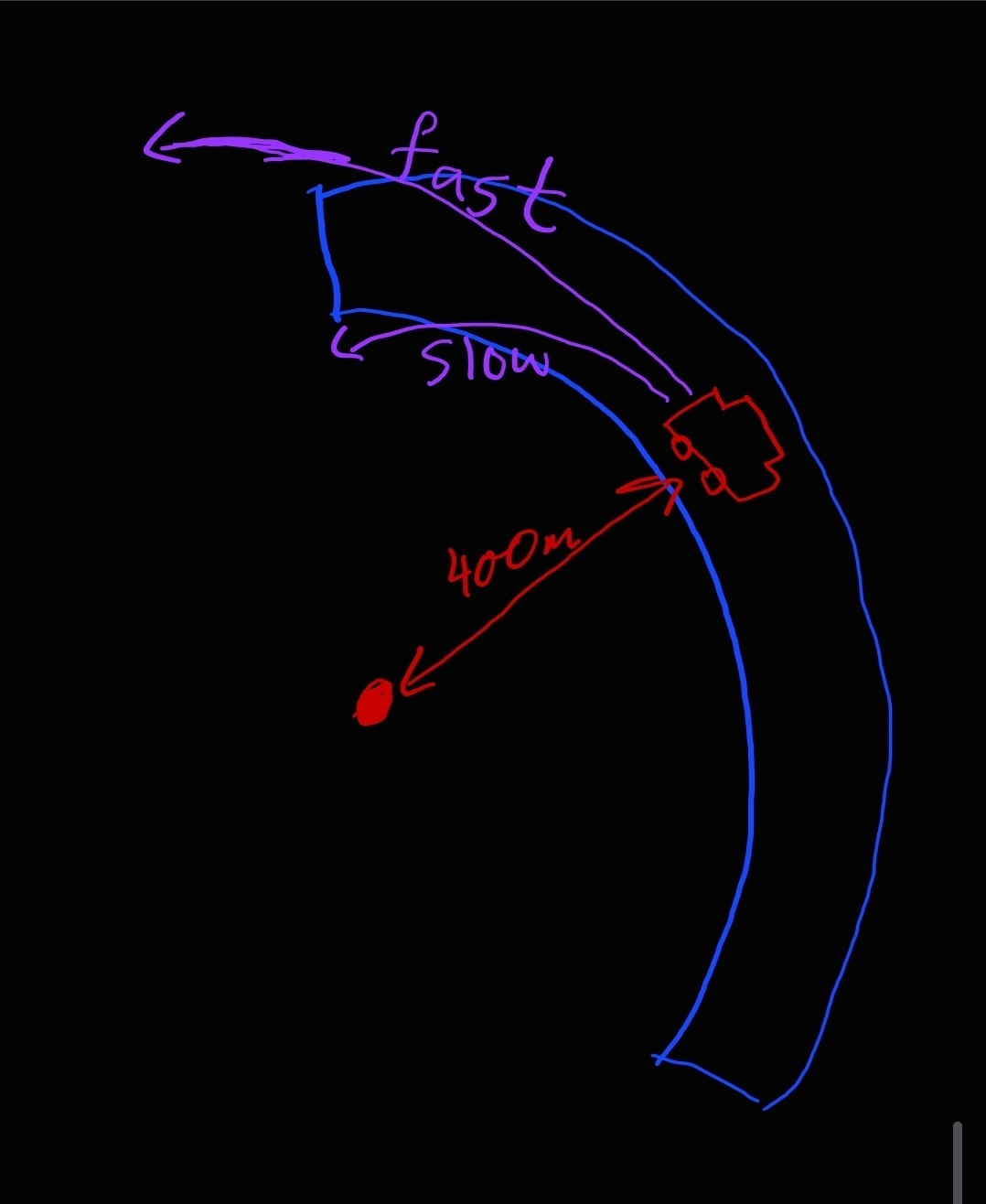
A slow car can't make a very wide turn, and a fast car can't make a very narrow turn (experience in driving may help you imagine this). Since our car is aiming for maximum velocity, then it will "want" to go up the ramp and fly off. Hence, friction will try to pull the car down the ramp.
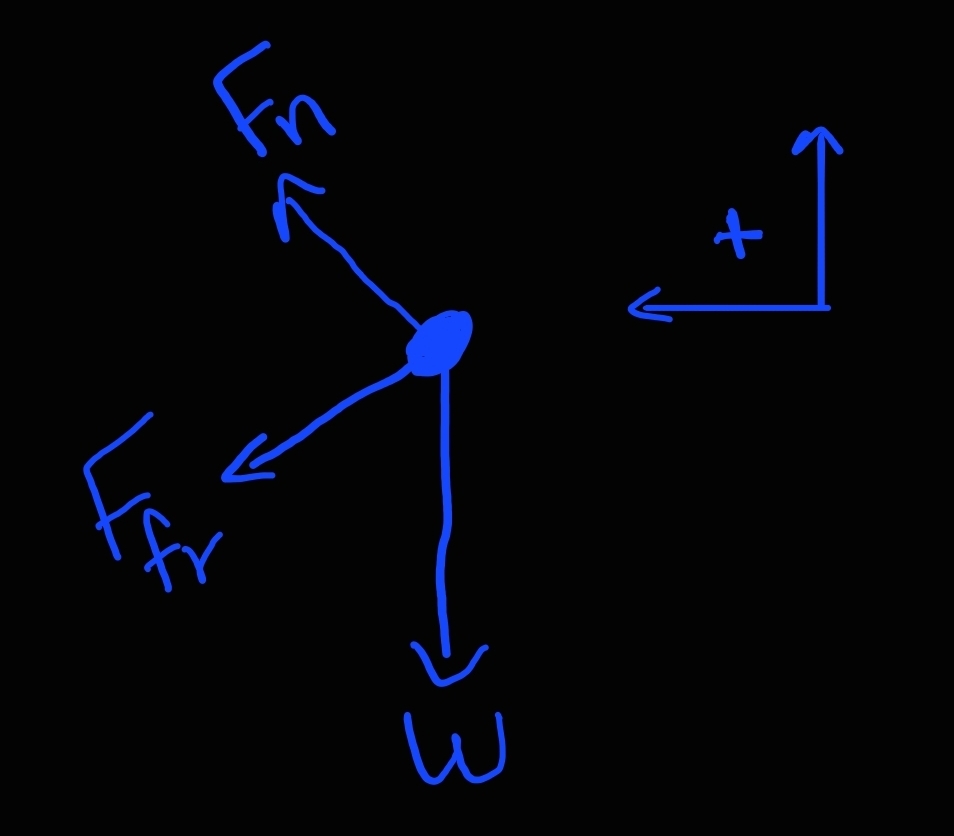
We now need to break down the friction force and the normal force into our standard x and y forces. But what are their angles? To figure this out, let's return to our car diagram and replace the car by the free body diagram.
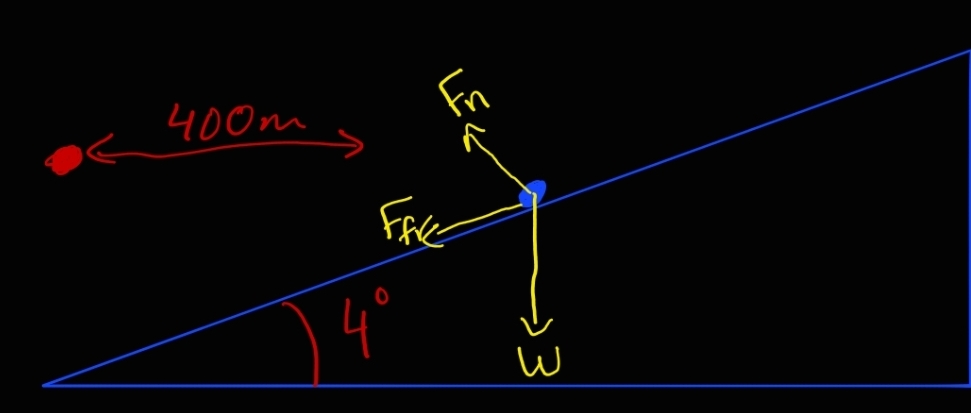
Now, let's draw a horizontal line that goes through the center of mass:
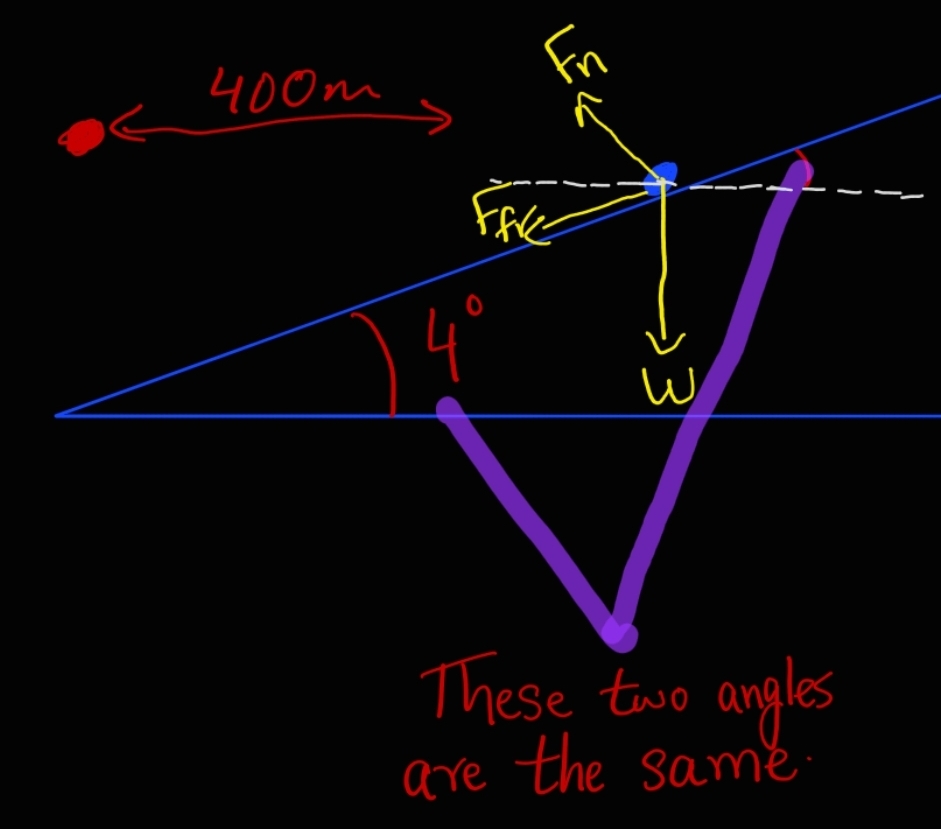
Now, let's clean up to find the other needed angles:
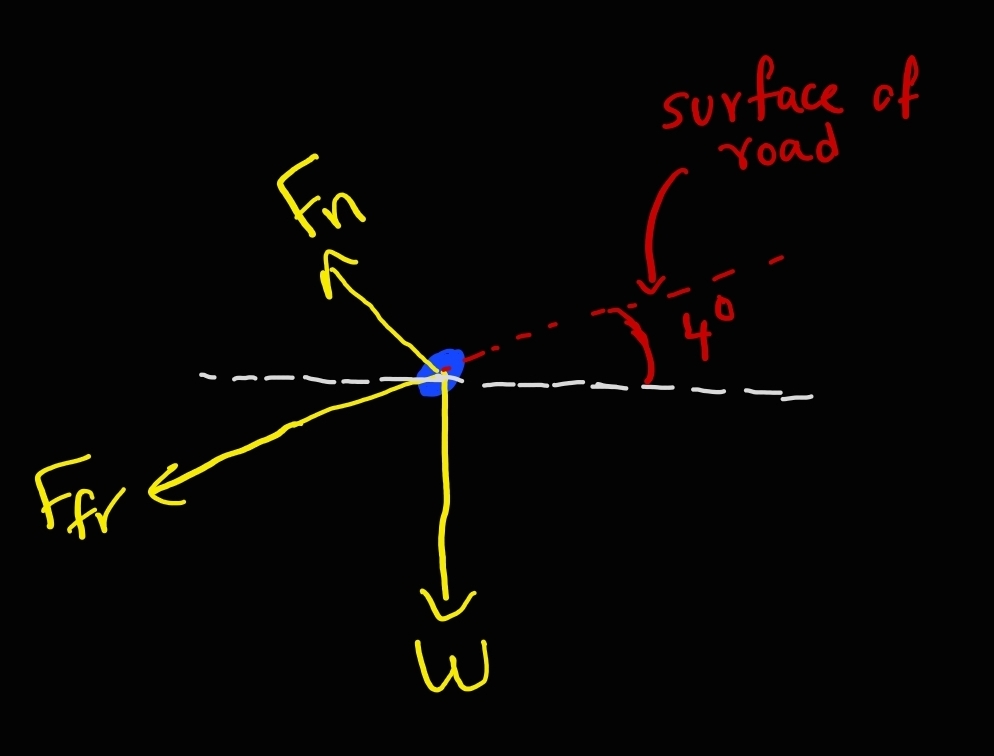
Let's start with the normal force. We know that it is perpendicular to the surface of the road. So the angle between the normal force and the surface of the road must be 90 degrees.
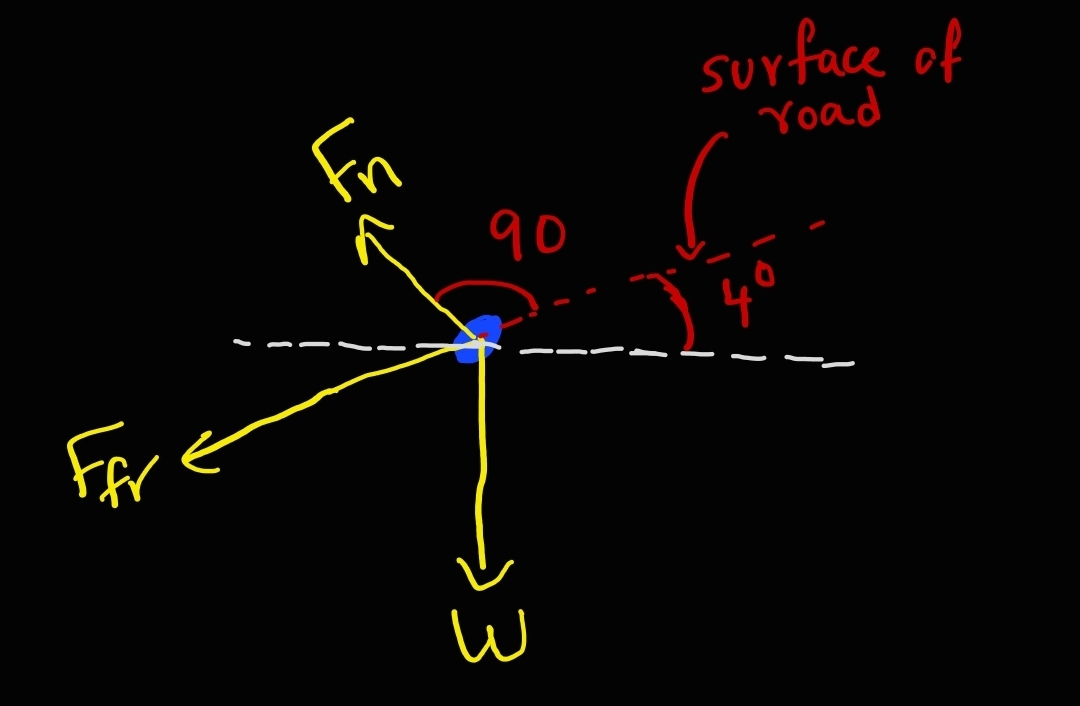
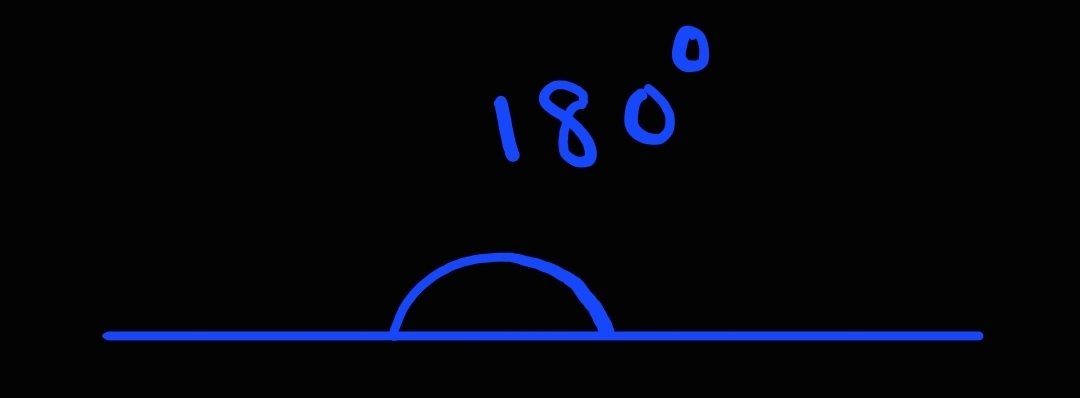
Now, look at the white horizontal line. We know that a straight flat line has an angle of 180 (look at the image below if you don't understand):
Hence, we need to find the purple shaded area in this image:
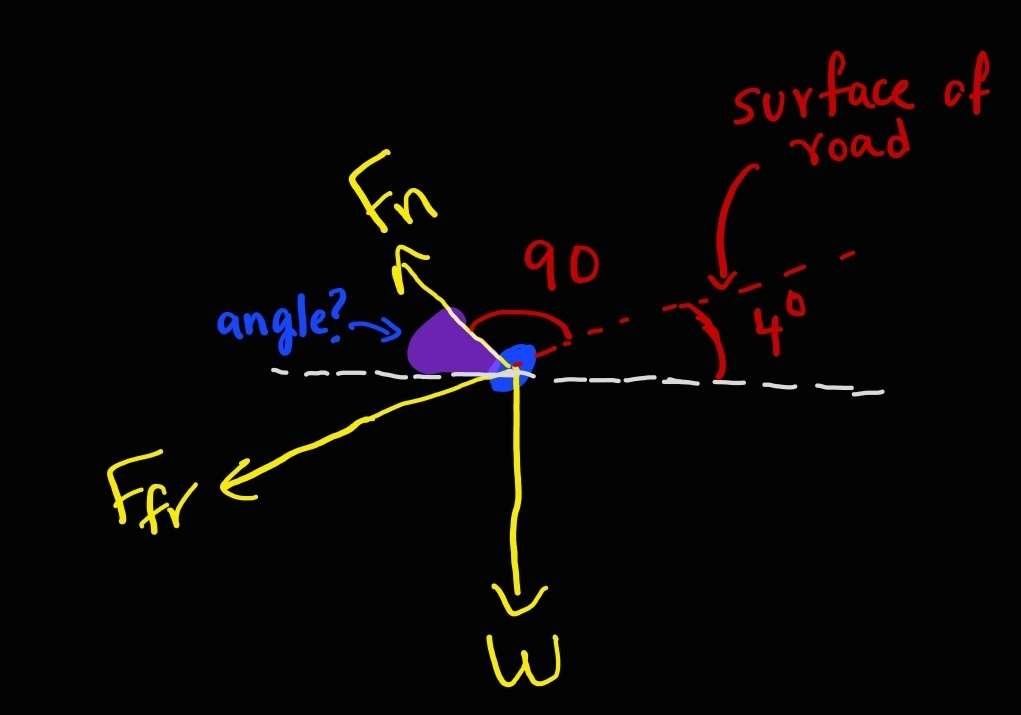
Well, the white horizontal line must have a total angle of 180. It seems that it is broken down into 3 parts: $180=\text{purple angle}+90+4$
Move everything to the other side to find the purple angle:
$180-90-4=86$ degrees
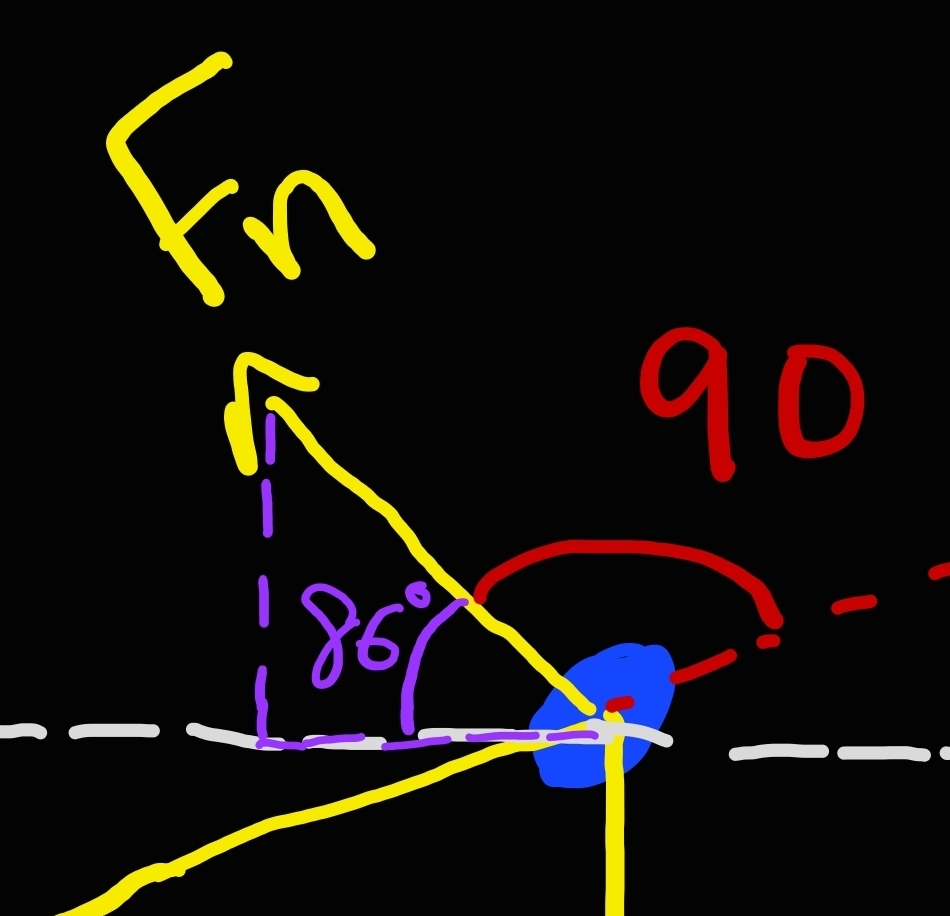
We can finally break down the normal force using SOH CAH TOA!
- The y component will be $F_n\sin 86$
- The x component will be $F_n\cos 86$
We can do the same trick to find the angle for the friction force. Do you see how the friction force is making a straight line with the surface of the road? Well, that straight line must also have an angle of 180 degrees, and it seems like it is broken into 3 parts, as shown in the image below:
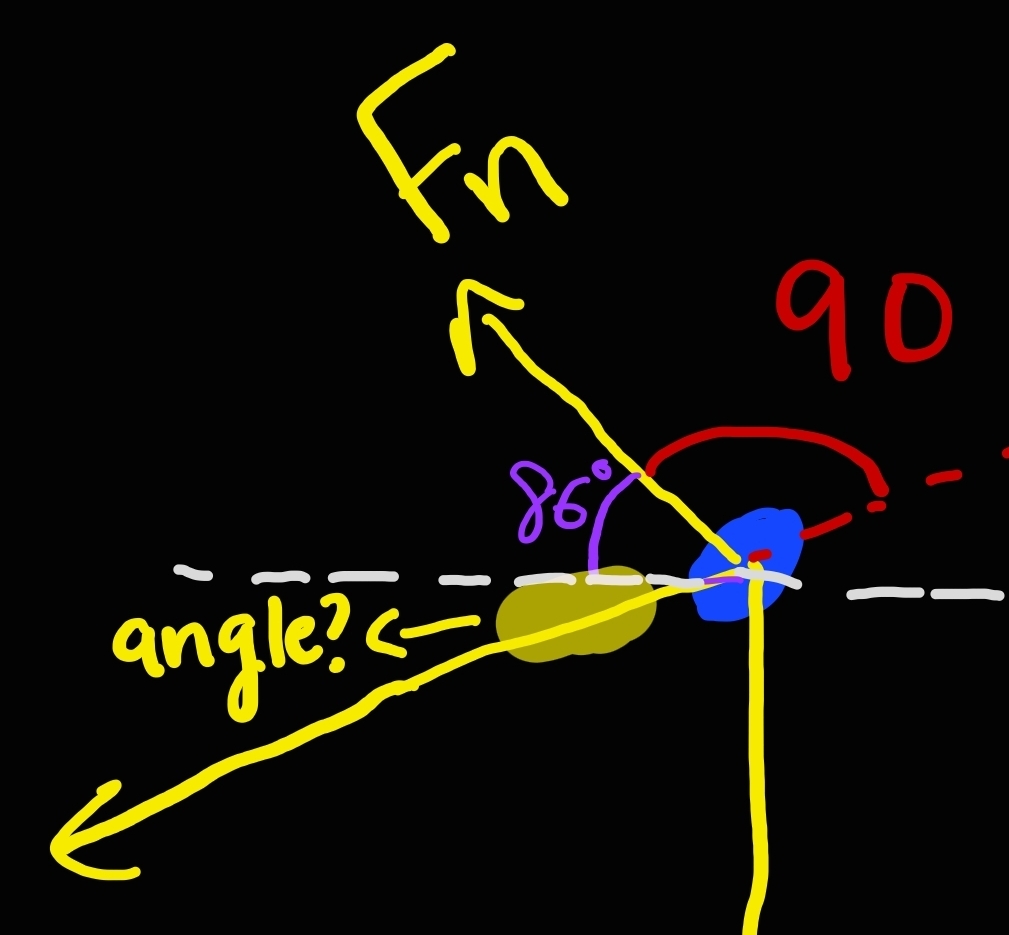
Let's find the yellow angle.
$180=\text{yellow angle}+86+90$
$180-86-90=\text{yellow angle}=4$ degrees
So here is our triangle.
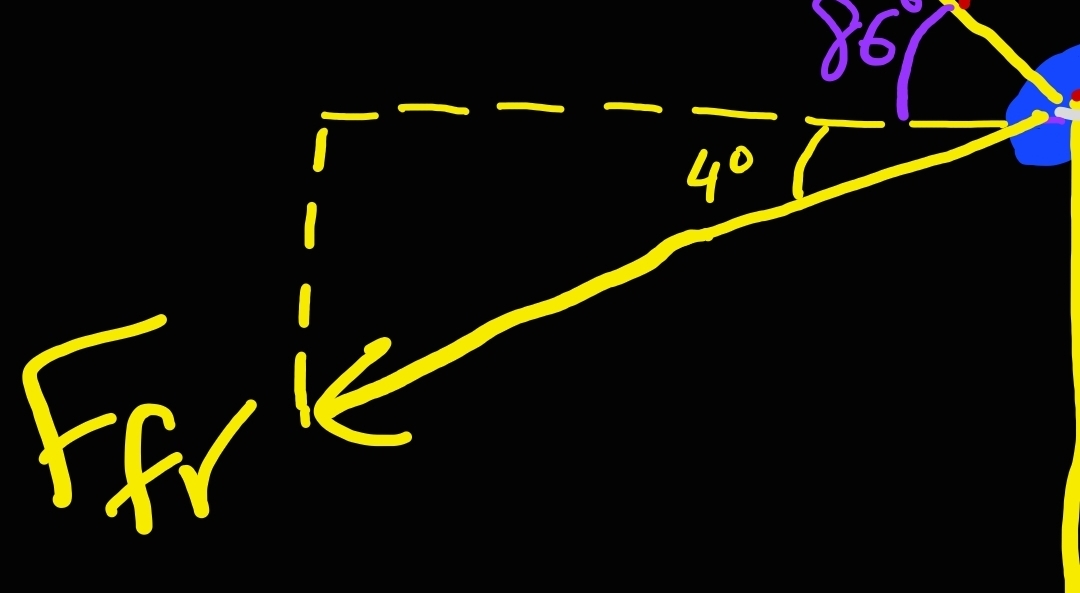
Let's find the components:
- The y component will be $F_{fr}\sin 4$
- The x component will be $F_{fr}\cos 4$
We finally broke down everything. Observe our new free body diagram next to our original diagram:
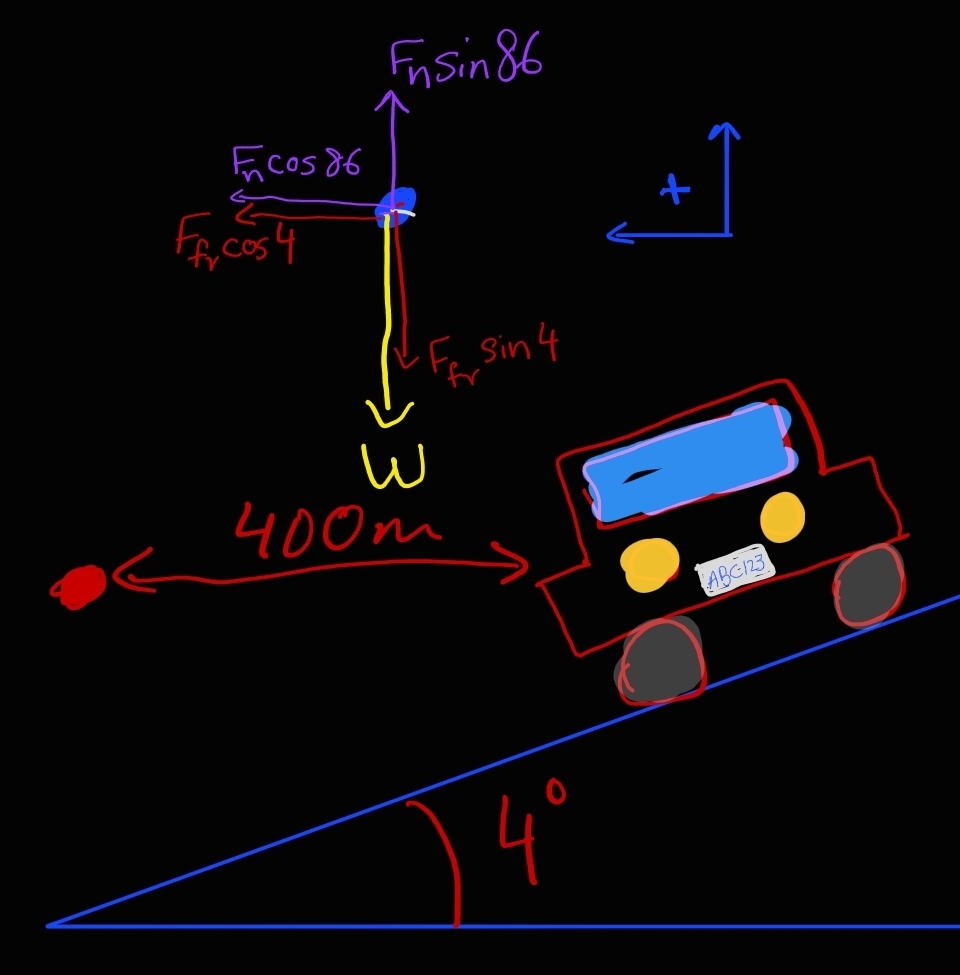
Let's now do some force analysis:
- In the y-axis.
We know that the car won't be flying up or breaking through the floor, so there must be no acceleration in the y-axis $F_y=0$
So,
$F_n\sin 86-W-F_{fr}\sin 4=0$
$F_n\sin 86-mg-\mu F_n\sin 4=0$ (input formula for weight and friction)
$F_n\sin 86-\mu F_n\sin 4=mg$
$F_n(\sin 86-\mu\sin 4)=mg$ (factor $F_n$)
$F_n=\frac{mg}{\sin 86-\mu\sin 4}=\frac{150 \cdot 9.8}{\sin 86-0.1 \cdot \sin 4}=1484 N$ - x-axis, with centripetal forces.
Notice that both components of friction and normal force are pointing towards our center, hence $F_c=F_n\cos 86+F_{fr}\cos 4=ma_c$
Let's input the formula for friction and centripetal acceleration in our equation:
$F_n\cos 86+\mu F_n\cos 4=m \cdot \frac{v^2}{R}$
Let's separate $v^2$:
$v^2=\frac{R(F_n\cos 86+\mu F_n\cos 4)}{m}$
Let's input our known values:
$v^2=\frac{400(1484\cos 86+0.1 \cdot 1484 \cdot \cos 4)}{150}=670.8 m²/s²$
$v=\sqrt{670.8}=25.9 m/s$ (this is equal to around 57 mph)
We found our maximum velocity, so we are done!
This question feels very long just because it has a ton of pictures. Hopefully they helped you though. Yes, there is a way to solve this question without knowing the mass of the car, I recommend you try to play with the algebra and figure it out. And yes, there were multiple ways to figure out the angles for your forces, I just picked what I thought was simplest to explain.
This is basically the core of centripetal forces. Here are some final tips:
- Never draw a "$F_c$" force on your free body diagram. $F_c$ is a title that you give once to your forces and then the symbol $F_c$ disappears completely. You barely saw it in my previous examples.
- Ask yourself: "What force is going directly towards or away from the centre?"
- You can sometimes break down forces and use their components in your $F_c$.
- The question may sometimes ask you for "minimum velocity" or "maximum velocity," you should know the difference.
Energy
Energy analysis is another useful way to solve problems. In fact, it can be a faster (and hopefully easier) way to solve ramp problems!
Work
Work is measured in Energy, and the unit of energy is Joules $J$. Formula: $F_{parallel} \cdot \text{distance}$ (this is the formula for a constant force, more on this later). Notice that work requires a force being applied on an object over some distance AND the force must be parallel to the direction the object is moving in. If your force is perpendicular to the direction of motion, it will not do any work.
To solve any problem related to energy, you must know that energy is conserved. Which means:
Energy you start with = Energy you end with + energy you lose
Or more commonly seen as:
$E_{initial}=E_{final}$
Energy likes to switch between different forms. After I show you the typical types of energy, this should make more sense.
Mechanical Energy
This energy is broken down into 2 types —
- Kinetic energy —
This energy is related to the speed of the moving object and it doesn't care about direction. The faster the object is, the more kinetic energy it has. The formula for kinetic energy is $\frac{1}{2}mv^2$ (hopefully you can see why it doesn't care about direction: the velocity is squared, which means it doesn't differentiate between $+$ and $-$ signs) - Potential energy —
Potential energy encompasses several types of energy, but the main ones are:- Gravitational potential energy: you can think of this as the likelihood of an object to fall. Formula: $mgh$, where $m$ is the mass in $kg$, $g$ is gravity, $h$ is height relative to a reference point in meters.
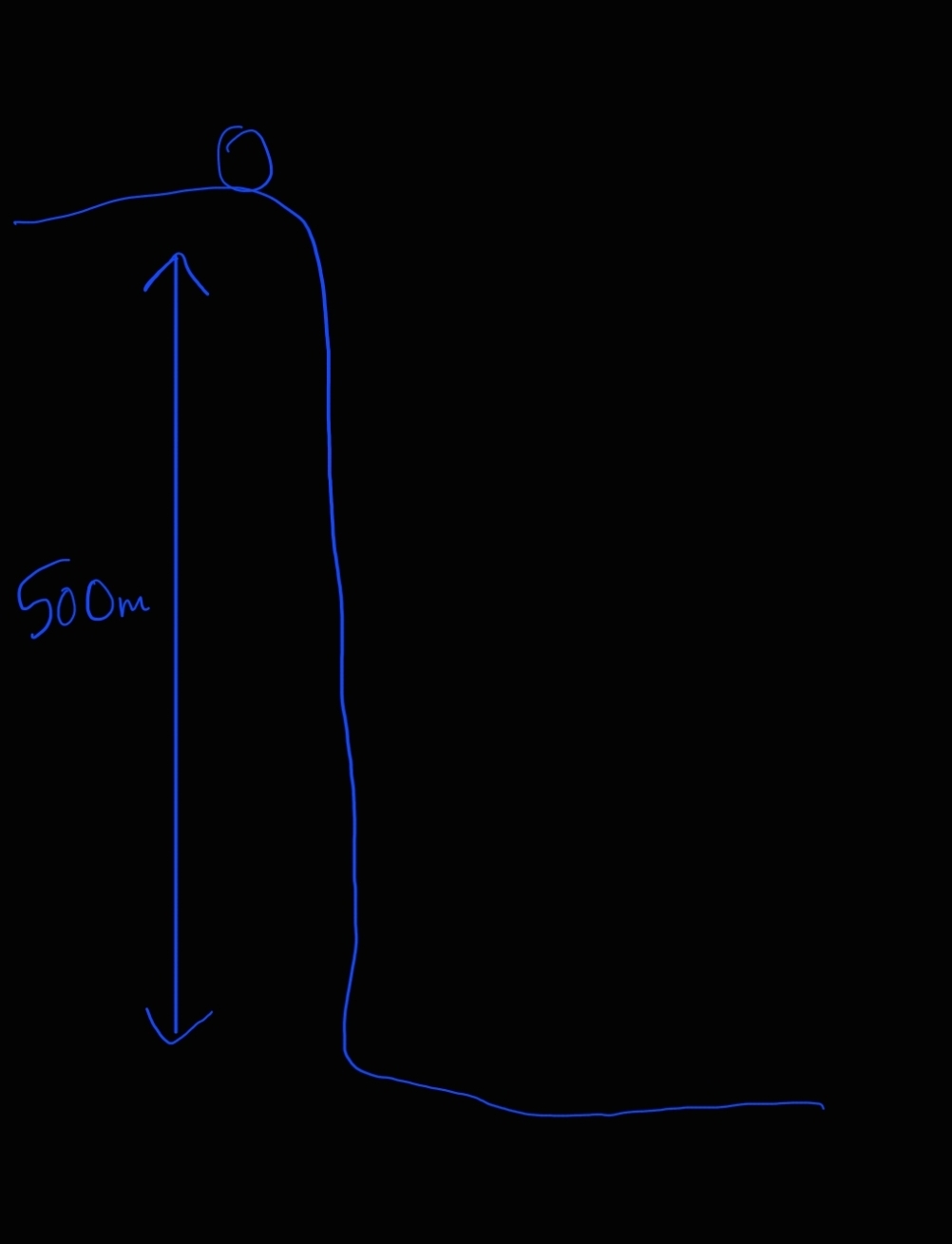
I want to stress about $h$ being relative to something. For example, if your object is about to fall from a cliff that is $500$ meters high:
Then you have to decide where is $h=0$ and where your object is relative to that point. Generally (although not a requirement and definitely not a strict rule), I like to make the lowest point $h=0$. Hence, the ball would be $500$ meters above my reference, since I would make the ground my reference. - Spring Potential Energy: think of this as the "desire" of the spring to compress or decompress. Formula: $\frac{1}{2}kx^2$ where $k$ is the spring constant and $x$ is the displacement of the spring. If your object is sitting next to a compressed spring, then the spring will want to give its potential energy to your object.
- Gravitational potential energy: you can think of this as the likelihood of an object to fall. Formula: $mgh$, where $m$ is the mass in $kg$, $g$ is gravity, $h$ is height relative to a reference point in meters.
- Lost energy —
This isn't really a type of energy, but I believe it's something important to mention. There are some forces (most common: friction) that take away from your object's energy. These forces are called non-conservative forces.
For example, let's say your object started with $100J$ of energy, and it moved on a surface with friction. Friction caused your object to lose $10J$ of energy. Your object now has $90J$ of energy. If your object wanted to go on another journey, its starting energy would be $90J$.
It doesn't mean that energy was destroyed, it just became something that your object doesn't contain (for example, it became heat lost to the surroundings. The surroundings gained your lost energy).
Now that I have introduced the basics of energy, let's try a standard ramp problem.
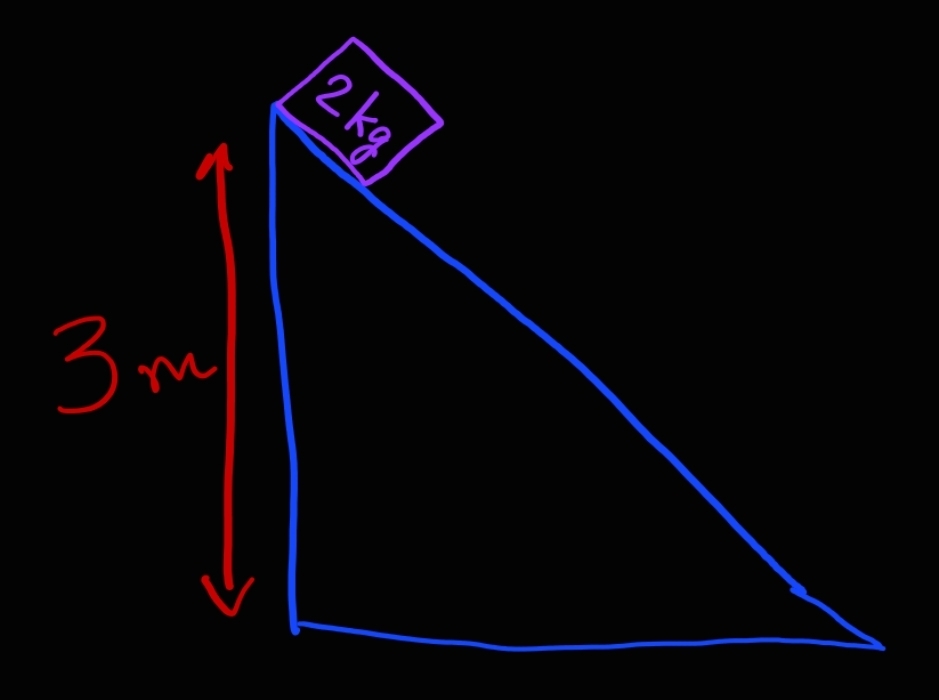
Question: What's the velocity of a $2kg$ block after it reaches the bottom of the frictionless ramp (the block starts from rest)?
 ▼
▼
Notice that I didn't give you the angle of the ramp. This means that the answer will be the same regardless of how steep that ramp is. The angle of the ramp is important usually when you have friction. The next practice problem will utilize the angle of the ramp.
Now, to solve such questions you need to ask yourself:
- Do we need to break down our problem into parts? Note: if yes, you will have to repeat the following questions for each part, since each part is its own separate journey. You usually want to break your problem into parts if there is something tricky or you have a non-conservative force like friction somewhere.
- What type of energy do I have before I start my journey? How much (just understand what to put in your formula. Numerical values can be done in the last step)?
- Is there anything that may make me lose energy? How much?
- What type of energy will I have after I end my journey? How much (make initial = final + losses)?
Let's start solving:
- Do we need to break down our problem into parts?
This is recommended when you have something that makes you lose energy or when there's something overly tricky. Since we don't have anything here, we can move on. - What type of energy do I have before I start my journey?
Well, the block wasn't moving before we started, so it can't have any kinetic energy (velocity was zero). There are also no springs, so we don't need to think of spring potential energy. But, our object seems quite elevated. So it must have gravitational potential energy. How much? Well, the formula is: $mgh$, and the block was $3$ meters high. - Is there anything that may make me lose energy? How much?
Nope. There is no friction or anything that may take our energy. Let's continue. - What type of energy will I have after I end my journey? How much?
Well, there's definitely still no springs, so we don't care about that. Also, the block is no longer elevated, so it can't have gravitational potential energy. But the block is certainly moving. So it must have kinetic energy ($\frac{1}{2}mv^2$)
We are ready to make our $E_{initial}=E_{final}$
$mgh=\frac{1}{2}mv^2$ (notice that I can cancel the mass of the block. This means that it doesn't matter if the block is $2kg$ or $100kg$)
$gh=\frac{1}{2}v^2$
$2gh=v^2$
$v=\sqrt{2gh}=\sqrt{2 \cdot 9.8 \cdot 3}=7.7 m/s$
We found the speed of the block, so we finished the question!
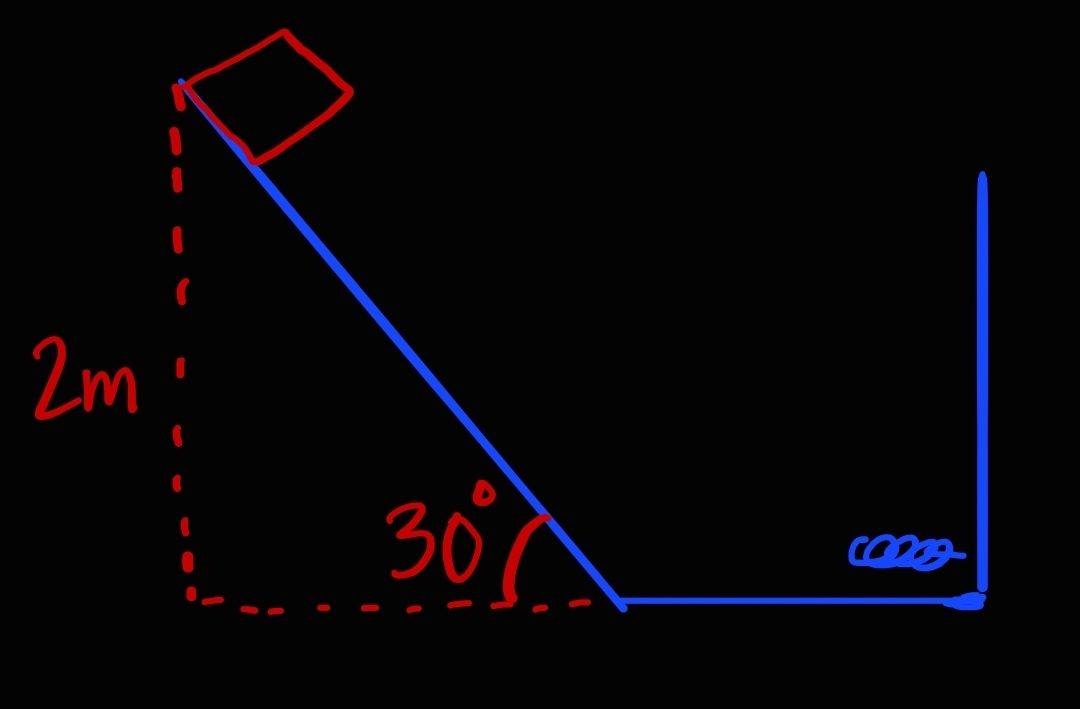
Question: A $1.5 kg$ block begins to slide from rest on a ramp with friction (kinetic friction coefficient is 0.1) and compresses a spring at the bottom (only the ramp surface has friction. No other surface has friction). How much will the spring be compressed? The spring coefficient is $5 N/m$.
 ▼
▼
We will ask ourselves the same questions:
- Do we need to break down our problem into parts? Note: if yes, you will have to repeat the following questions for each part, since each part is its own separate journey. You usually want to break your problem into parts if there is something tricky or you have a non-conservative force like friction somewhere.
- What type of energy do I have before I start my journey? How much (just understand what to put in your formula. Numerical values can be done in the last step)?
- Is there anything that may make me lose energy? How much?
- What type of energy will I have after I end my journey? How much (make initial = final + losses)?
Let's answer each question:
- Do we need to break down our problem into parts?
It is completely possible (and some may consider it easier) to solve this problem without breaking it down into parts. I want to break it down so that you have some practice.
Since we have friction, it is best to break our problem into parts. Here is how I will break it:
Part A: Block is on the ramp
Part B: Block is off the ramp and going towards the spring.
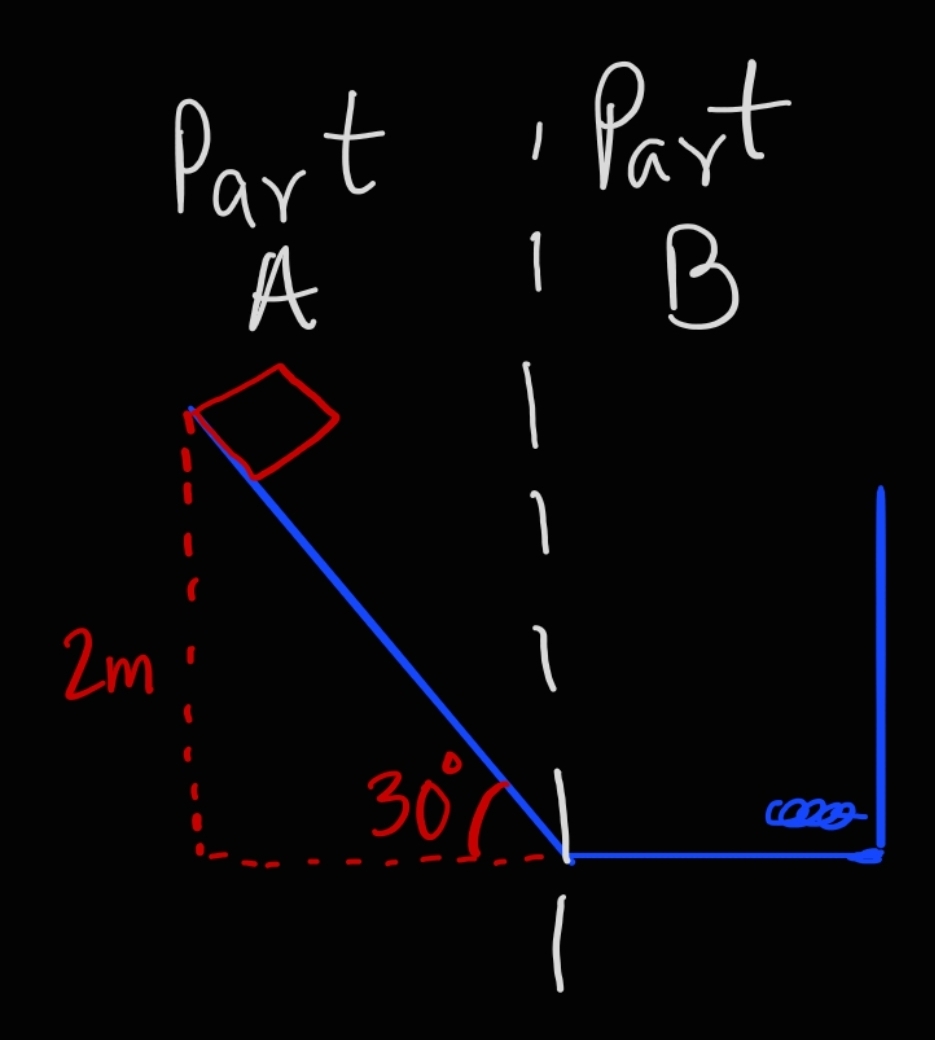
I like to give friction its own journey because students typically 1) forget to include it in their $E_{initial}=E_{final}$ or 2) they include it more than once (which is wrong).
Lastly, there aren't really any strict guidelines regarding how you want to break down your problem. What's important is that you understand what type of energy you start with and what type of energy you end with, in addition to energy you may have lost.
Now, since we have 2 parts, we will have to run through our 3 questions twice.
PART A
- What type of energy do I have before I start my journey? How much (just understand what to put in your formula. Numerical values can be done in the last step)?
The question says the block starts from rest, so it will not have any kinetic energy. If we let our starting $h=0$ be at the bottom of the ramp, then the block must start with some gravitational potential energy. At the top, $h=2$. So our initial/beginning energy is $mgh$ (I advise you to input the numerical values in the end). - Is there anything that may make me lose energy? How much?
There is friction on the ramp, and friction causes us to lose energy. We need to find the work done by friction $W=Fd$. We need to find the force of friction and the distance the block travelled while it was on the ramp.
Let's start with the frictional force $F_{friction}=\mu \cdot F_n$. Hopefully you remember that our normal force is $mg\cos\theta$, so our frictional force is $F_{friction}=\mu \cdot mg\cos\theta$.
Now, we need to find the distance the block travelled. This means that we need to find the length of the ramp. Hopefully you can see that we have a right triangle.
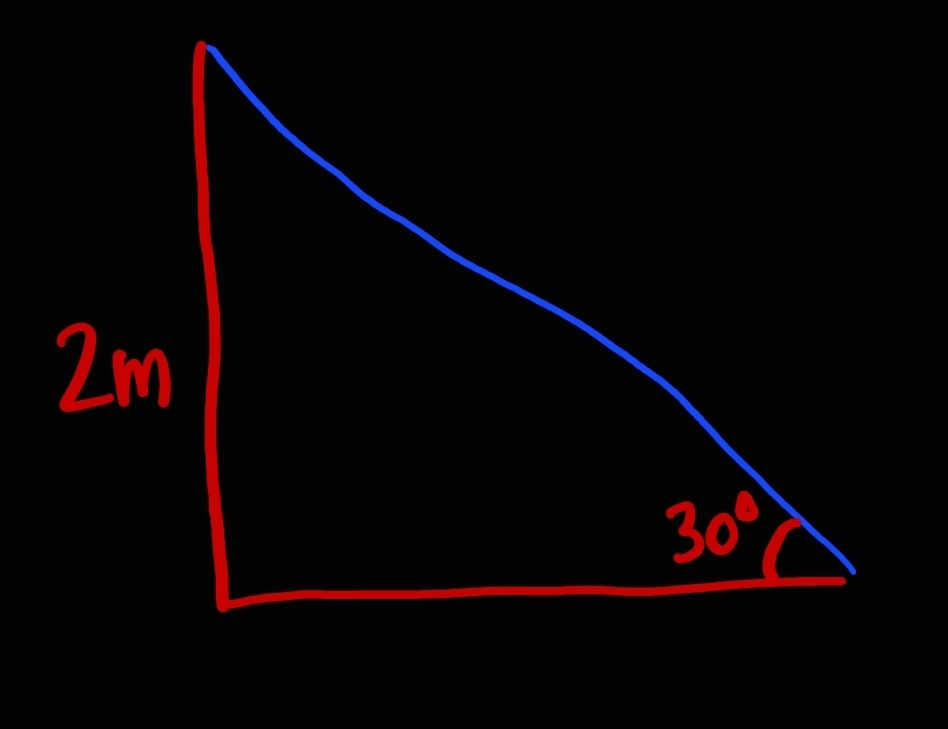
The blue part (the length of the ramp) is the hypotenuse of this triangle. Moreover, the height of the ramp is opposite to our angle, so we can use SOH (from SOH CAH TOA) to find the length of the hypotenuse:
$\sin\theta = \frac{opp}{hyp}$
$\sin\theta \cdot hyp=opp$
$hyp=\frac{opp}{\sin\theta}$ (You can remember this formula if you wish so that you don't need to derive it every time).
Hence, the distance travelled is $\frac{opp}{\sin\theta}$.
So the total work done by friction is $W=\mu \cdot mg\cos\theta \cot \frac{opp}{\sin\theta}$. - What type of energy will I have after I end my journey? How much (make initial = final + losses)?
At the end of the ramp, the block will have kinetic energy (because it is moving) and no gravitational potential energy. Hence the energy it ends with is $KE=\frac{1}{2}mv^2$.
We are now ready to do (for part A)
Energy you start with = Energy you end with + energy you lose
$$mgh=\frac{1}{2}mv^2+\mu \cdot mg\cos\theta \cdot \frac{opp}{\sin\theta}$$(notice that we can cancel $m$ from both sides)
$$gh=\frac{1}{2}v^2+\mu \cdot g\cos\theta \cdot \frac{opp}{\sin\theta}$$(I'm trying to solve for velocity so that I can use it for part B)
$$gh-\mu \cdot g\cos\theta \cdot \frac{opp}{\sin\theta}=\frac{1}{2}v^2$$ $$v^2=2\left(gh-\mu \cdot g\cos\theta \cdot \frac{opp}{\sin\theta}\right)$$ $$v=\sqrt{2\left(gh-\mu \cdot g\cos\theta \cdot \frac{opp}{\sin\theta}\right)}$$ $$v=\sqrt{2\left(9.8 \cdot 2-0.1 \cdot 9.8 \cdot \cos 30 \cdot \frac{2}{\sin 30}\right)}=5.69 \text{ m/s}$$This is not the answer to the question, but we will need this value in the next part.
PART B
Let's run through the questions 1 more time.
- What type of energy do I have before I start my journey? How much (just understand what to put in your formula. Numerical values can be done in the last step)?
Now, the block is off the ramp, so it will have no gravitational potential energy. However, the block is moving, so it will have some kinetic energy $\frac{1}{2}mv^2$ (the $v$ is the same $v$ we calculated in part A). That is the only type of energy it will have.
Notice that I'm not including the work done by friction, because that is lost energy, not something the block can possess. (this is the mistake many students make, they include the work done by friction over here). - Is there anything that may make me lose energy? How much?
Nope. There is no friction or anything that may take our energy. Let's continue. - What type of energy will I have after I end my journey? How much (make initial = final + losses)?
The block will compress the spring as much as possible, so all its kinetic energy will be converted to spring potential energy $\frac{1}{2}kx^2$.
We are now ready to use $E_{initial}=E_{final}$
$\frac{1}{2}mv^2=\frac{1}{2}kx^2$ (notice that we can cancel the $\frac{1}{2}$ from both sides)
$mv^2=kx^2$ (Let's solve for $x$)
$x^2=\frac{mv^2}{k}$
$x=\sqrt{\frac{mv^2}{k}}$ (now input the values)
$x=\sqrt{\frac{1.5 \cdot 5.69^2}{5}}=3.12$ m
We found our answer!
I recommend trying to solve this problem without breaking it down into parts.
More regarding work and energy: I mentioned that $W=Fd$ is true when the force is constant. What do you do if it isn't? Well, you have 2 options, depending on your knowledge.
- $W=\int_0^d F \ dx$.
You will be given a function for $F$, if you integrate that function (calculus knowledge) using a definite integral that goes over your covered distance, you will get the work done. - Graphical approach (may still require calculus)
You will be given a graph of Force vs. position. You should find the area under the graph (same way you found the area under the graph in kinematics).
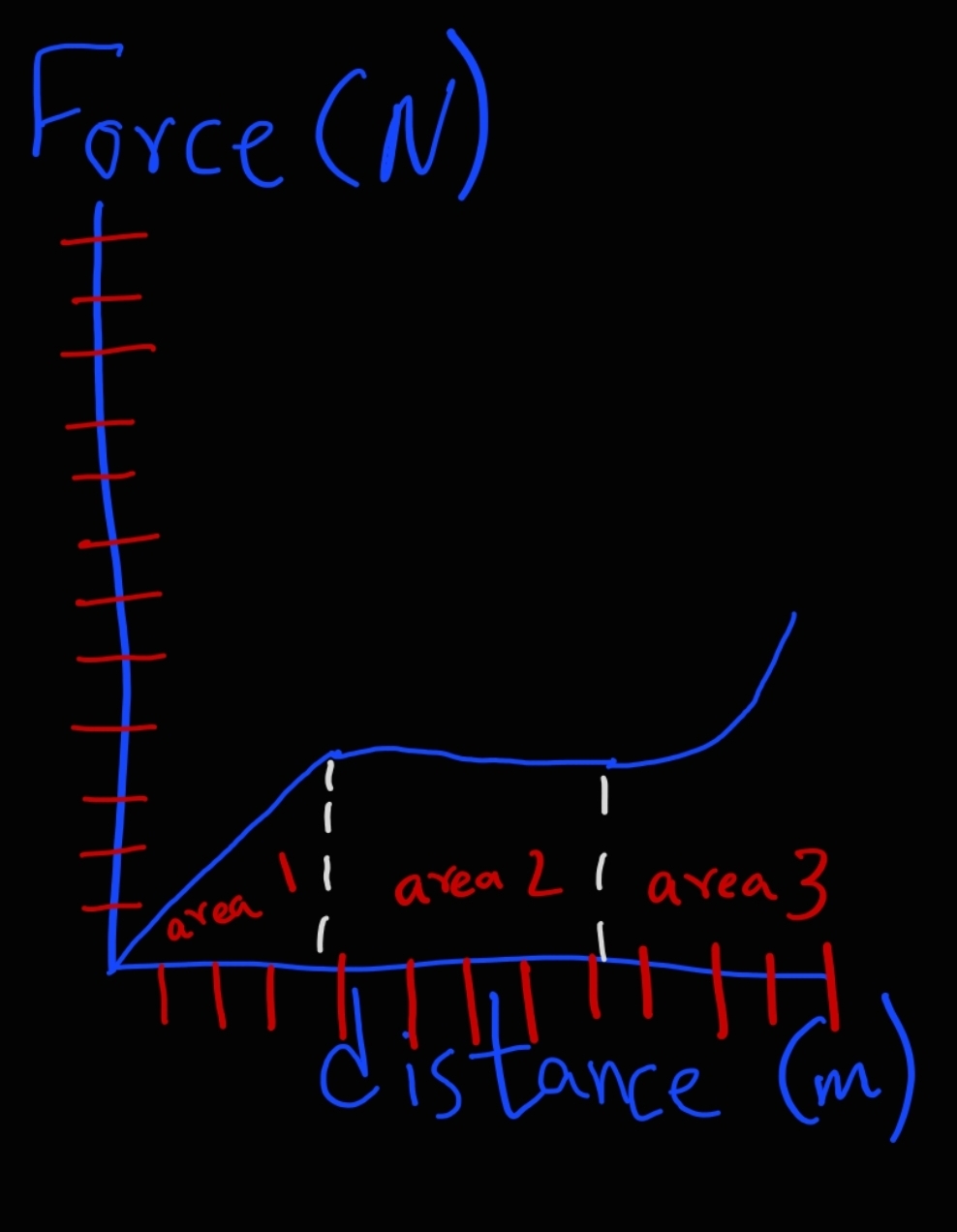
Power
How fast you are doing work. Formula: $\frac{W}{time}$ Units: $J/s$ (joules per second).
If you are doing $1000 J$ in $5$ seconds, then your power is $\frac{1000}{5}=200 J/s$.
Note:
- Power is also the gradient/slope of a Work vs time graph. You can find the slope the same way you found it in kinematics.
- In a Power vs. time graph (which is different from a Work vs time graph), the area under the graph is Work.