Chemistry
These notes were made by KEMO to help his members on the STEM Help! Discord server. If you wish to join, here is the server invite: https://discord.gg/f2V6GUwE2V
This will be the start of my Chemistry notes. I will try to cover all the necessary topics that a person may encounter throughout the beginning of his academic journey. I used the IGCSE 0620 Chemistry syllabus as inspiration for what to cover, although I will eventually add more advanced topics.
Introduction
Everything around you is made from atoms. This includes the food you eat, the water you drink, the phone you use, and even yourself. In chemistry, you will study how these atoms interact with each other and with the environment.
What does an atom contain? An atom contains protons, neutrons, and electrons and all of them have different properties and are found in different places in the atom.
Location of protons, neutrons, and electrons
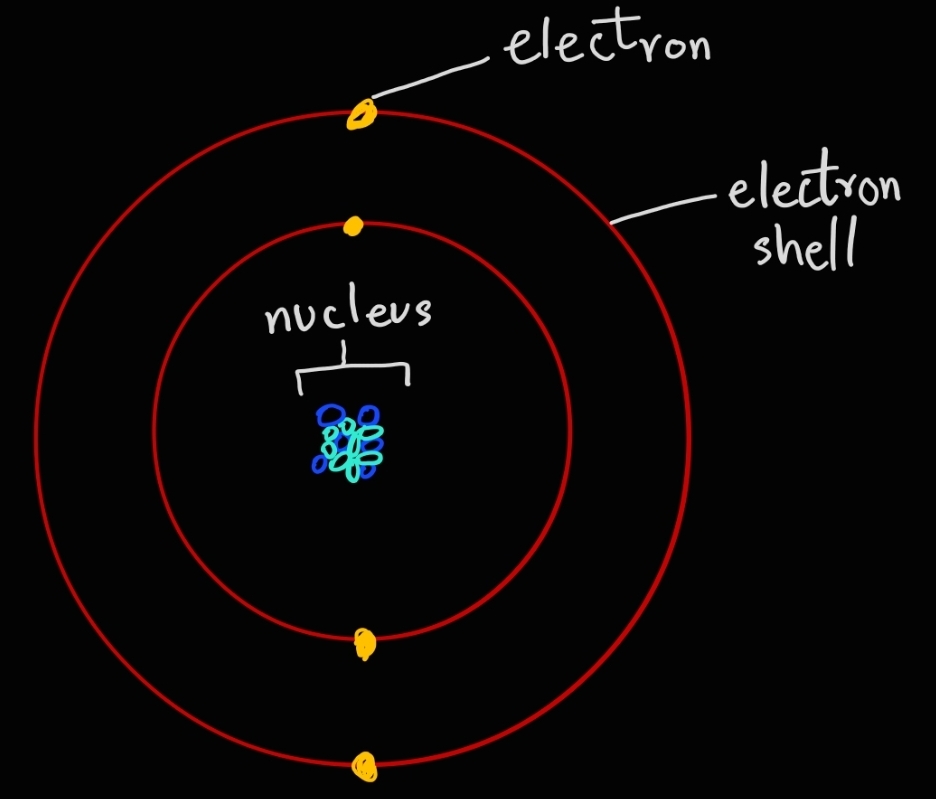
- Protons and neutrons are found in the center of the atom, in a place called the "nucleus".
- Electrons are found around the nucleus and in their own "electron shells".
Properties of protons, neutrons, and electrons
- Protons - They have a positive charge (+) and an amu mass (basically some arbitrary mass measurement unit, same way you can measure mass in kilograms, grams, pounds, etc.) of 1.
- Neutrons - They have a neutral charge (not plus or minus) and an amu mass of 1.
- Electrons - They have a negative charge (-) and an amu mass of 11840 (way smaller than the mass of neutrons or protons)
Atomic number
Are all atoms the same? Nope. To help you understand, I will give you an example. Imagine there is a company with 100 different roles (for example, janitors, managers, doctors, lawyers, teachers, etc.). In order to differentiate between each role, the company creates a unique ID number that identifies each role (for example, janitors get the ID number 001, managers get 002, and so on). A similar concept is found in atoms.
The unique ID system for atoms is based on how many protons they have. For example,
- If an atom has 1 proton, then it must be a hydrogen atom.
- If an atom has 2 protons, then it must be a helium atom.
- If an atom has 3 protons, then it must be a lithium atom.
- If an atom has 8 protons, then it must be an oxygen atom.
When I gave the example of the company, I said that the ID is used to differentiate between "roles." Well, in the atomic world, the "ID" (or the number of protons) tells us which element an atom belongs to. To help give you a clearer idea, let's return to the example of the company with the 100 different job roles.
Every job role will obviously have several workers doing it. For example, the company may have 56 employees working as janitors. Think of each worker as an individual atom. Workers with the same role (e.g. janitors) are like atoms of the same element.
For example, water is made up of 2 hydrogen atoms and 1 oxygen atom. Hence, we can say that water contains 3 atoms in total (2 hydrogen atoms and 1 oxygen atom), but only 2 different elements: hydrogen and oxygen.
You should now be aware of this term (you may see it often):
Atomic number: How many protons an atom has.
Here's a practice question:
You are inspecting 2 atoms. You realize that one atom has an atomic number of 6 and the other atom has an atomic number of 11. Do these 2 atoms belong to the same element group? ▼
Answer: Nope. This is because they have different atomic numbers. Only atoms with the same atomic number belong to the same element group.
Nucleon number and Isotopes:
If 2 atoms have the same atomic number, does it mean that they are absolutely the same in everything? Nope.
For example, Helium atoms are always made up of 2 protons. However, in nature, you can find some Helium atoms with 1 neutron and find others with 2 neutrons. This means that they have different total masses (remember, both protons and neutrons have a mass of 1 amu).
The helium atom with 1 neutron would have a total mass of 2 × 1 amu + 1 amu = 3 amu (2 protons = 2 amu, 1 neutron = 1 amu) while the helium atom with 2 neutrons would have 2×1+2×1=4 amu. In other words, they have different nucleon numbersNucleon numberThe total mass of the atom. Obtained by adding the mass of the protons present and the mass of the neutrons present..
What do we call 2 atoms with the same atomic number (i.e. being from the same element group) but different nucleon numbers (i.e. having different neutron numbers)? We can them isotopesIsotopesatoms with the same atomic number but different nucleon number. The different nucleon number is resulting from them having a different number of neutrons..
You should be able to go back and forth between these 3 things: the atomic number, nucleon number, and the neutron number. If you were given 2 of them, you should be able to calculate the third one. I will give you 3 examples.
Question 1: An element has 15 neutrons and a nucleon number of 35. What is the element's atomic number? ▼
Answer: I recommend you list out what you have and what you are looking for:
- Atomic number: ?
- Neutron number: 15.
- Nucleon number: 35.
Then, just quickly recall the definition of each term.
- Atomic number: Number of protons.
- Neutron number: Number of neutrons.
- Nucleon number: Number of protons + number of neutrons
Or
Nucleon number: Atomic number + Neutron number.
So, we can plug in the numbers into the equation of the nucleon number.
Nucleon number = Atomic number + Neutron number.
35=x+15
35-15=x
20=x
The atomic number of the element is 20.
Question 2: An atom has an atomic number of 20 and 25 neutrons. What is the nucleon number of the atom? ▼
Answer: As usual, list out what we know and what we don't know.
- Atomic number: 20
- Neutron number: 25
- Nucleon number: ?
Quickly recall your definitions:
- Atomic number: Number of protons.
- Neutron number: Number of neutrons.
- Nucleon number: Number of protons + number of neutrons
Or
Nucleon number: Atomic number + Neutron number.
Input what you know into the formula of the nucleon number.
Nucleon number: Atomic number + Neutron number.
Nucleon number =20+25=45
Question 3: An atom has 7 protons and a nucleon number of 13. How many neutrons does it have? ▼
Answer: List out what you know and what you don't know.
- Atomic number: 7
- Neutron number: ?
- Nucleon number: 13
Now the definitions,
- Atomic number: Number of protons.
- Neutron number: Number of neutrons.
- Nucleon number: Number of protons + number of neutrons
Or
Nucleon number: Atomic number + Neutron number.
Now use the nucleon number formula to figure out the answer.
Nucleon number: Atomic number + Neutron number.
13=7+x
13-7=x
6=x
Ions
Can atoms gain or lose electrons? Yes! If an atom gains or loses electrons, we call it an "ionIonAn atom that has lost or gained one or more electron(s).."
If an atom gains an electron, it becomes a negatively charged ion, also known as an anion. If an atom loses an electron, it becomes a positively charged ion, also known as a cation (I know, it is a bit counterintuitive that gaining is associated with being negative).
Keep in mind: Protons are positively charged and electrons are negatively charged. Technically speaking, it is only correct to say the term "atom" when the particle has "proton number = electron number," and atoms will always have a neutral charge (the positive charge from the protons will cancel with the negative charge of the electrons). If the proton number is not equal to the electron number, it is officially an ion.
Let's have some practice calculating the charge of some ions.
Question 1: An ion has 5 protons, 6 neutrons, and 3 electrons. What is the charge of the ion? ▼
Answer: We don't really need the number of neutrons to answer this question, since neutrons don't have a charge. We only need the number of protons and electrons.
- 5 protons will give us a charge of +5.
- 3 electrons will give us a charge of -3.
- Hence, +5-3=+2. The ion has a charge of +2.
Question 2: An ion has an electron number of 18 and an atomic number of 15. What is the charge of the ion? ▼
- 18 electrons will give us a charge of -18.
- The atomic number is the same thing as the proton number. Therefore, the ion has 15 protons, giving us a charge of +15
- Hence, +15-18=-3. The ion has a charge of -3.
Electron shells
Electron shells are a huge deal in chemistry courses. So, it is necessary to be comfortable with the foundations before we move on.
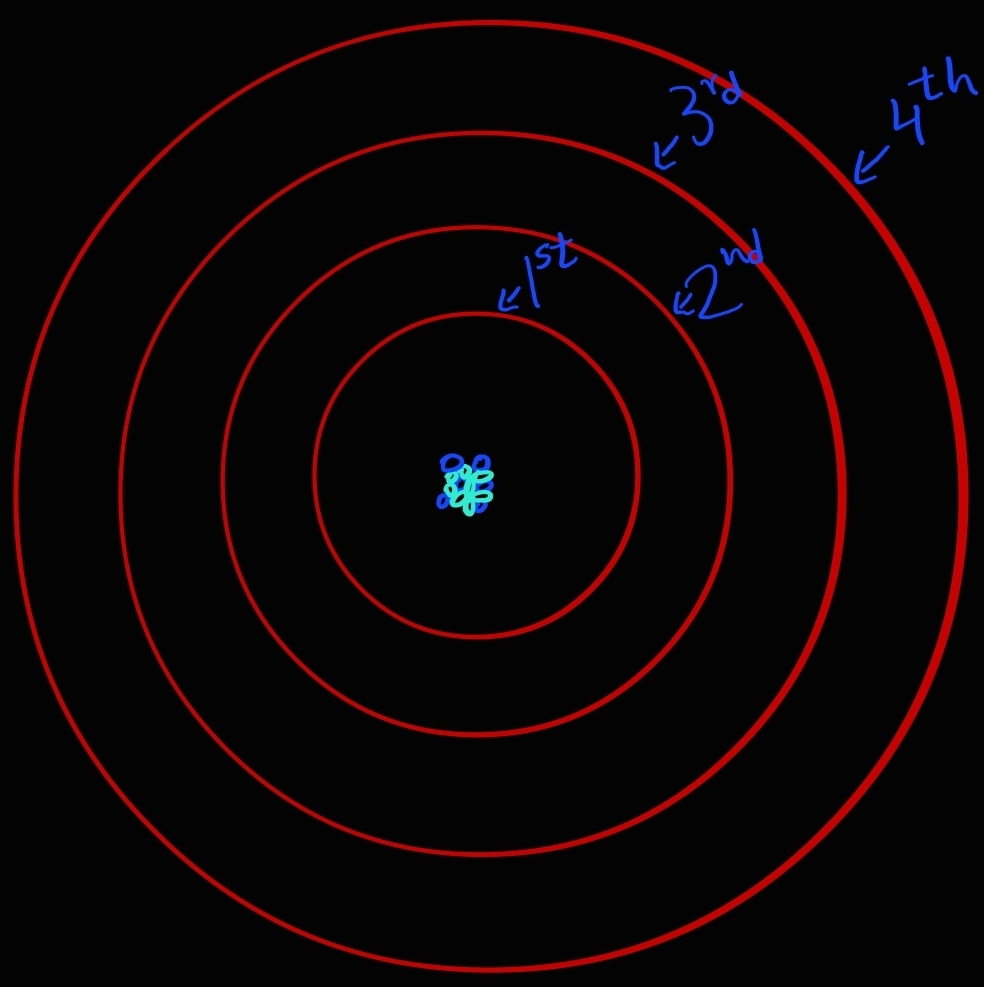
As we said previously, electrons are found in electron shells. But how many electrons can be found in each shell? Well, for now, we only care about the first 4 shells surrounding the nucleus, and up to an atomic number of 20 (so the elements-of-interest right now are from hydrogen to calcium).
As you can see, you start moving the shells from the inner-most to the outer-most shell.
- The first shell can hold up to 2 electrons.
- The second and third shells can hold up to 8 electrons.
- Since we are stopping at calcium (atomic number 20), the fourth electron shell can hold up to 2 electrons (if you go on further to bigger elements, you will find that the fourth shell can hold more electrons, but things do get messy).
Lastly, the amount of electrons in the outermost shell is referred to as "valence electronsValence electronsthe number of electrons in the outermost shell.".
Electron configuration (sometimes known as electron arrangement)
Sometimes you are asked to write the electron configuration of an atom or an ion. It is simply how many electrons are in each shell. It is written as follows:
Electrons in 1st shell, electrons in 2nd shell, electrons in 3rd shell, etc.
Let us take some atoms and ions as examples (we also drew them in the next page, "Drawing and bonding"):
Hydrogen atom: It only has 1 electron, found in the first electron shell. Therefore, its electron configuration is: 1.
Sodium atom: There's 2 electrons in the first shell, 8 in the second, and 1 in the third. Therefore, the electron configuration of the sodium atom is: 2,8,1.
Chloride -1 ion: It has 2 electrons in the first shell, 8 in the second, and also 8 in the third. Hence, the electron configuration is: 2,8,8.
Chemical Bonds
A chemical bond is the attractive force that holds two or more atoms together.
You can think of it as friendships. When people become friends, they usually stay with each other, which is why its called "friendship bonds."
The goal of chemical bonds
At our current level in the notes, chemical bonds happen so that each atom has a completely filled outer electron shell. By having a completely filled outer electron shell, the atoms reach "the noble gases electronic configuration." The noble gases are the only elements that naturally have a full outer electron shell. Every other element typically needs to get involved in some chemical bonding in order to have a full outer shell. Having a full outer shell allows the atom to be very stable (and hence very unreactive, since interacting with other elements will reduce their stability).
Atoms reach the noble gas electronic configuration either by transferring (ionic bonding) or sharing (covalent bonding) electrons. The different types of bonding will be discussed in detail in the next page.
How to know 2 or more elements are bonded together
When you see 2 or more element symbols next to each other, they are bonding together. For example:
- H2O (2 Hydrogens bonding with an oxygen)
- NH3 (1 nitrogen bonding with 3 hydrogens)
- C5H12 (group of carbon and hydrogen atoms bonding together)
- H2SO4 (hydrogen, sulfur, and oxygen bonding together)
Molecules, Compounds, and Mixtures.
Molecules
2 or more atoms covalently bonded together. The atoms can be from the same element (e.g. 2 oxygen atoms).
Compounds
2 or more atoms from different elements bonded together. This means that every compound is a molecule, but not every molecule is a compound. For example, water (made from 2 hydrogens and 1 oxygen – 2 different elements) is both a compound and a molecule, however, hydrogen gas (made from 2 hydrogen atoms – only 1 element) is a molecule but not a compound.
Mixtures
The physical combination of 2 or more substances. The mixture can be separated using physical processes. For example, you can have a cup with sand and water. If you filter it, you can separate the sand from the water. Hence, it is a mixture. Notice also that after separating, you did not chemically change anything about the sand, and you also didn't chemically change anything about the water. are terms you will use throughout your chemistry journey.
Note: Both molecules and compounds can not be broken down into the atoms/elements that built them using physical processes (like filtration, evaporation, etc.). For example, no matter how many times you filter pure water, you will still have just pure water. You will never be able to break it down or separate it into hydrogen and oxygen with this method or any other physical method. In order to break them down or separate them, you must use chemical processes.
Metals, non-metals, metalloids
Based on how an element acts in the world, it can be classified as a metal, non-metal, or a metalloid. Let us go over the physical (the temperature it melts/boils in, density, color, electrical conductivity, malleability, ductility, etc.) and chemical (how reactive they are, color they produce when in flames, bonding, etc.) properties of metals and non-metals. Note: metalloids are simply "in-between" the 2 groups, they display some properties of metals and some properties of non-metals.
The tables may introduce a bunch of new terms, for now just have a look through the tables without worrying about the terms. I will go over them afterwards.
| Metals | Non-metals |
|---|---|
| Usually shiny | Dull appearance |
| Dense | Not dense |
| The color of most metals is silver. Exceptions: gold and copper. | Various colors |
| Malleable and ductile | Not malleable or ductile |
| Good conductors of heat and electricity | Bad conductors of heat and electricity (exception: graphite is a good conductor of electricity) |
| High melting and boiling points | Low melting and boiling points (exception: graphite and diamond. Yes, diamond is a non-metal) |
| Metals | Non-metals |
|---|---|
| Reacts with dilute acids to form metallic salts | Generally do not react with dilute acids |
| Reacts with oxygen to form basic oxides | Reacts with oxygen to form acid oxides |
| Some react very vigorously with water and steam (to produce hydrogen gas and metal hydroxides), some only with steam, and others don't react with water or steam at all. | Generally do not react with water or steam |
| Tend to lose electrons (i.e. ionic bonding) | Tend to gain (ionic bonding) or share (covalent bonding) electrons. |
- Density refers to how heavy something is in comparison to its volume. For example, there's A LOT of feathers in 1 kg of feathers, this is because feathers are not dense. In comparison, the size of 1kg is relatively very small in comparison to the feathers, because iron is a dense material.
- Being malleable means that it can be pressed into thin sheets without breaking.
- Being ductile means that it can be shaped into a thin wire without breaking (example: copper wire using in electricity and such)
- Good conductors of heat means heat can pass through them well.
- Good conductors of electricity means electricity can pass through them well.
- The melting point is the temperature at which the element melts from solid to liquid (the melting point of ice is 0 Celcius).
- The boiling point is the temperature at which the element boils from liquid to gas (the boiling point of water is 100 Celcius)
- Stuff related to reacting with acids and bases (or being acidic or basic) will be discussed in the Acids and Bases section.
- An oxide is when 1 element (and only 1) is bonded to oxygen. (For example, carbon dioxide is 1 carbon bonded to 2 oxygens).
- The types of bonding will be discussed soon.
Solids, liquids, gases
I will use water as an example to explain this section. Water is a compound (and a molecule), with the chemical formula H2O. Assume you have a cup of water. How many molecules of water do you think are in the cup? Well, in reality, there's a lot (a quick google search says there's 7.9 septillion, or around 8 trillion trillion molecules).
How are these molecules interacting with one another?
The answer to that question depends on the physical state of the compound/element (solid, liquid, gas).
Solids
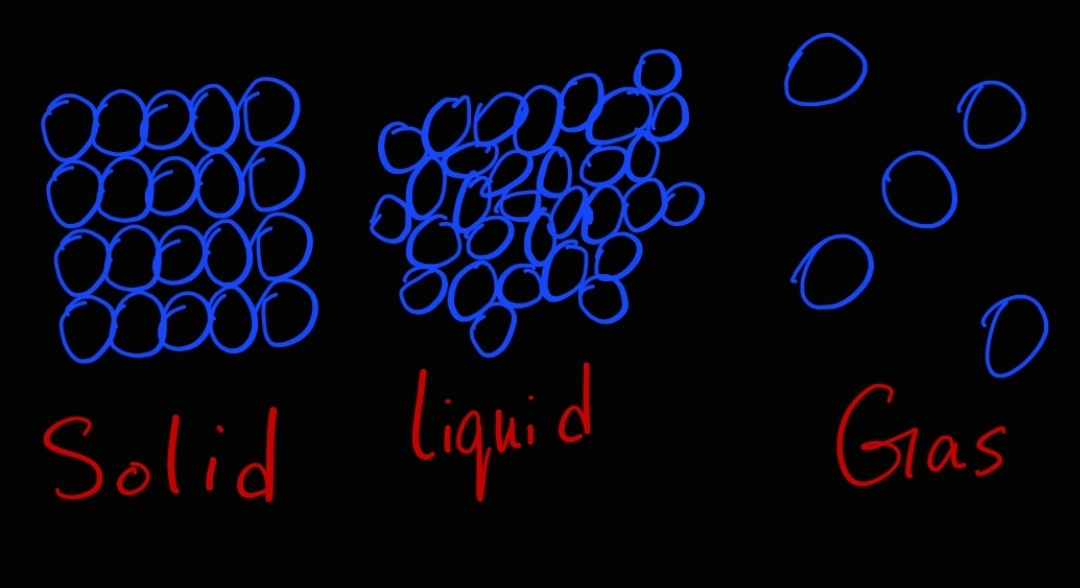
- Tightly packed
- Fixed shape
- Fixed volume
- Particles vibrate in their fixed position
Liquids
- Also closely/tightly packed
- No fixed shape
- Fixed volume
- Particles slide and move past each other
The idea of having a fixed volume but no fixed shape for liquids makes sense. You can put a gallon of water in a bottle, in a pot, in a bag, on the ground, etc. and it will take the shape of whatever you put it in (because particles can slide over each other), but it will always remain as 1 gallon of water.
Gases
- Very loosely packed
- No fixed shape
- No fixed volume
- Particles move rapidly in all directions
Similar to liquids, gases take the shape of the container. However, they also take the volume of the container. For example, if you spray some perfume in a very small room, the smell of the perfume will be very strong. Moreover, if you spray that same perfume but in a very large room, the smell of the perfume will be very weak. This is because the gaseous perfume molecules are relatively close to each other in the small room, and are very far away from each other in the large room.
Naming convention of monoatomic ions
You need to understand how things are named in chemistry to avoid confusion when answering exam questions (some exam questions will even test you only on naming conventions). There's a bunch of conventions that I will cover throughout these notes, but for this section, let's focus on naming monoatomic ionsMonoatomic ionsan ion made up of only 1 atom. Later on, you will also see ions made up of several atoms..
- If it is a metal:
You say: "the name of the metal" + "ion".
For example,
- Sodium ion (sodium atom that lost an electron)
- Calcium ion (calcium atom that lost some electrons)
- Aluminum ion (aluminum atom that lost some electrons)
- If it is a non-metal:
For this, replace the end of the element's name with "-ide" and then add the word "ion."
For example (I listed all of them for you),
- Carbide ion (carbon atom that gained some electrons)
- Nitride ion (nitrogen atom that gained some electrons)
- Phosphide ion (phosphorus atom that gained some electrons)
- Oxide ion (oxygen atom that gained some electrons)
- Sulfide ion (sulfur atom that gained some electrons)
- Selenide ion (selenium atom that gained some electrons)
- Fluoride ion (fluorine atom that gained an electron)
- Chloride ion (chlorine atom that gained an electron)
- Bromide ion (bromine atom that gained an electron)
- Iodide ion (iodine atom that gained an electron)
Periodic Table
We are now ready to introduce the periodic table.
We will now go over the typical rules of reading the periodic table.
Element cells
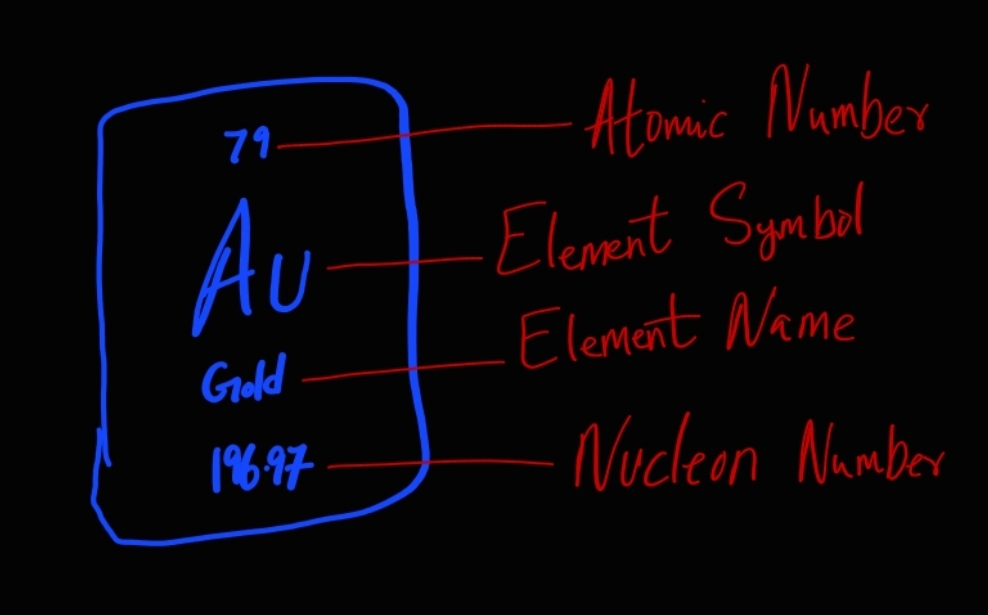
This is called the element cell (every small rectangular block, there's a total of 118 element blocks on the periodic table). It is made up of 4 things:
- Element name: For example: gold, oxygen, sodium, hydrogen, chlorine, magnesium, calcium, etc.
- Element symbol: You will use the chemical symbols when writing chemical equations later on in the notes. For example, Au (for gold), O (for oxygen), H (for hydrogen), Cl (for chlorine), Mg (for Magnesium), Ca (for calcium). Notice that the element symbol will always start with a capital letter, and if it contains a second letter, that letter will always be a lowercase letter.
- Atomic number and nucleon number: As discussed before, "Atomic number" is the number of protons that the element has, "nucleon number" is the total mass of the element caused by protons and neutrons.
If you ever get confused which number is the atomic number and which is the nucleon number, remember that the atomic number will almost always be smaller than the nucleon number for any element.
For example, Gold has 2 numbers: 79 and 196.97. Which one is the atomic number and which is the nucleon number? The smaller number will always be the atomic number and the bigger number will always be the nucleon number. Hence, 79 is the atomic number and 196.97 is the nucleon number.
Rows and columns
You can also know how many electron shells are there and how valence electrons are there. You can read those from the number of rows and columns.
The row number (more commonly known as the "period") tells you how many electron shells are there in an element. So, if an element is in row 4, then it has a total of 4 electron shells.
Regarding the column number (also known as the group number), as you can see, the groups go from 1 to 8. The number of the group tells you how many valence electrons there are. So if an electron is in group 6 (or column 6), it has 6 electrons in its outermost shell.
However, you might notice that not all columns are numbered. There's a huge jump between groups 2 and 3. Elements found in this jump are called transition metals. They behave a little differently from elements with a group number. They will be discussed later.
Placement of Metals, Non-metals, and Metalloids
The last thing to cover is how the periodic table arranges elements of the metal, non-metal, and metalloid groups.
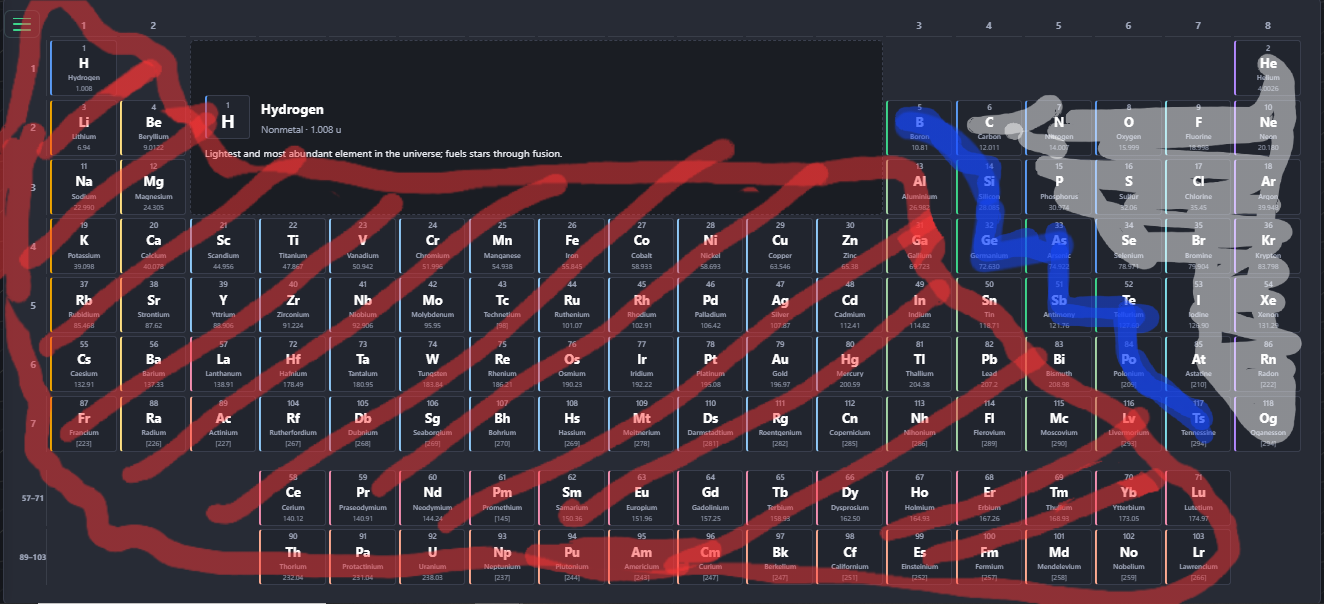
(I might replace this image later on when I get a better one)
- All the elements enclosed in the red shape (basically the majority of the periodic table) are metals.
- All elements that are colored in blue are metalloids.
- All elements that are colored in white/grey are non-metals.
If you need to memorize this, I recommend you memorize just the metalloids, and then know that on the left will be the metals, and on the right will be the non-metals.
Let us now have some practice applying our current knowledge:
Question: Search the periodic table for the element: Arsenic. After that, answer the following questions:
- What is its atomic and nucleon number? What is its chemical symbol?
- Which group is it in?
- What period is it in?
- How many electron shells does it have?
- How many valence electrons does it have?
- Is it a metal, non-metal, or a metalloid?
▼
Answers:
- Its atomic number is 33, and the nucleon number is 75 (notice that the nucleon number is bigger than the atomic number). Its chemical symbol is As.
- Group 5.
- Period 4.
- Since it is in period 4, it has 4 electron shells.
- Since it is in group 5, it has 5 valence electrons.
- It is a metalloid.
1. Drawing and Bonding
In this section, we will go over ionic, covalent, metallic bonds, and also how to draw atoms, ions, etc.
Let's start by drawing atoms. There's a few things you need to include in your drawing:
- The nucleus (and protons and neutrons).
- The electrons (how many electrons and how many electron shells).
Note:
- Where you place the electron inside the shell doesn't matter.
- When drawing ions, you must enclose the drawing with square brackets and put the charge of the ion on top.
Let's use a couple of examples to demonstrate how to draw.
Example 1: Draw a hydrogen atom.
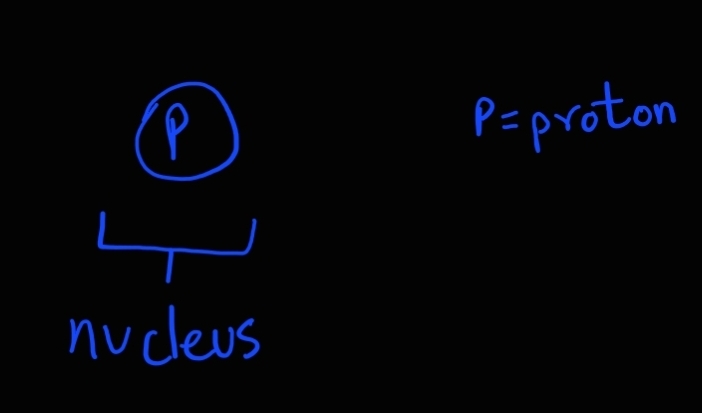
How many protons and neutrons should be in the nucleus?
From the periodic table, we know that a hydrogen atom has 1 proton. Notice that the nucleon number of hydrogen is also 1, which means nucleon number = atomic number. This means that hydrogen typically has no neutrons.
So the nucleus should contain 1 proton and no neutrons.
How many electrons and how many electron shells?
First, we need to decide how many electrons we have. Notice that we are drawing a hydrogen atom, which means that the proton number = electron number.
Since we have 1 proton, we should have 1 electron. This is how you will distribute them in their electron shells:
- Start with the first (inner-most) shell, which can hold up to 2 electrons.
- Once you completely fill the first shell, move on to the second shell, which can hold up to 8.
- Once you completely fill the second shell, move on to the third one, which can also hold up to 8.
- Then, move on to the fourth. According to the syllabus I'm following, the biggest atom you are expected to draw is Calcium, which only has 2 electrons in its fourth shell.
- Do the above steps until you draw all the electrons that the atom/ion has.
Since we have only 1 electron, we will draw 1 shell and 1 electron inside it.
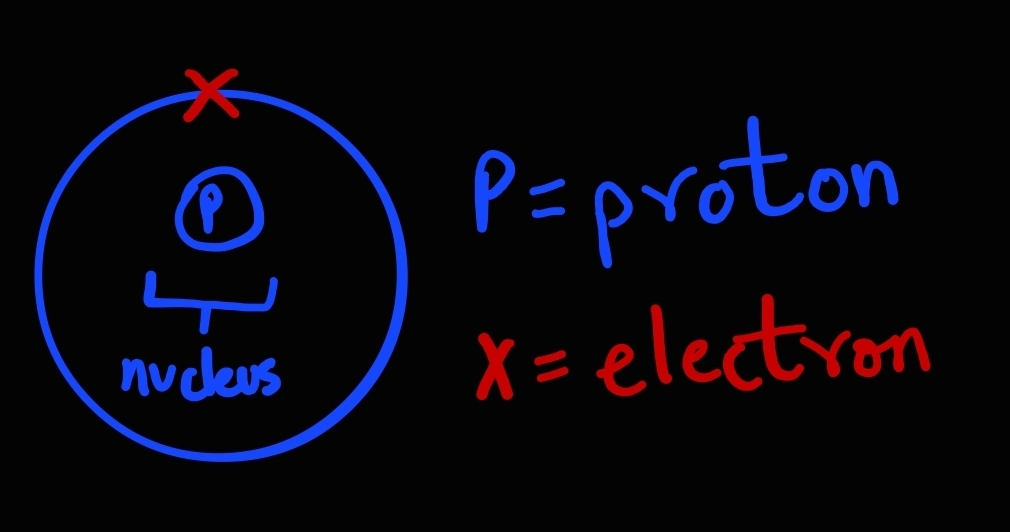
Since we now have:
- The complete nucleus,
- All the electrons in their respective shells
We have officially drawn a hydrogen atom.
Example 2: Draw a Sodium atom.
Just like before, look in the periodic table and check how many protons and neutrons does a typical sodium atom have.
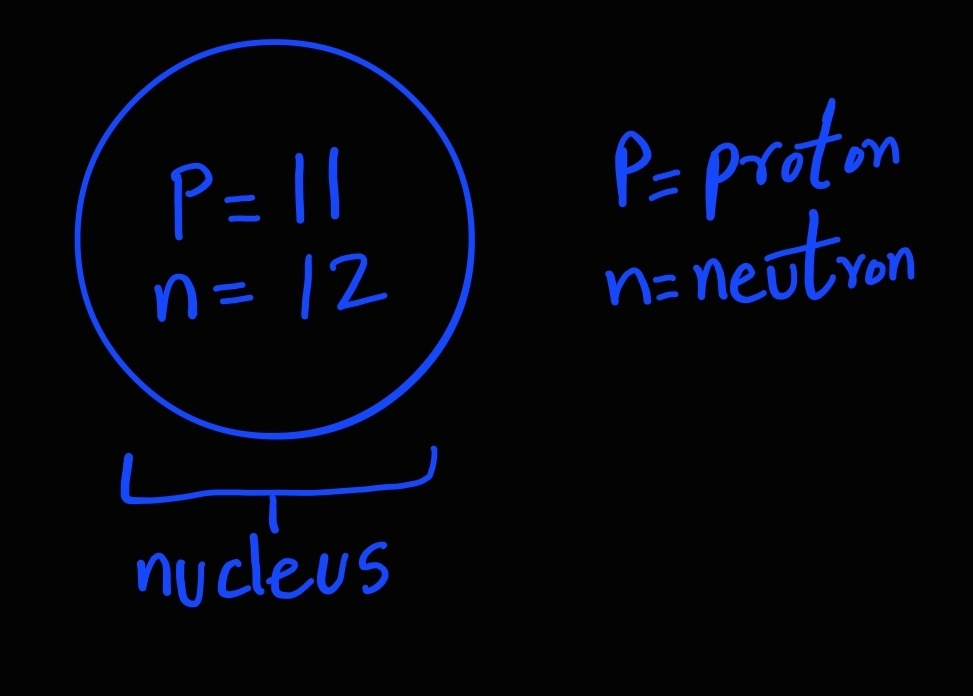
You will find sodium has 11 protons and a nucleon number of 23. So neutron number = 23-11=12 neutrons.
Since it is fairly tedious to draw 23 circles in the nucleus, this is how I typically draw the nucleus:
Now, since we are drawing an atom, we know that the proton number= electron number. Hence, we will have 11 electrons.
- 2 electrons will be in the first (inner-most) shell.
- 8 electrons will go into the second shell.
- The last electron will go into the third shell.
Here is how it should look.
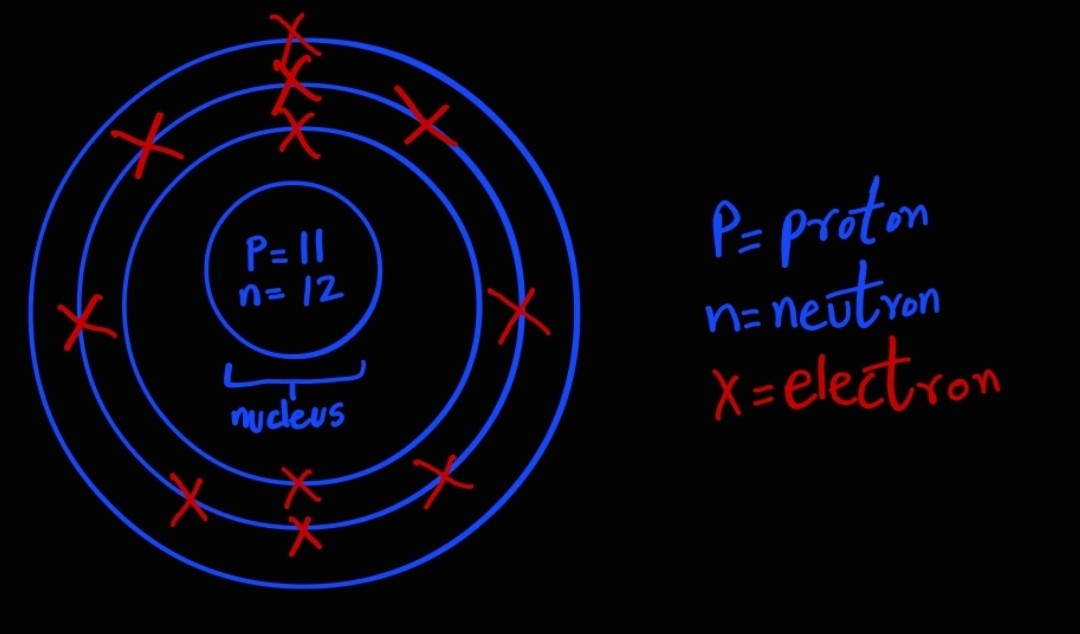
Example 3: Draw a chloride -1 ion.
From our naming conventions, we know that chloride is a chlorine atom that gained some electrons. But how many electrons did it gain? Well, it gained 1 electron because the charge of the ion is 1 (the negative just means "gain," as we discussed previously. If it was +1, it would mean it lost 1 electron).
Now, from the periodic table, we know that chlorine has 17 protons and has a nucleon number of 35. Hence, its neutron number = 35-17=18 neutrons.
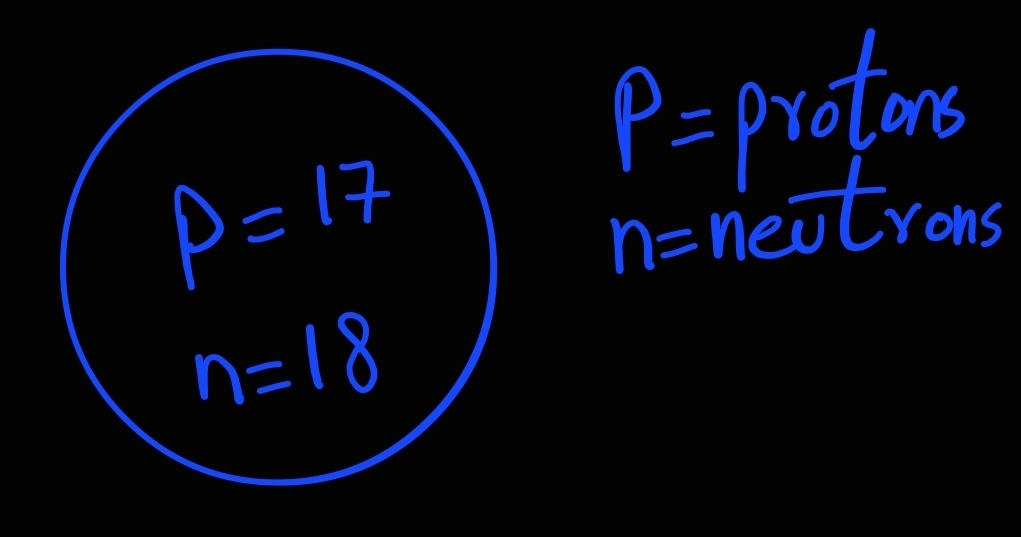
Moreover, a chlorine atom will typically have 17 electrons (since atoms have protons = electrons), but since our chloride ion gained 1 electron, then it must have a total of 17+1=18 electrons.
- 2 electrons will be in the first (inner-most) shell.
- 8 electrons will be in the second shell.
- The last 8 electrons will be in the outermost shell.
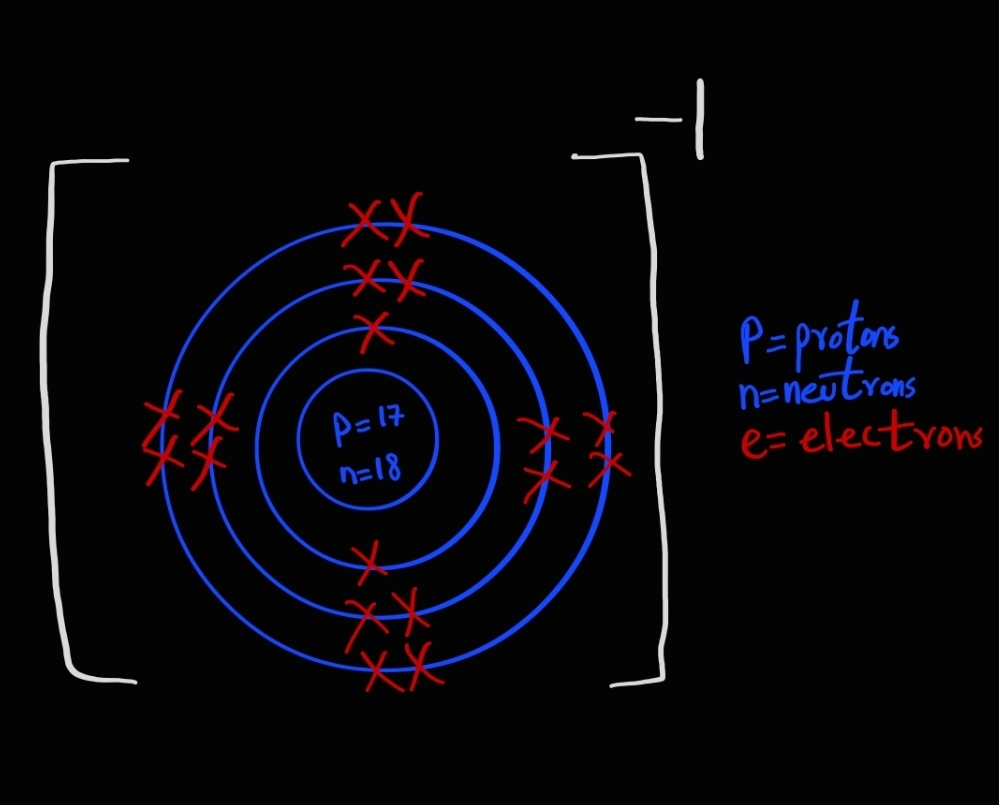
Important tips and notes to remember when drawing ▼
- Sometimes, the exam question will ask you to draw only the valence electrons or the valence shell. In that case, only draw the outermost shell with its electrons. Never draw the inside shells or electrons.
- Sometimes, the question will tell you the number of neutrons that you are supposed to have. In that case, don't use the nucleon number in the periodic table.
- In some periodic tables, the nucleon number is not a whole number (this is because the periodic table typically shows the average nucleon number of that element, since many elements have isotopes with differing nucleon numbers). If you have to use the periodic table to decide how many neutrons you should have, round up/down the nucleon number to have a whole number.
- Again, when drawing ions, remember to enclose your ion in square brackets with the ion charge on top, same way I have drawn it in the chloride example.
- More details regarding drawing will be mentioned in future sections, when appropriate.
Chemical Bonds
I recommend you revise the section regarding the goal of chemical bonds before reading forward.
Ionic bonding
Ionic bonding is the first major concept we will cover. As I said previously, ionic bonds occur when a transfer of electrons happens.
Rules of ionic bonds
- The bond happens between a metal and a non-metal.
- The metal gives away electrons, and the non-metal accepts those electrons. This means that the metal is an "electron donor" and the non-metal is an "electron acceptor."
- The amount of electrons donated by a metal is equal to its group number.
For example: 1) sodium is a metal in group 1, hence every sodium atom will donate only 1 electron. 2) Strontium is a metal in group 2, hence every strontium atom will donate 2 electrons.
So, electrons donated by each atom=group number of metal
Note: Transition metals vary in the amount of electrons they donate.
- Non-metals can be somewhat confusing. electrons accepted by each atom=8-(group number of non-metal). Or in other words, the amount of electrons accepted by a non-metal is equal to how far away its group number is from 8.
For example, 1) phosphorus is in group 5. So, 8-5=3, which means that every phosphorus atom will accept 3 electrons. 2) Oxygen is in group 6. So, 8-6=2. So, every oxygen atom will accept 2 electrons.
- In the end, you will have ions with a complete outer electron shell.
- The name of the ionic compound will be: the name of the metal + name of the non-metal ion.
For example: Sodium chloride (metal: sodium, non-metal ion: chloride), calcium oxide (metal: calcium, non-metal ion: oxide), aluminum nitride (metal: aluminum, non-metal ion: nitride)
Rules to write the chemical formula of an ionic compound
There are 2 rules:
- You write the chemical formula for the metal before the non-metal (same way you say the name of the metal before the non-metal ion)
- I will explain this rule using an example.
Assume you have magnesium bromide. Magnesium is found in group 2, which means it wants to donate 2 electrons. Bromide is the ion of bromine, found in group 7, and 8-7=1, which means that it can only accept 1 electron. This is a problem, because electrons donated > electrons accepted (or in other words, magnesium wants to donate more electrons than 1 bromine atom can accept). How can we fix this? You bring another bromine atom to help. When you have 2 bromine atoms, each atom can accept 1 electron from magnesium, allowing magnesium to donate its 2 electrons (now electrons donated = electrons accepted). So, in order to write the correct ionic compound formula for magnesium bromide, we need 1 magnesium ion for every 2 bromide ions, or MgBr2.
But is there a faster way to determine how many atoms of metals and non-metals we need so that electrons donated = electrons accepted? Yes.
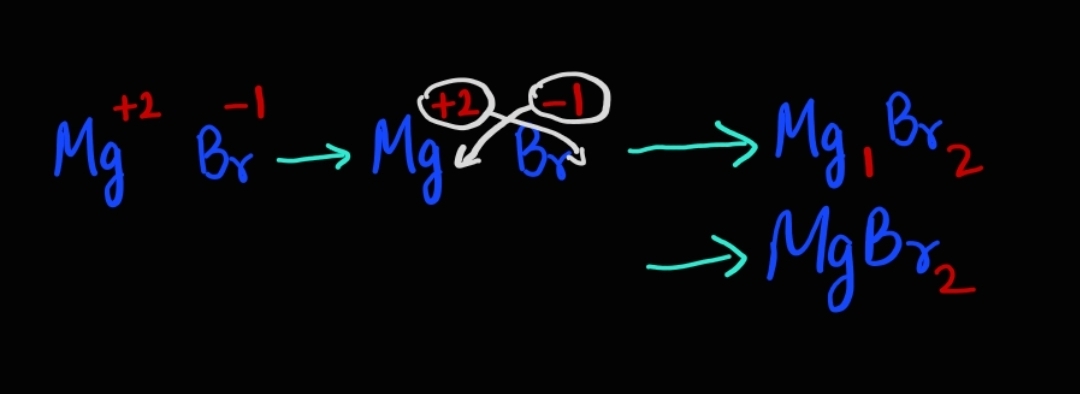
Start by writing the chemical formula for the metal and the non-metal ions, with their respective charges on top of them (remember, they have a charge because they are ions, which means they either lost or gained electron
Then, ignore the plus or minus signs and cross the numbers.
Finally, make sure the numbers are in their simplest ratio (in other words, 2 magnesium ions for every 4 bromide ions is the same thing as 1 magnesium ion for every 2 bromide ions. Since the latter is the simplest ratio, you should pick that). And, if you are left with a "1" for either your metal or non-metal, simply ignore it and don't write it.
If you are unsure whether you did it correctly or not, check if electrons donated = electrons accepted. If they are equal, it is correct (just make sure that the numbers are in their simplest ratio, and the ratio must be in whole numbers, not fractions or decimals). If they aren't equal, you did something wrong.
The examples will show you some things related to drawing that you should keep in mind.
Let us apply these rules in the following examples.
Example 1: Sodium Chloride.
- Identify the electron donor and acceptor.
Sodium is the electron donor because it is the metal, chloride (or chlorine) is the electron acceptor because it is the non-metal.
- How many electrons are given away by 1 atom of the electron donor, and how many electrons are accepted by 1 atom of the electron acceptor?
Since sodium is in group 1, then it gives away 1 electron. Chlorine is in group 7, and from the rules above, electrons accepted = 8-group number. Hence, 8-7=1, every chlorine atom will accept 1 electron.
- What is the chemical formula of sodium chloride
I will use the shortcut I showed you above.
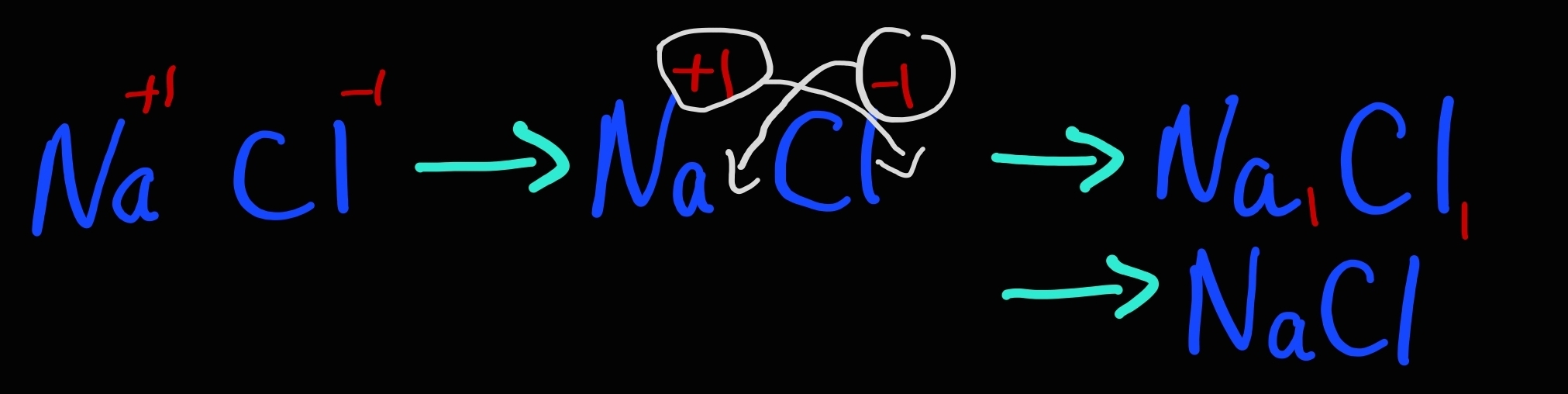
- Draw the resulting ionic compound.
Please check with your syllabus or teachers how exactly they want the diagram to be drawn. Sometimes, they don't want the inner shells, only the outermost shell. I will draw the complete compound.
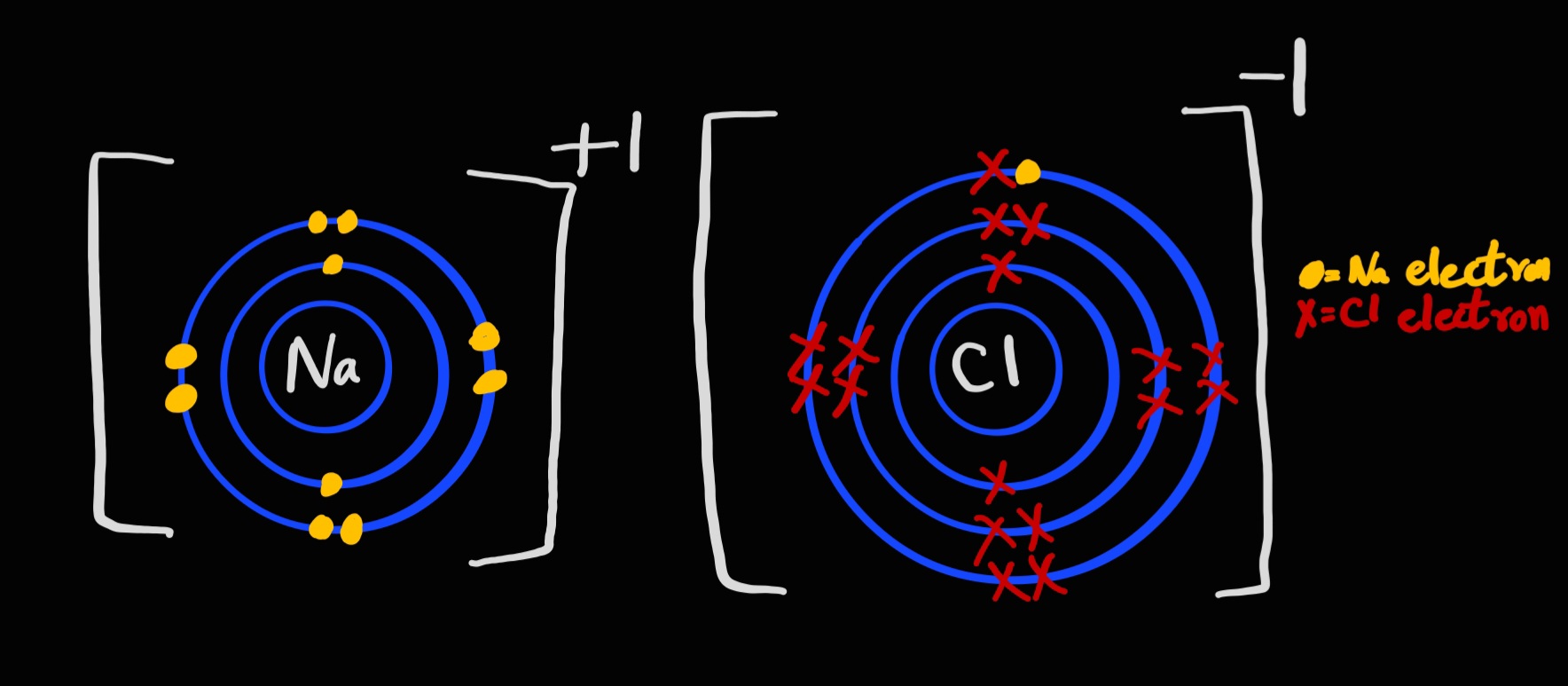
The rules of drawing are the same as they were before (just put the symbol of the element inside the nucleus instead of protons/neutrons). Remember to keep track of how many electrons each element has in their shells before you start drawing. You must always have a full outer shell.
This is known as a dot-and-cross diagram. It is given this name because the electrons are dots and crosses. Moreover, notice that sodium now has 2 shells instead of 3. This is because it lost the electron that was in the third shell.
Example 2: Aluminum oxide.
- Identify the electron donor and acceptor.
Aluminum is the metal, hence it will be the electron donor. Oxide (the ion of oxygen) is the non-metal, hence it will be the electron acceptor.
- How many electrons are given away by 1 atom of the electron donor, and how many electrons are accepted by 1 atom of the electron acceptor?
Aluminum is in group 3, which means that each aluminum atom will donate 3 electrons. Oxygen is in group 6, and electrons accepted=8-group number = 8-6=2. Therefore, each oxygen atom will accept 2 electrons.
- What is the chemical formula of aluminum oxide?
I will use the same shortcut I used previously.
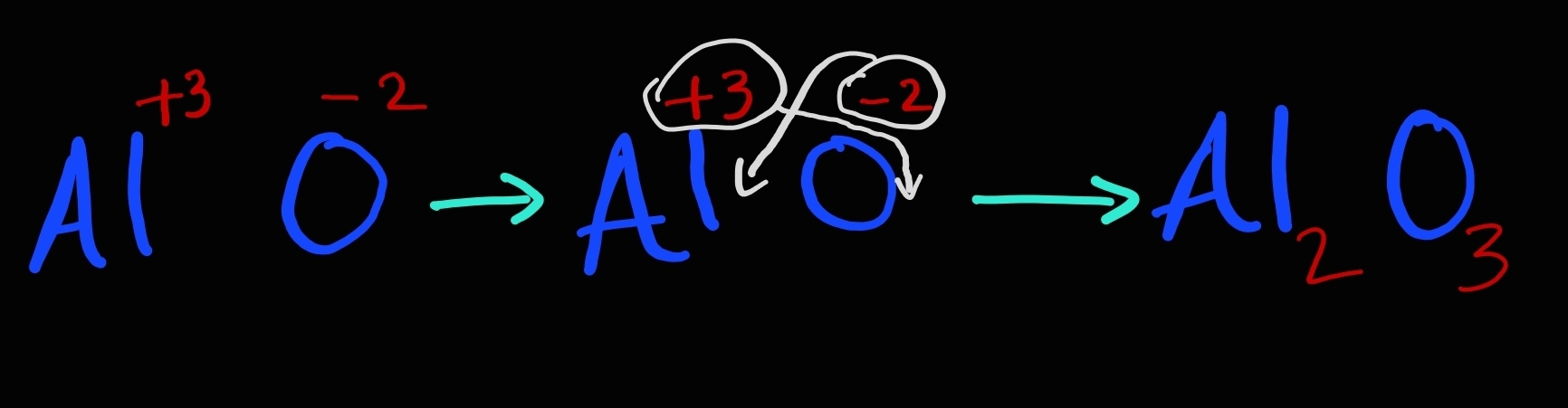
Let's assume that I'm not sure whether Al2O3 is the correct formula or not. Here's how to check. ▼
- One aluminum atom will give 3 electrons, so 2 aluminum atoms will give 6 electrons. Electrons donated = 6.
- One oxygen atom will accept 2 electrons, so 3 oxygen atoms will accept 2×3=6 electrons in total. Electrons accepted = 6.
- Electrons donated = electrons accepted.
- Moreover, the numbers are in their simplest ratio (2 and 3, you can't simplify it more than that).
- Hence, it is correct!
- Draw the resulting ionic compound.
New drawing ruling to keep in mind (in addition to the dot-and-cross): It will be tedious to draw 2 complete aluminum ions and 3 complete oxygen ions. Instead, we will draw just one ion of each type and indicate how many of each ion are present by writing the number to the left of the brackets, as shown below:
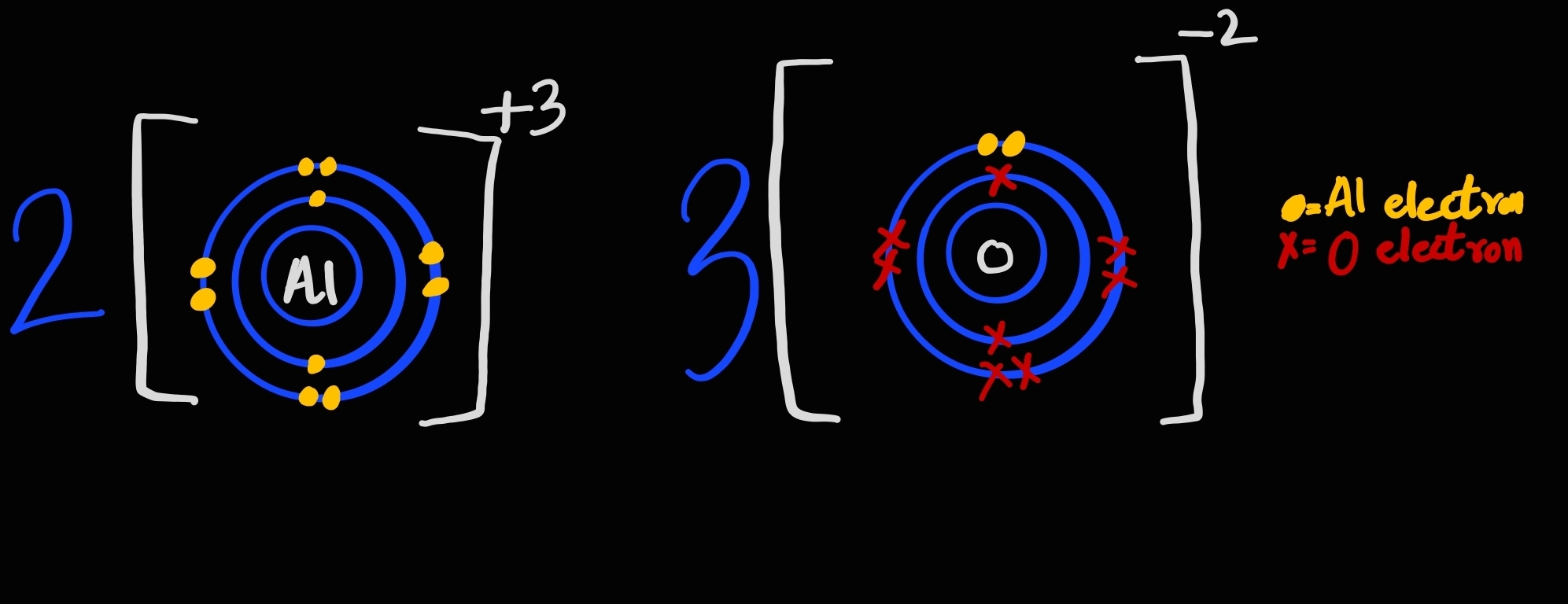
Each aluminum atom lost 3 electrons, while each oxygen atom gained 2 electrons, giving them both full outer shells.
Example 3: Calcium sulfide
- Identify the electron donor and acceptor.
Calcium is the metal, so it will be the electron donor. Sulfide (the ion of sulfur) is the non-metal, so it will be the electron acceptor.
- How many electrons are given away by 1 atom of the electron donor, and how many electrons are accepted by 1 atom of the electron acceptor?
Calcium is in group 2, so it will give away 2 electrons. Sulfide (or sulfur) is in group 6, so electrons accepted = 8-group number =8-6=2.
- What is the chemical formula of calcium sulfide?
We will use the same trick we used in the previous examples.
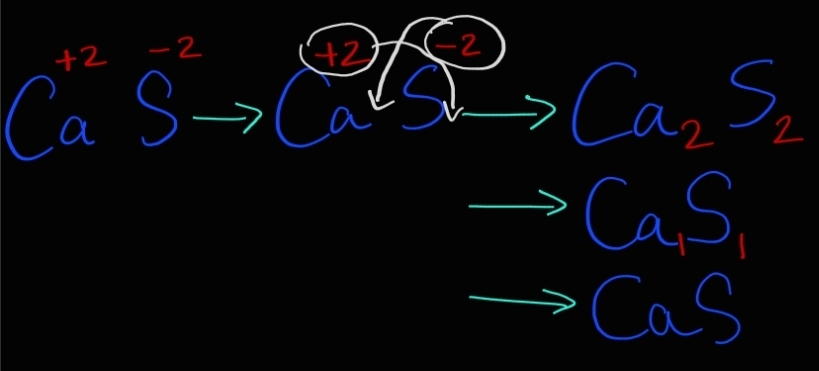
As you can see, the shortcut we used initially told us: for every 2 calcium ions, you will need 2 sulfide ions. But that is the same as saying: for every 1 calcium ion, you will need 1 sulfide ion. And since the latter is the simplest ratio, we should pick that. Moreover, as we stated previously, if we have a 1, we can simply make it disappear, giving us a final answer of CaS.
If you are unsure, check: does electron donated=electron accepted? You will notice that it does.
- Draw the resulting ionic compound.
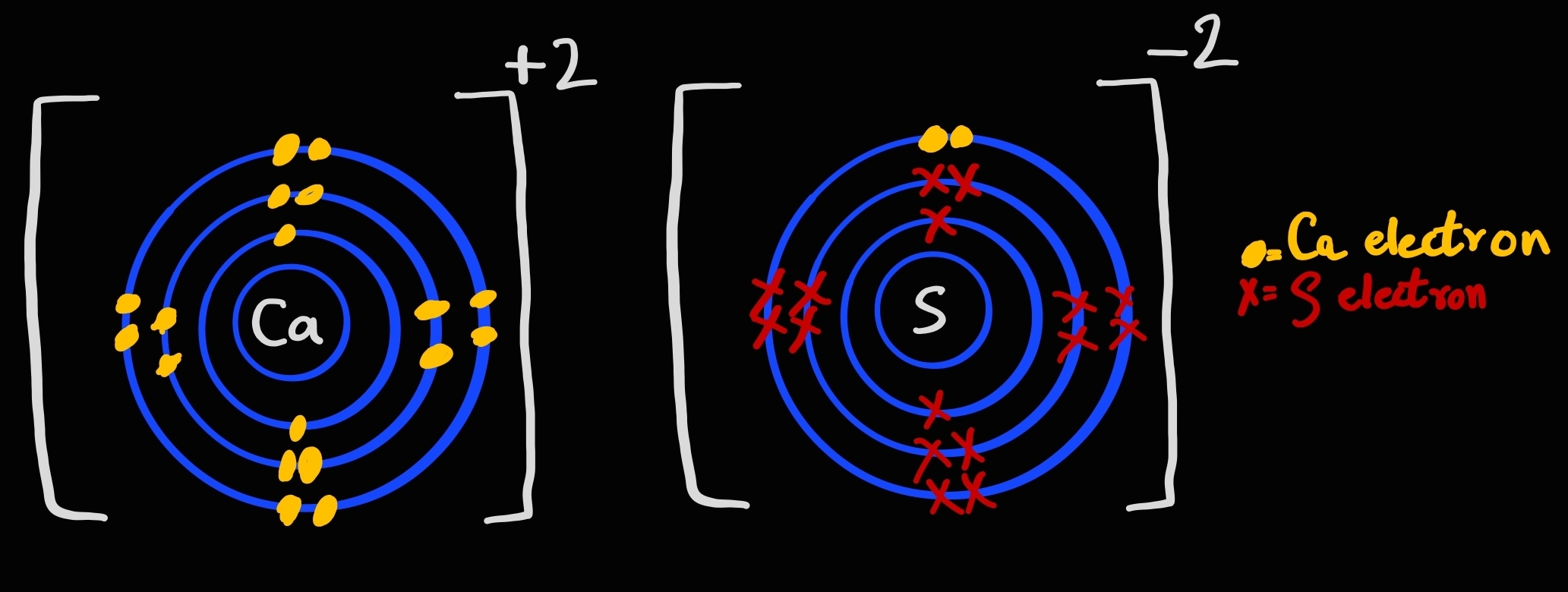
So are ionic compounds just 2 or 3 ions floating around in space?
No. Similar to how I told you that a typical cup of water contains trillions of trillions of particles, ionic compounds are in reality made up of a bunch of ions interacting with each other.
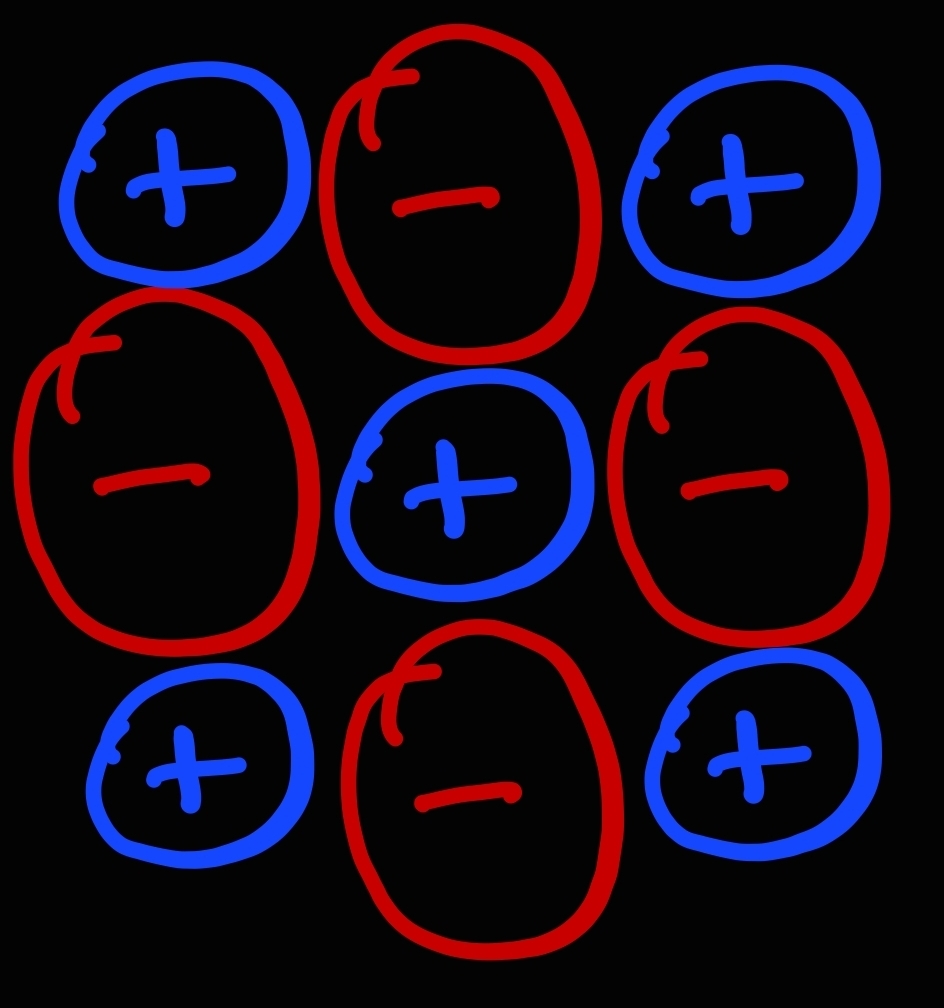
Ionic compounds form a "giant ionic lattice," alternating between positive and negative ions, as shown in the image.
In reality, this is supposed to be a 3D image... Just imagine it is a cube. As you can see, every ion is surrounded by ions of an opposite charge (every (+) is surrounded by several (-) and vice versa). This allows several ionic bonds (strong electrostatic attraction forces) to be present between the ions.
A general rule for you to remember: Oppositely-charged particles are attracted to each other. Same-charge particles are repelled by each other.
Characteristics of ionic compounds
- High melting/boiling points
This is because of the multiple strong ionic bonds in the lattice, which require a lot of energy to break. - Good conductors of electricity in molten or aqueous states, but not solid state
In the solid state → the ions are stuck to each other and don't move → hence preventing any electric current from flowing.
When they are in the molten/aqueous state → the ionic bonds are broken → allowing the ions to roam freely and transfer the electric current.
- Brittle
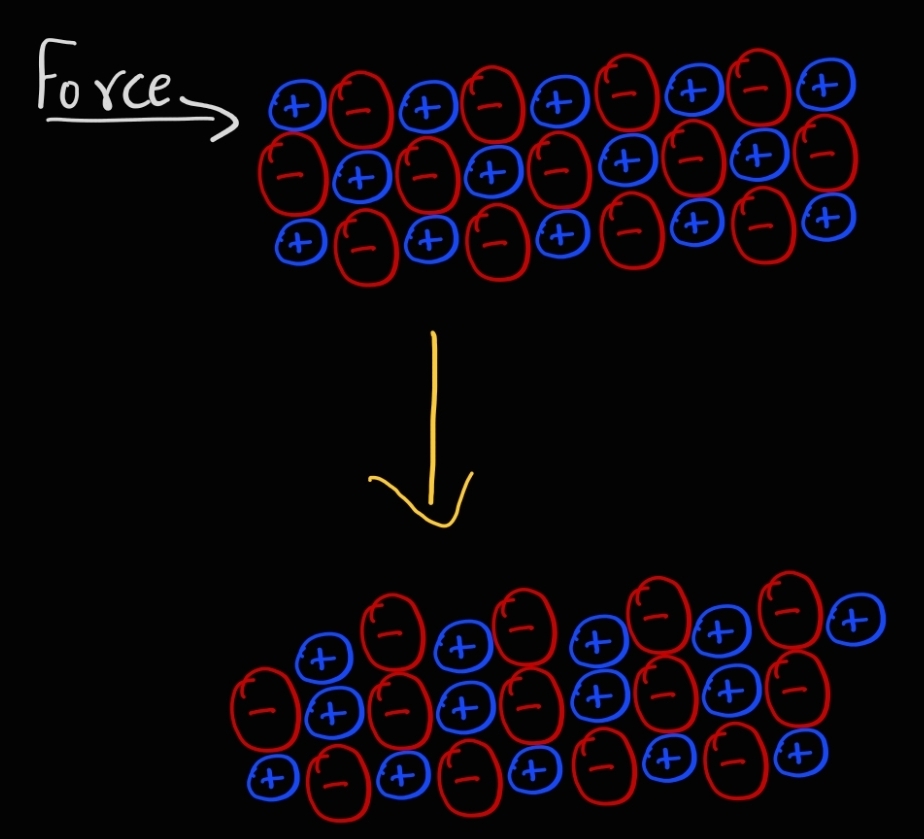 They break fairly easily. This is because of their ionic lattice structure. When a force is applied to an ionic compound, some of the rows shift their position, causing the following arrangement.
As you can see, now positive ions are now directly next to each other. Same thing with the negative ions. This causes extreme repulsion to occur. Recall the rule: same-charge particles repel each other.
They break fairly easily. This is because of their ionic lattice structure. When a force is applied to an ionic compound, some of the rows shift their position, causing the following arrangement.
As you can see, now positive ions are now directly next to each other. Same thing with the negative ions. This causes extreme repulsion to occur. Recall the rule: same-charge particles repel each other.
Covalent bonding
This is the second type of bonding that you should be familiar with. A compound made up of covalent bonds is called a molecular compound.
Covalent bonding usually occurs between non-metals. It is based on atoms sharing electrons. Covalent bonding happens so that each atom has a full outer shell, which makes them very stable.
Why don't non-metals completely transfer their electrons to each other similar to metals in ionic bonding (recall that during ionic bonding metals completely lose their electrons and give them away to non-metals)? It's because it is more beneficial for non-metals to gain electrons rather than lose them to reach stability, and covalent bonding allows both of the participating atoms to "gain by sharing."
To understand the general idea of covalent bonding, I will first give a simple example for you to imagine.
Both Johnny and Adam need to have 8 apples. However, both of them individually have 7 apples. So, Johnny decides to share 1 of his apples with Adam, and Adam decides to share one of his apples with Johnny (by sharing, both Adam and Johnny consider the shared apples their own). This is what they have left:
Apples owned by Johnny only - 6
Apples owned by Adam only - 6
Apples owned by both Johnny and Adam (i.e. shared apples) - 2
Since both of them now have 6+2=8 apples, they are both happy.
In this imaginary example, the apples are the electrons and the 2 boys are the atoms. There are a few things I want you to notice in this example:
- The most common case of covalent bonding (which is what I'm covering) is that each atom contributes some electrons to share with the other atom in the covalent bond.
This means that half of the shared electrons will be from Atom 1 and the other half will be from Atom 2.
This also means that the number of shared electrons must be an even number.
- The shared electrons are owned by both atoms in the covalent bond. Keep in mind: a covalent bond is 1 shared pair of electrons.
Single, double, and triple bonds
Between 2 atoms, covalent bonds come in 3 levels:
- Single bonds: each atom contributes a single electron to the sharing (so you have 1 pair of shared electrons). In structural formulae, it is made up of 1 dash (-).
- Double bonds: each atom contributes 2 electrons to the sharing (so you have 2 pairs of shared electrons). This means that a double bond is made up of 2 covalent bonds, so in structural formulae, it is made up of 2 dashes on top of each other (=).
- Triple bonds: each atom contributes 3 electrons to the sharing (so you have 3 pairs of shared electrons). This means that a triple bond is made up of 3 covalent bonds, so in structural formulae, it is made up of 3 dashes on top of each other (≡).
- Quadruple bonds exist, but you aren't expected to know them for beginner-level chemistry courses.
How many bonds does the atom need to form? - General rule
For an atom to reach a full valence shell by covalent bonding: The number of electrons it contributes = number of extra electrons it needs to have a full shell.
For example,
1- If an atom needs 1 more electron to have a full shell, then it must contribute 1 electron in covalent bonding. In other words, it needs to form a single bond with another atom.
2- If an atom needs 2 more electrons to have a full shell, then it must contribute 2 electrons in covalent bonding. In other words, it needs to form 2 bonds (not necessarily a double bond, it can be 2 single bonds)
And so on.
So here's how your thought process should be:
- Count how many electrons each atom has before bonding
- How many more do each atom need to reach a full outer shell?
- The answer to step 2 = The number of covalent bonds that each atom must be involved in to have a full outer shell.
- Check to see if you have single, double, or triple bonds.
Drawing molecules - Example 1: Fluorine
Now, we will look at group 7 and draw covalent bonds using dot-and-cross diagrams and also their structural formula.
Group 7 is also known as the halogens group (each element can be called a "halogen.") For your general information, "halogen" is a Greek term that means "salt-former."
The halogens (and some other elements we will discuss) are known as a diatomic elementDiatomic elementsElements that are found in nature as 2 atoms bonded together. (The prefix di- means 2, atomic refers to atoms. So diatomic means 2 atoms). This basically means that they are found in nature as molecules made from 2 atoms of that element, bonded together by a covalent bond.
But how do covalent bonds allow the halogens to have a full outer shell? Let us first inspect the outer shell of 2 unbonded fluorine atoms.
I used the dot-and-cross diagram format for now to easily differentiate between the atoms' electrons.
- How many electrons does each atom have?
As you can see, each fluorine atom has 7 electrons in its outer shell. - How many more do each atom need to reach a full outer shell?
They only need 1 more electron to have a full outer shell. - The answer to step 2 = The number of covalent bonds that each atom must be involved in to have a full outer shell.
Each fluorine atom needs to be involved in 1 covalent bond.
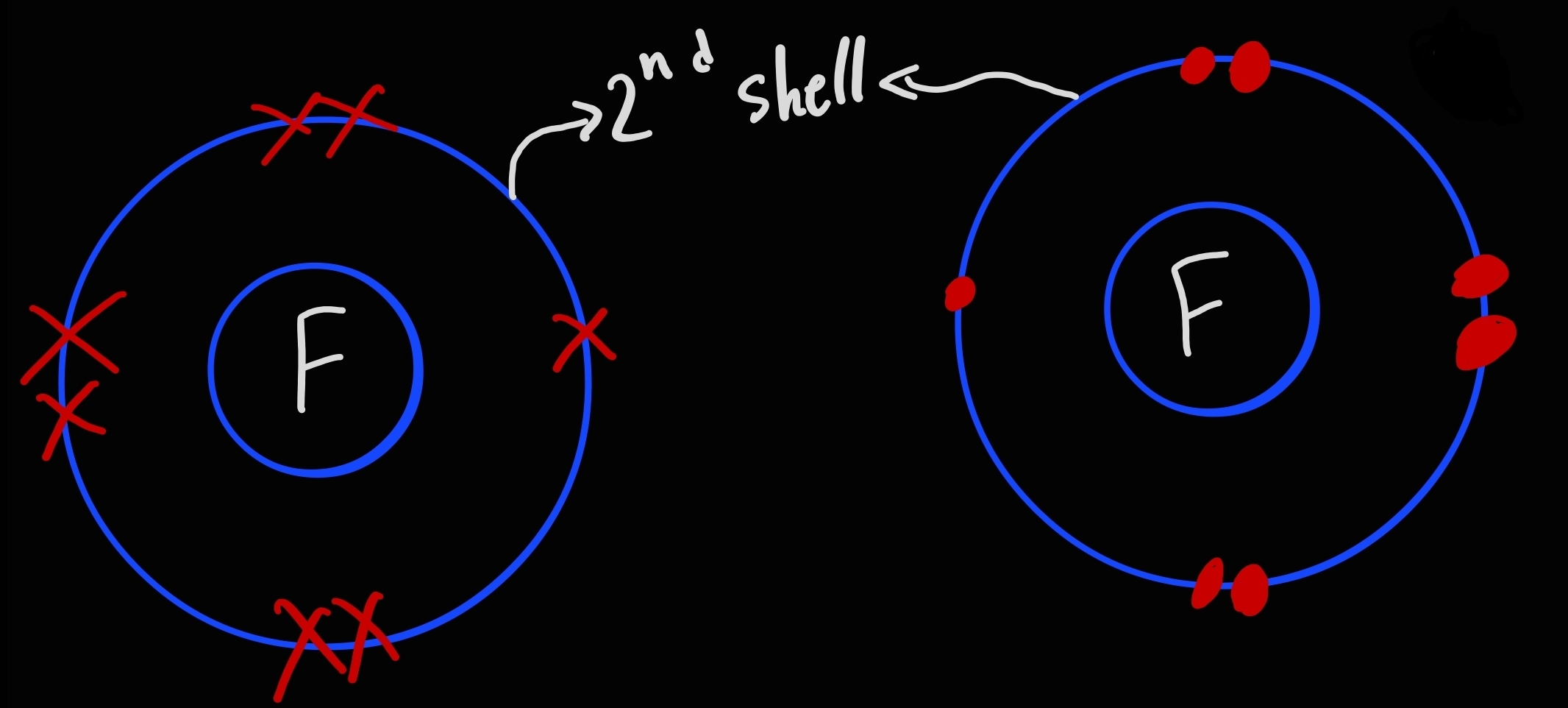
So, each fluorine atom will share 1 electron, forming the following molecule:
Dot-and-cross diagram:
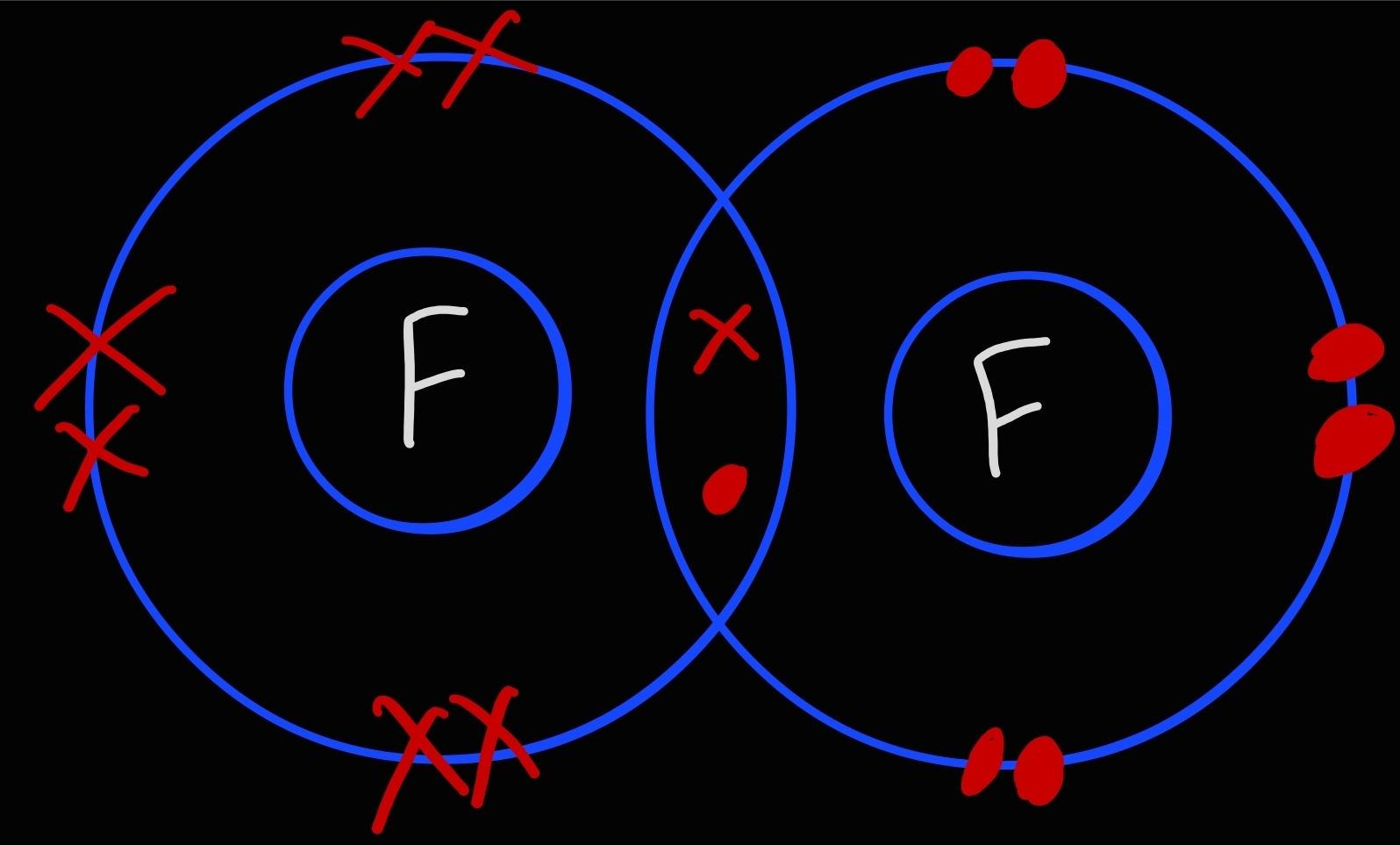
The electrons found in the overlap between the 2 shells are the ones being shared. As I mentioned previously, the shared electrons are "owned" by both atoms. Hence, if you count how many electrons each atom has now, it is 8.
Structural formula:
Dot-and-cross diagrams can become cluttered when you are drawing big compounds. To solve this issue, we will draw compounds using their structural formulae. To draw the structural formula, you don't need to draw any circles or electrons. You just show how the atoms are connected to each via their covalent bonds. You represent their covalent bonds using dashes.
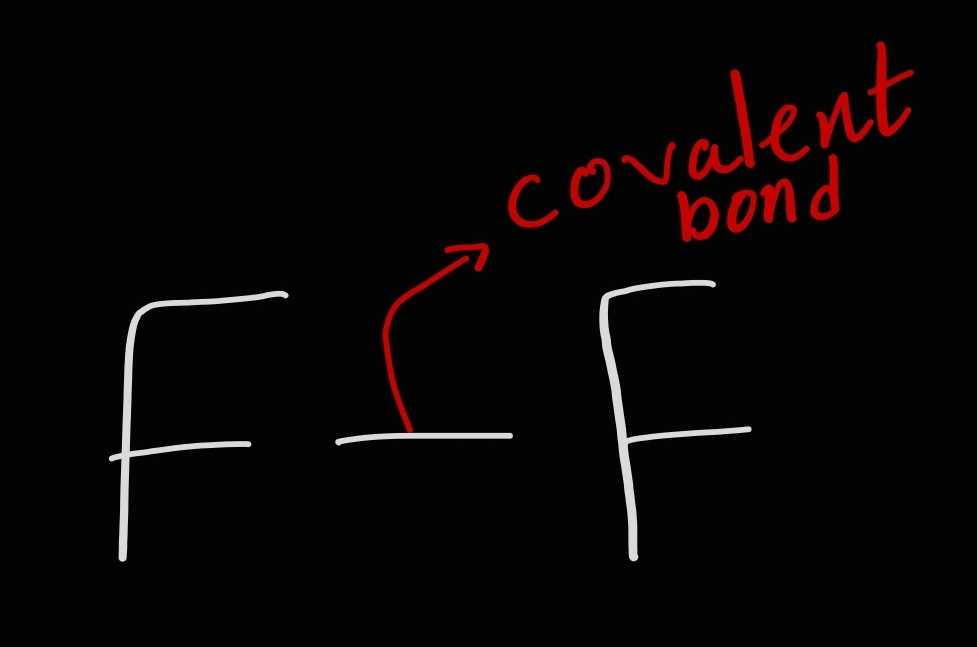
When drawing structural formulae, each dash represents 1 covalent bond.
Example 2: Double bond - Oxygen
Let's take an example where we have a double covalent bond: the oxygen we breathe (You may already know its chemical formula: O2).
Oxygen is also known as a diatomic element. This basically means that it is found in nature as molecules made from 2 oxygen atoms, bonded together by covalent bonds.
Here's the outer shell of 2 unbonded oxygen atoms.
- How many electrons does each atom have?
As you can see, each oxygen atom has 6 electrons in its outer shell. - How many more do each atom need to reach a full outer shell?
They only need 2 more electrons to have a full outer shell. - The answer to step 2 = The number of covalent bonds that each atom must be involved in to have a full outer shell.
Each oxygen atom needs to be involved in 2 covalent bonds.
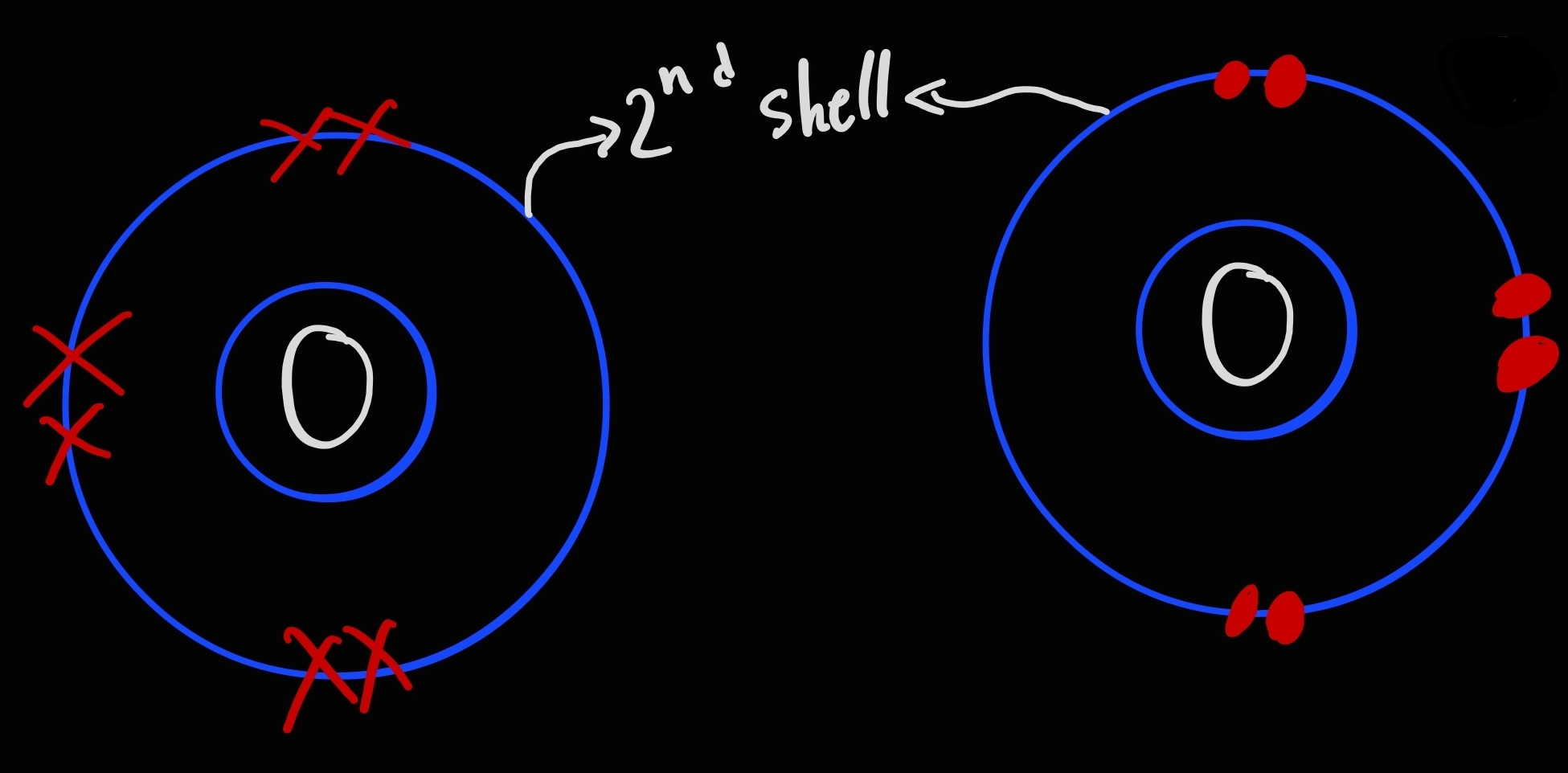
So, each oxygen atom will share 2 electrons; 2 electrons from the left oxygen atom, and 2 electrons from the right oxygen atom.
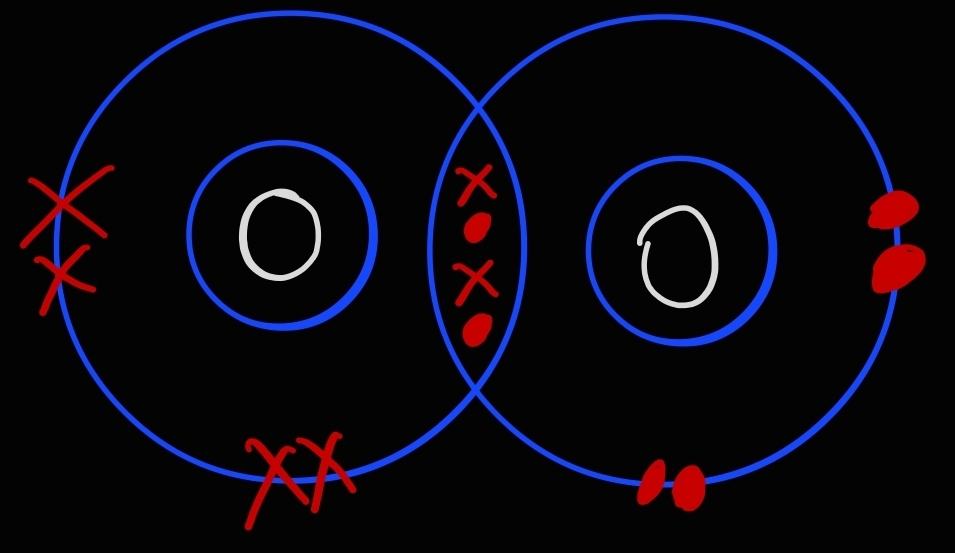
Now, this is called a double bond because each atom is contributing 2 electrons to the sharing.
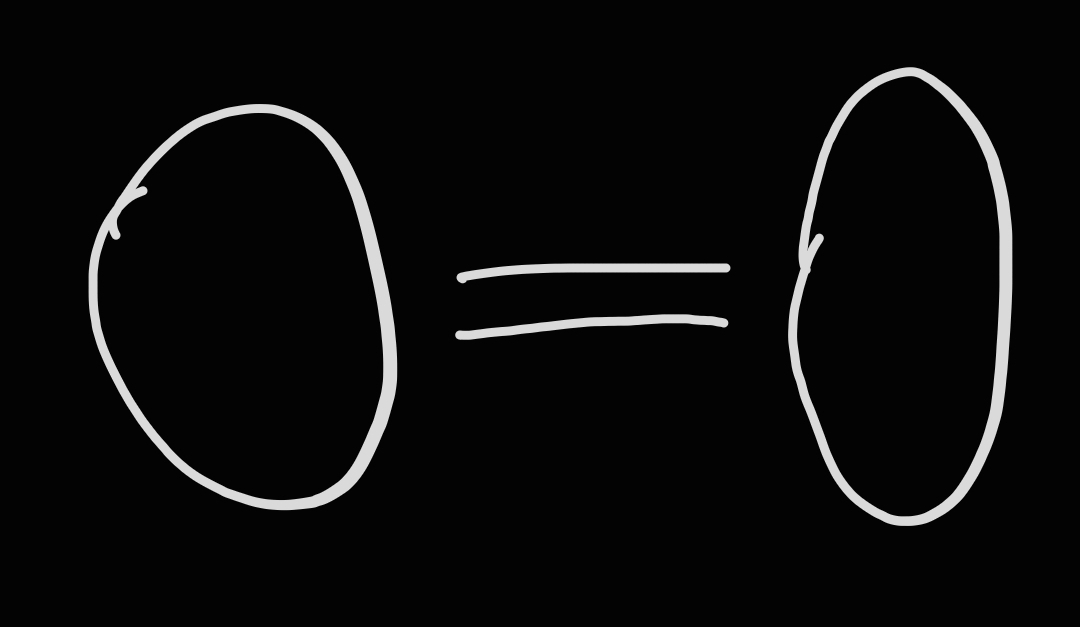
Structural formula:
Example 3: Triple bond - Nitrogen
Let's now look at an example with a triple bond.
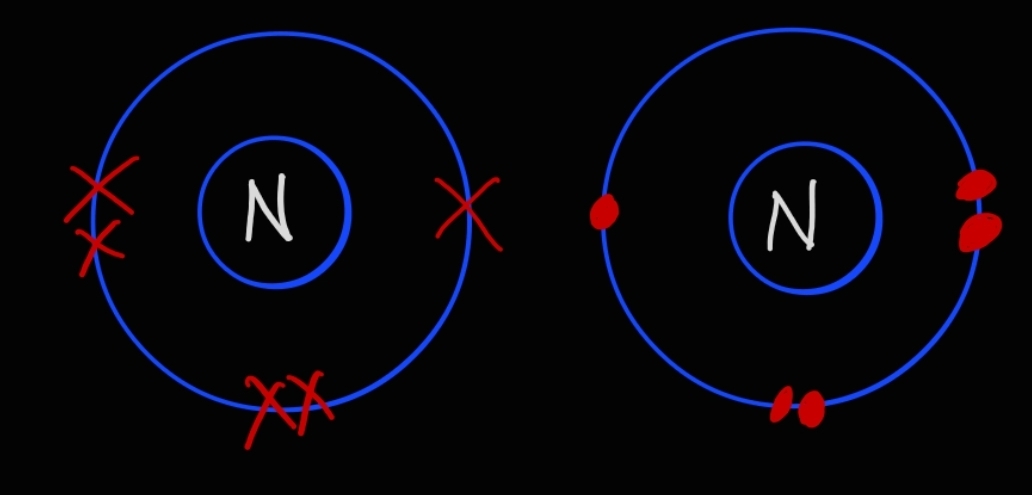
Nitrogen is a diatomic element that makes up the great majority of our atmosphere. Here is a diagram of 2 unbonded nitrogen atoms.
- How many electrons does each atom have?
As you can see, each nitrogen atom has 5 electrons in its outer shell. - How many more do each atom need to reach a full outer shell?
They only need 3 more electrons to have a full outer shell. - The answer to step 2 = The number of covalent bonds that each atom must be involved in to have a full outer shell.
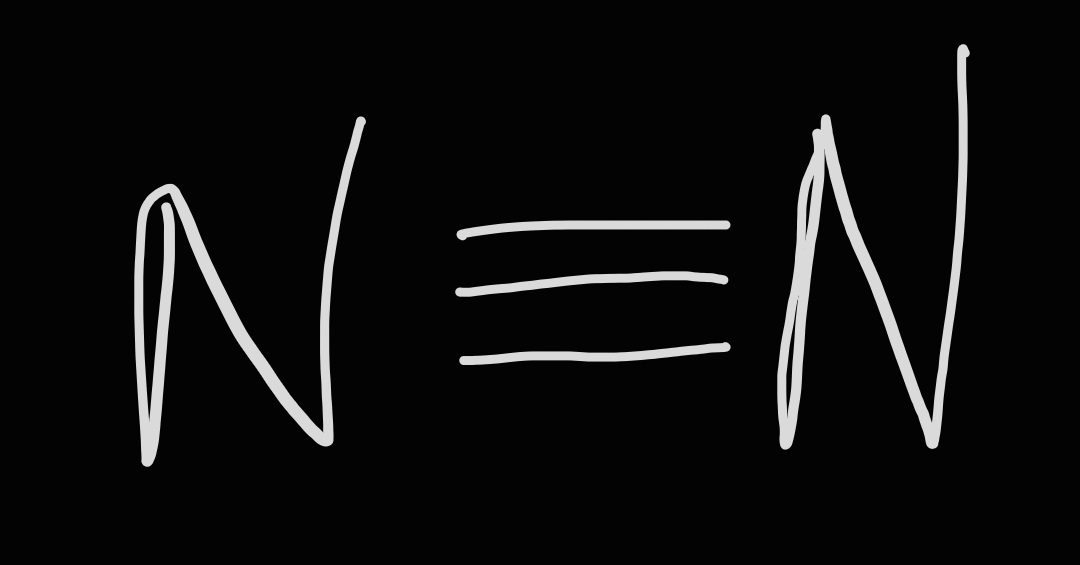
Each nitrogen atom needs to be involved in 3 covalent bonds, which means that each nitrogen atom needs to contribute 3 electrons.
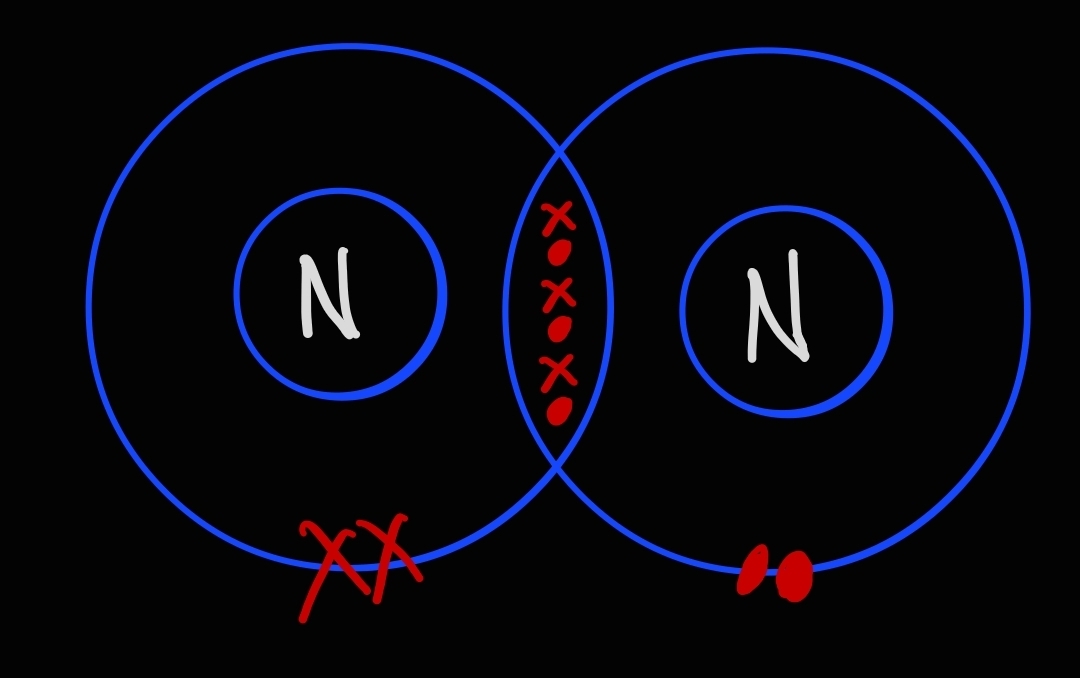
And since between the 2 atoms, each atom is contributing 3 electrons, then we have a triple bond.
Structural formula:
Covalent bonding with more than 2 atoms:
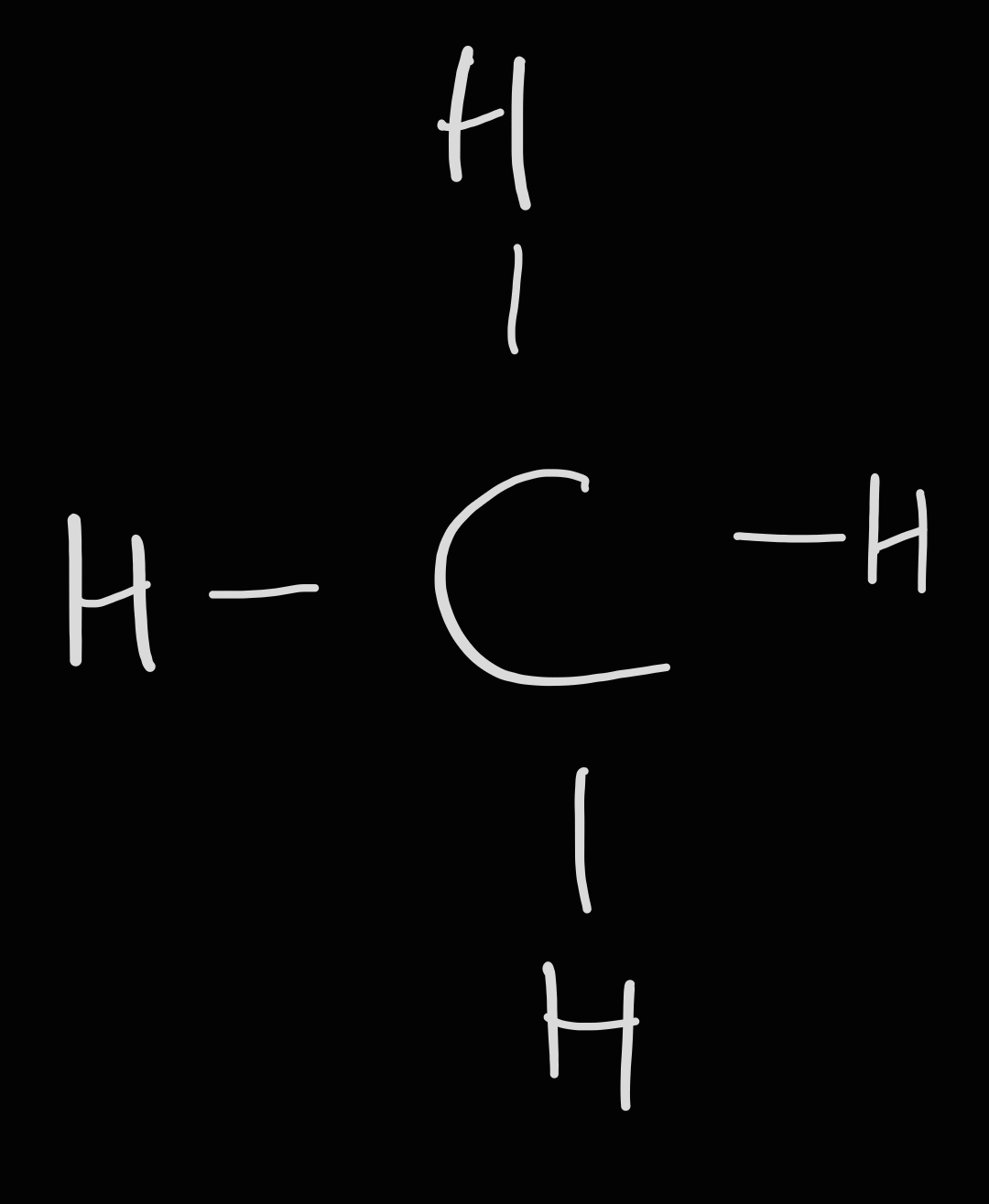
It is extremely common for covalent structures to have more than 2 atoms. Here is an example, CH4 or methane (1 carbon atom bonding with 4 hydrogen atoms).
- How many electrons does each atom have?
The hydrogen atoms have 1, Carbon has 4. - How many more do each atom need to reach a full outer shell?
Hydrogen is a bit special, because its outermost shell is also the first shell, which can hold up to 2 electrons max. Since hydrogen already has 1 electron out of those 2, it needs 1 more.Lastly, the carbon atom needs 4 more.
- The answer to step 2 = The number of covalent bonds that each atom must be involved in to have a full outer shell.
Each hydrogen atom needs to be involved in 1 covalent bond, and the carbon atom needs to be involved in a total of 4 covalent bonds.
As you can see, each hydrogen atom is involved in 1 covalent bond, and carbon is involved in a total of 4. This allows every atom to have a full outer shell.
Naming convention of typical covalent compounds
This is very important. Most of the time, you will only be given the name of the chemical compound, and you would be expected to know the chemical formula. Add this to our list of naming conventions:
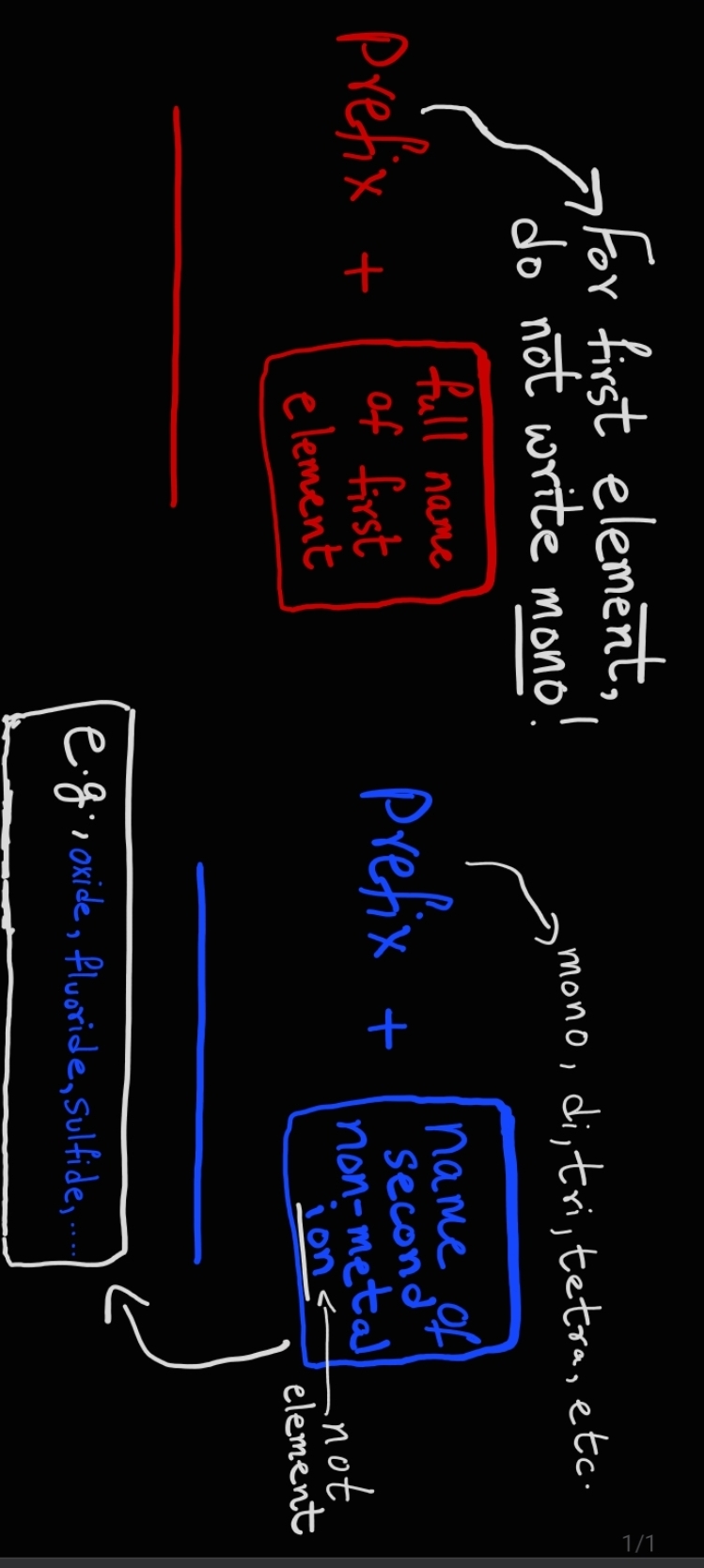
- First word: Write the name of the first element in the chemical formula.
- Add a prefix to that name (do not write mono. For the first element, the prefixes start from di-)
| Prefix | Meaning |
|---|---|
| Mono- | 1 |
| Di- | 2 |
| Tri- | 3 |
| Tetra- | 4 |
| Penta- | 5 |
| Hexa- | 6 |
| Hepta- | 7 |
| Octa- | 8 |
| Nona- | 9 |
| Deca- | 10 |
- Next word: Write the monoatomic-ion name of the second element.
- Add a prefix. Keep in mind that of the "vowel drop" rule: If your prefix ends with a vowel and the monoatomic-ion name starts with a vowel, then you will drop the ending vowel of the prefix. The only exception to this rule is if your prefix ends with "i," in that case don't drop anything.
List of vowels in English: A, E, I, O, U, and (sometimes) Y.
Examples -
Mono (prefix) + oxide (monoatomic-ion name of element) = monoxide (not monooxide)Penta + oxide = pentoxide (not pentaoxide)
Exception example: di + oxide = dioxide
Practice examples - Example 1: SF6
- SF6 (1 sulfur covalently bonded to 6 fluorines)
Step 1: Write the name of the first element
The name of the first element is Sulfur.
Step 2: See if you need to add a prefix.
Remember, for the first element, you do not write "mono." So we don't write any prefixes.
So first word: Sulfur.
Step 3: Write the monoatomic ion name of the second element.
The second element is fluorine. The monoatomic ion of fluorine is fluoride.
Step 4: Add the prefix.
We have 6 fluorides. 6 = hexa.
So second word: hexafluoride.
Name: Sulfur hexafluoride.
Example 2: N2O
- N2O (2 nitrogens and 1 oxygen covalently bonding together)
Step 1: Write the name of the first element
The name of the first element is Nitrogen.
Step 2: See if you need to add a prefix.
We have 2 nitrogens, so we have to add the prefix "di".
So first word: Dinitrogen
Step 3: Write the monoatomic ion name of the second element.
The second element is oxygen. The monoatomic ion of oxygen is oxide.
Step 4: Add the prefix.
We have 1 oxide. 1 = mono.
Notice, mono ends with a vowel (the "o") and oxide also starts with a vowel that isn't "i." Because of this, we will have to drop the ending-vowel of the prefix.
So second word: monoxide
Name: Dinitrogen monoxide.
Example 3: CCl4
- CCl4 (1 carbon covalently bonded to 4 chlorines)
Step 1: Write the name of the first element
The name of the first element is Carbon.
Step 2: See if you need to add a prefix.
The prefix is "mono," but as we know, we don't use "mono" for the first word.
So first word: Carbon
Step 3: Write the monoatomic ion name of the second element.
The second element is chlorine. The monoatomic ion of oxygen is chloride.
Step 4: Add the prefix.
We have 4 chlorides. 4 = tetra.
So second word: tetrachloride
Name: Carbon tetrachloride.
Example 4: P4O10
- P4O10 (4 phosphorus's and 10 oxygens bonding together)
Step 1: Write the name of the first element
The name of the first element is Phosphorus.
Step 2: See if you need to add a prefix.
We have 4 phosphorus's, so we have to add the prefix "tetra".
So first word: Tetraphosphorus
Step 3: Write the monoatomic ion name of the second element.
The second element is oxygen. The monoatomic ion of oxygen is oxide.
Step 4: Add the prefix.
We have 10 oxides. 10 = deca.
Notice, deca ends with a vowel (the "a") and oxide also starts with a vowel that isn't "i." Because of this, we will have to drop the ending-vowel of the prefix.
So second word: decoxide
Name: Tetraphosphorus decoxide
A mix between ionic and covalent bonding - Polyatomic ions
As you hopefully know by now, monoatomic ions are ions made from a single atom. However, we can also have ions made from multiple atoms, called polyatomic ions (poly means many).
These are ions formed from multiple atoms covalently bonded together that act as if they are a singular ion.
For example, in NaCl, Na+ is the positive ion and Cl- is the negative ion. But how about NaNO3? The positive ion is still Na+, but now the negative ion is NO3- as a whole. And if you were to look at NO3-, you would notice it is a covalent compound.
Your goal in this section is to memorize the common polyatomic ions by name, charge, and formula. I organized the ions into groups for ease of memorization.
Tips on memorizing in the end.
| Name | Formula | Charge |
|---|---|---|
| Ammonium | NH4+ | +1 |
| Nitrite | NO2- | -1 |
| Nitrate | NO3- | -1 |
| Name | Formula | Charge |
|---|---|---|
| Carbonate | CO32- | -2 |
| Bicarbonate or hydrogen carbonate (mean the same thing) | HCO3- | -1 |
| Acetate | CH3COO- or C2H3O2- | -1 |
| Name | Formula | Charge |
|---|---|---|
| Cyanide | CN- | -1 |
| Cyanate | OCN- | -1 |
| Name | Formula | Charge |
|---|---|---|
| Carbonate | CO32- | -2 |
| Bicarbonate or hydrogen carbonate (mean the same thing) | HCO3- | -1 |
| Acetate | CH3COO- or C2H3O2- | -1 |
NOTE: The polyatomic ions section will be continued in the next update to these notes.
Simple molecules and Giant covalent structures:
There are 2 types of covalent chemical structures: simple molecular compounds and giant covalent structures.
Simple molecular compounds are the most common type you will see. These molecules are made up of a relatively small number of covalent bonds, which makes the molecule "simple."
- Low melting/boiling points: Between each molecule, there are specific forces responsible for holding the molecules together, called "intermolecular forces." These forces are relatively weak and don't require much energy to break, giving simple molecular molecules low melting and boiling points.
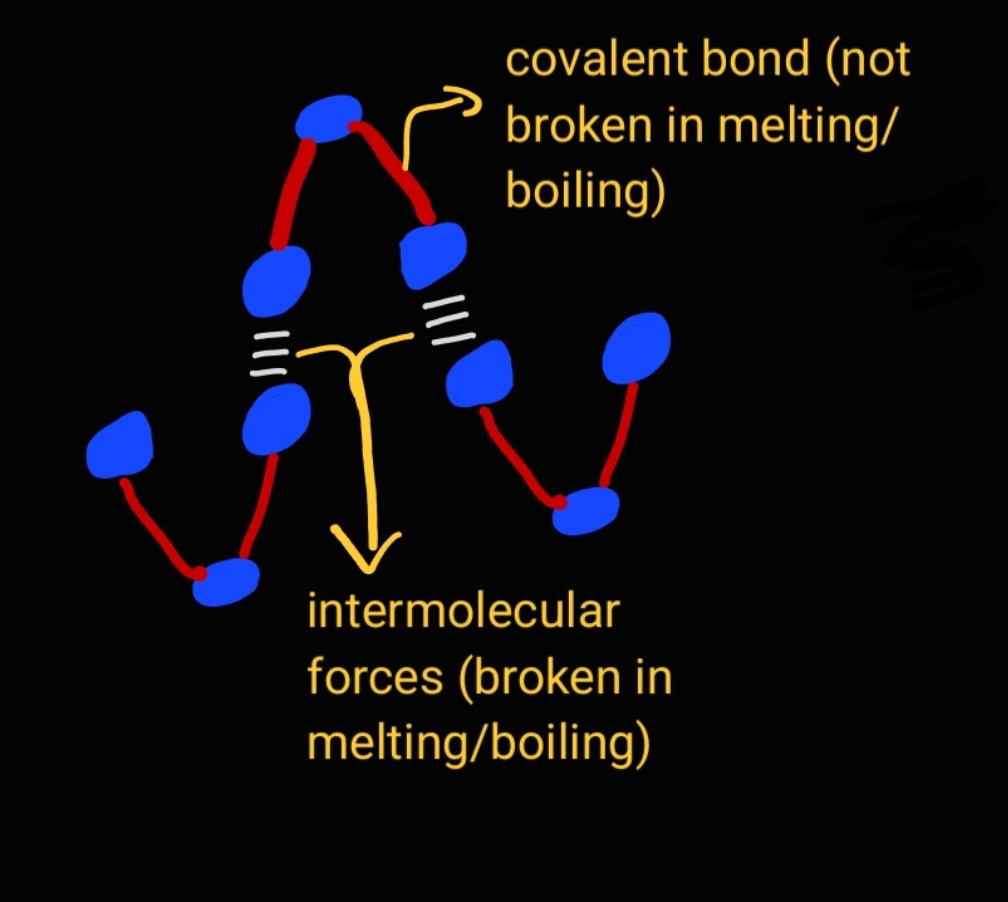
Important note: the covalent bonds are not broken when you melt or boil something. These covalent bonds remain and they are relatively quite strong. Instead, what is broken is the intermolecular forces between the molecules.
- Poor electrical conductivity: This is because they do not have any delocalized electrons or ions.
- Examples: The majority of covalent molecules you see are all simple covalent structures. For example, all the covalent molecules I drew above when explaining covalent bonding are simple covalent structures.
Giant covalent structures are a network of many atoms connected together by covalent bonds. There are 3 giant covalent structures you should know about: graphite, diamond, and silicon dioxide. We will go over all 3 of them (you need to be able to recognize these structures if you were shown a picture in an exam).
Graphite
First, let's look at its structure:
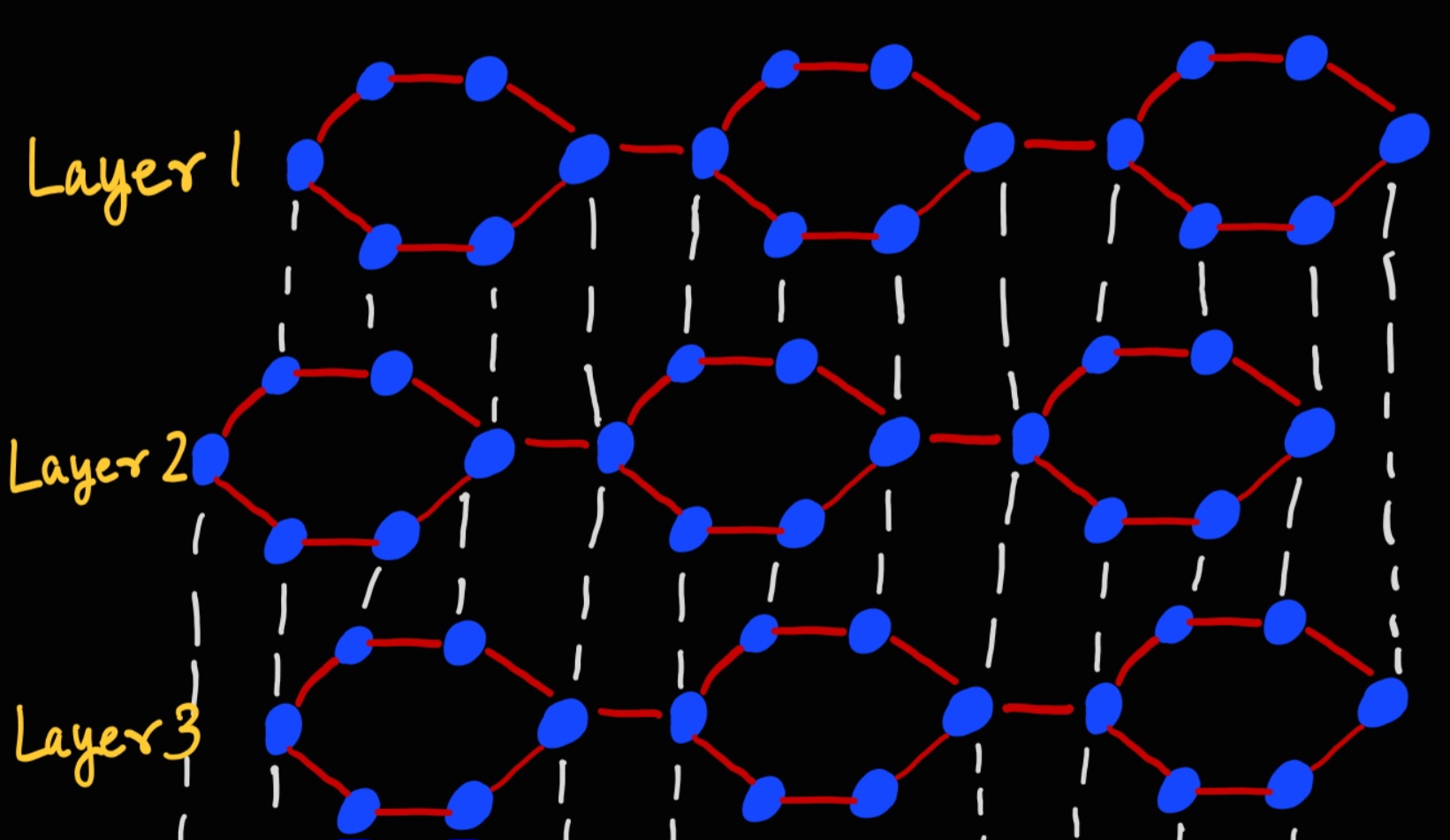
Blue - carbon atom
Red - covalent bond
White - intermolecular forces
As you can see, graphite is made up of carbon atoms covalently bonded together in a hexagonal arrangement to form a layer, and each layer is weakly connected to layers above and below them via the weak intermolecular forces (obviously my diagram is limited to a few layers, in reality there's a bunch). You can deduce a couple of things from this structure:
- Lubricant - Because the layers are weakly connected together via intermolecular forces, they can slide over each other quite easily. This makes graphite a good lubricant. In fact, this is why graphite is used in pencils - because the layers slide off the pencil and onto the paper.
- Good electrical conductor, allowing it to be used as electrodes - A carbon atom has 4 valence electrons. In graphite, notice how every carbon atom is forming 3 covalent bonds, which means every carbon atom is sharing 3 of its 4 electrons. This means that for every carbon atom, there is 1 electron that is not involved in bonding, instead it is delocalized and freely roaming around the structure. This allows graphite to be a good conductor of electricity, and hence used as an electrode (an electrode is an electrical conductor).
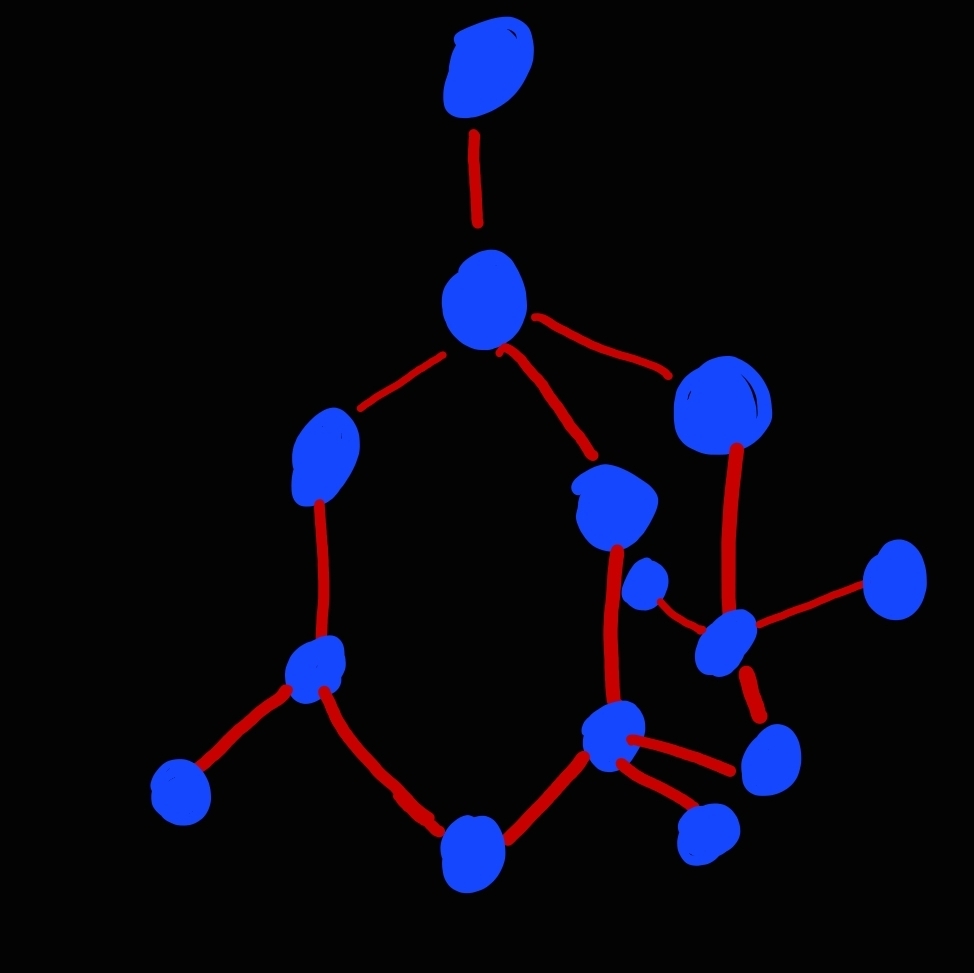
Diamond
Perhaps not the best drawing. Please refer back to your textbook or the internet for a better drawing. This is called diamond's crystal structure.
Blue - carbon atom
Red - covalent bond
So, in reality, diamond has a repeating tetrahedral structure, where every carbon atom is forming 4 covalent bonds. We can deduce a few things from this:
- Diamonds are very hard → used in cutting tools.
This is because it is completely filled with strong covalent bonds. Every carbon atom is forming 4 covalent bonds.
- Very high melting point (>3700 Celcius).
Again, because of the several covalent bonds formed.
- Not a good conductor of electricity.
An unbonded carbon atom has 4 valence electrons. In diamond, every carbon atom forms 4 covalent bonds, which means every atom is sharing all 4 electrons. Because all electrons are involved in bonding, you have no delocalized electrons that can move freely, causing diamond to be a bad electrical conductor.
Silicon Dioxide (silica)
NOTE: The silicon dioxide section will be continued in the next update to these notes.
First, what is the chemical formula of Silicon dioxide? Let's recall our naming conventions.
The structure of silicon dioxide is very similar to the structure of diamond:
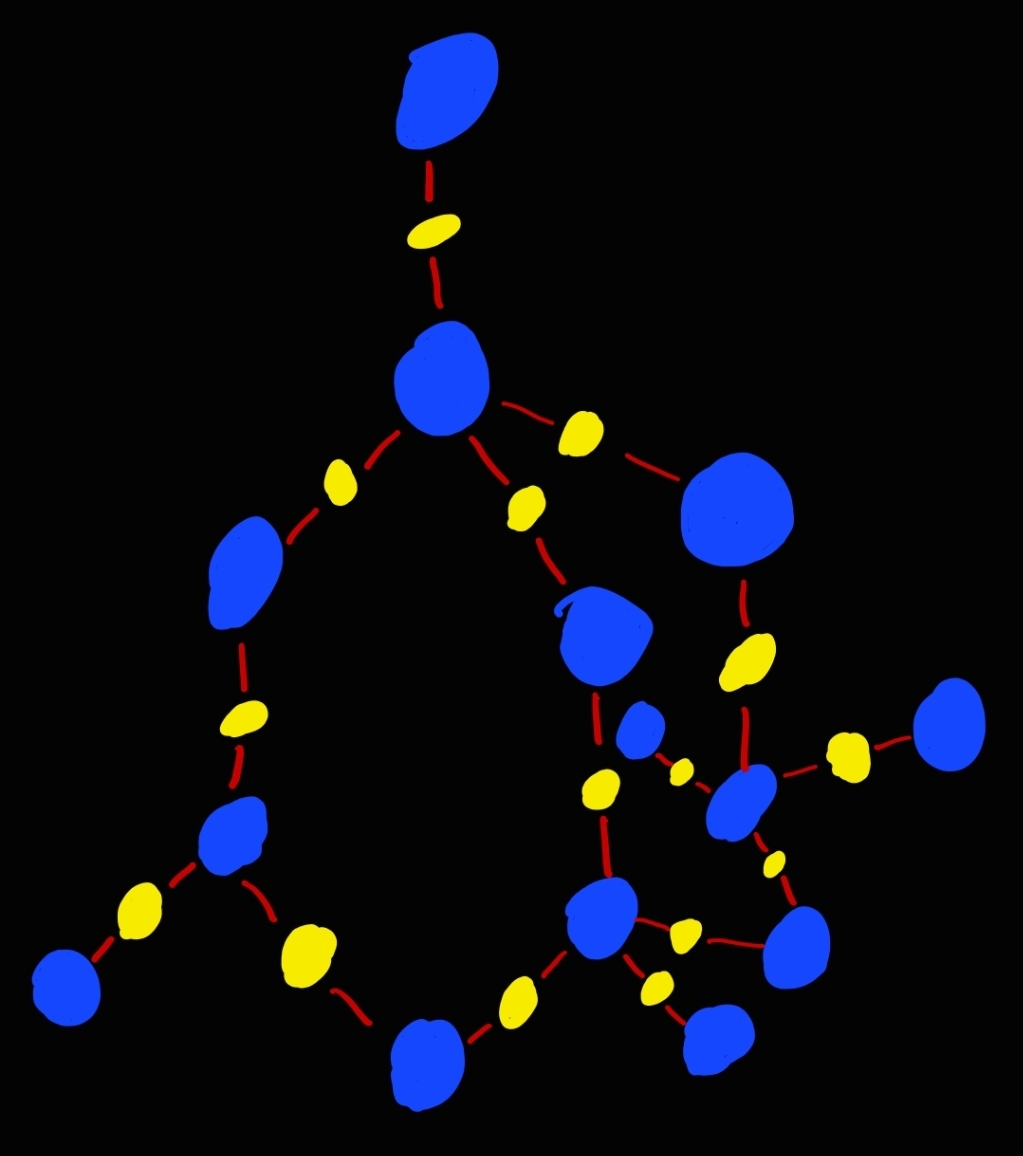
Blue - carbon
Yellow - oxygen
Red - covalent bond