Calculus I
Big thanks to Rapscallion for giving me advice and helping me review the notes!
These notes were made by KEMO to help his members on the STEM Help! Discord server. If you wish to join, here is the server invite: https://discord.gg/f2V6GUwE2V
I will try to go into enough depth to help you understand exam questions and the typical things you need to know, but not into too much depth. Refer back to your syllabus to make sure you're covering everything you need to cover.
If you see that a word is highlighted, that means I wrote down a simplified definition to help you understand what it means. Put your mouse over the highlighted word to see its definition.
Introduction
Calculus I is all about curves on graphs. Below are some things calculus I is used for that you will hopefully be able to figure out when you're done with these notes:
- Finding the area under a line on a graph
- Finding the slopeSlopeHow steep the line is on the curve. The greater magnitude (magnitude means I'm not referring to positive or negative signs. Just the number itself) the slope, the greater the steepness. If your slope is a negative value, that means that the line is going down. If your slope is a positive value, that means the line is rising up. (also known as the gradient) of a curved line at a specific point. Sometimes, this is given the term: rate of change.
- Finding the position of a moving object at a specific time period
- Finding the velocityVelocity(Note: you will not be asked to define this in a typical exam. I'm giving the definition for your benefit.) It's very similar to speed, but it also cares about direction. For example, a red car is moving 30 mph to the west and a blue car is moving 30 mph to the east. These 2 cars have the same speed (30 mph) but they have different velocities (they are going in different directions). When 2 objects are going in opposite directions, they will have opposite signs for their velocities (e.g. One car would have -30 mph and the other +30mph.) In either case, their speed will always be a positive value (e.g. just +30mph). of a moving object.
- Finding the rate of accelerationAcceleration(Note: you will not be asked to define this in a typical exam. I'm giving the definition for your benefit.) This refers to how quickly something is changing its velocity. The greater the magnitude of acceleration, the greater the object is changing its velocity. If acceleration is negative, the object is slowing down (can also be called deceleration). If the acceleration is positive, the object is speeding up. of a moving object.
1. Graphs and Functions
1.1 Lines/Curves and Functions
Let's get into lines and curves. Where do you typically see them? On graphs.
For example, look at the graph shown below:
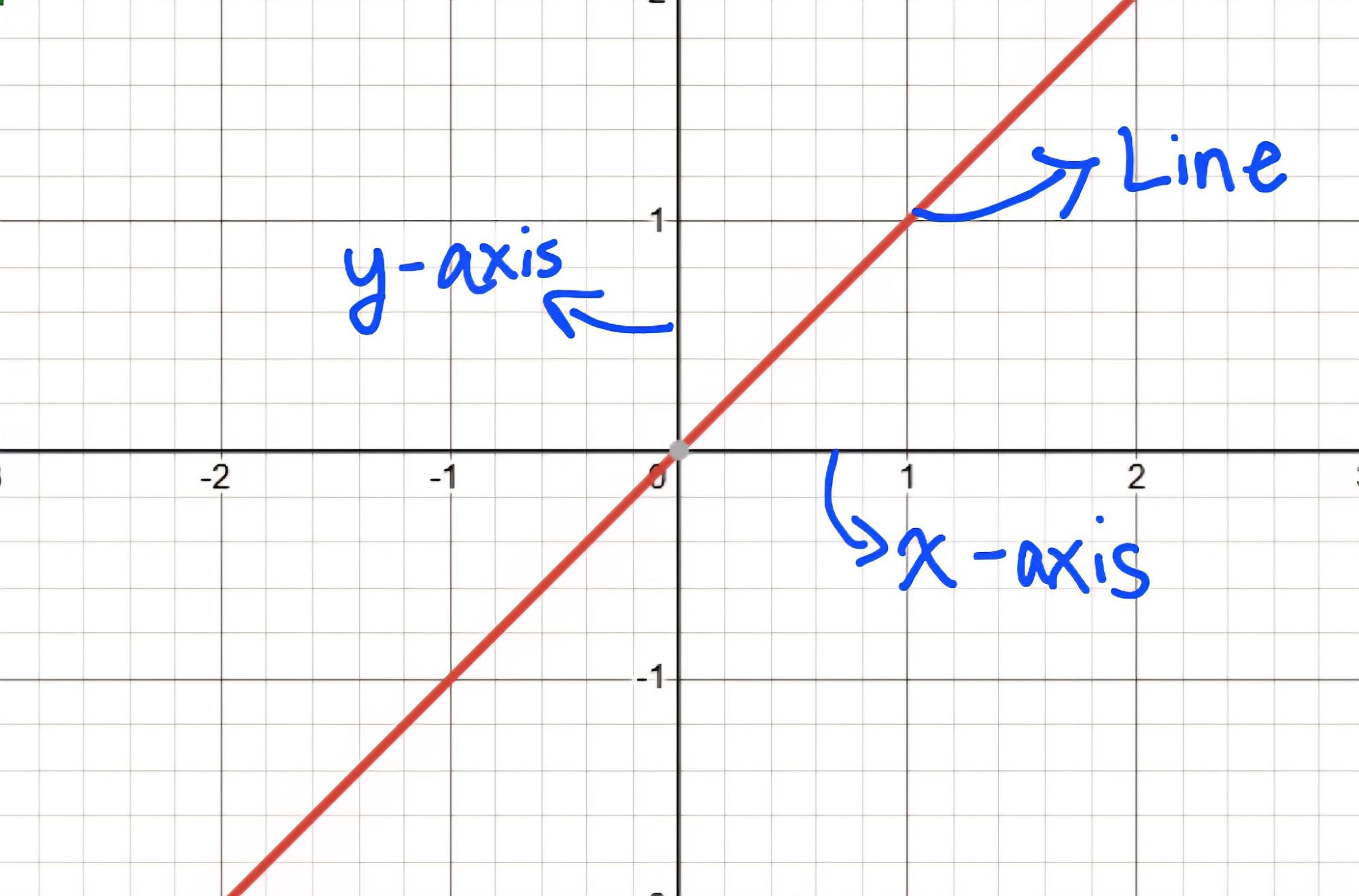
You can notice that when $x$ is $1$, $y$ is $1$. When $x$ is $2$, $y$ is $2$. When $x$ is $-0.5$, $y$ is also $-0.5$. In fact, for this particular line, $y$ will always equal $x$, hence the line can be rewritten as $y=x$. Another thing to keep in mind is: $x$ is the horizontal axis, while $y$ is the vertical axis.
On graphs, the line represents some kind of relationship between $x$ (the thing you typically want to change) and $y$ (the thing generally dependent on $x$). The usual expression is $y= …$, where the left hand side is dependent on the right hand side.
Functions are similar. They are used as a relationship between $x$ (again, the thing you typically change) and $f(x)$ (the thing dependent on $x$). The usual expression is $f(x)= …$, where the left hand side is dependent on the right hand side.
Since the definitions are very similar:
Can you draw every function on a graph? ▼
For the purposes of Calculus 1, yes! This is why you will usually see $y = …$ and $f(x) = …$ used interchangeably when you graph some things. As you advance more in mathematics, you may encounter some crazy functions that may break this rule, but this is not within the scope of our notes.
Can you turn every graph into a function? ▼
No, not all of them. Why? Because functions have a special rule: every $x$ value must correspond to only 1 $y$ value.
For example, here is the classical equation of a circle with a picture: $x^2+y^2=1$
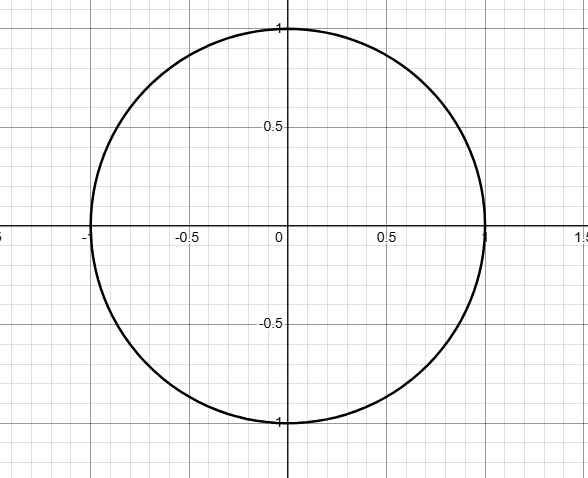
Let us pick $x = 0.5$. How many $y$ values are possible with that specific $x$ value? Look at the image below:
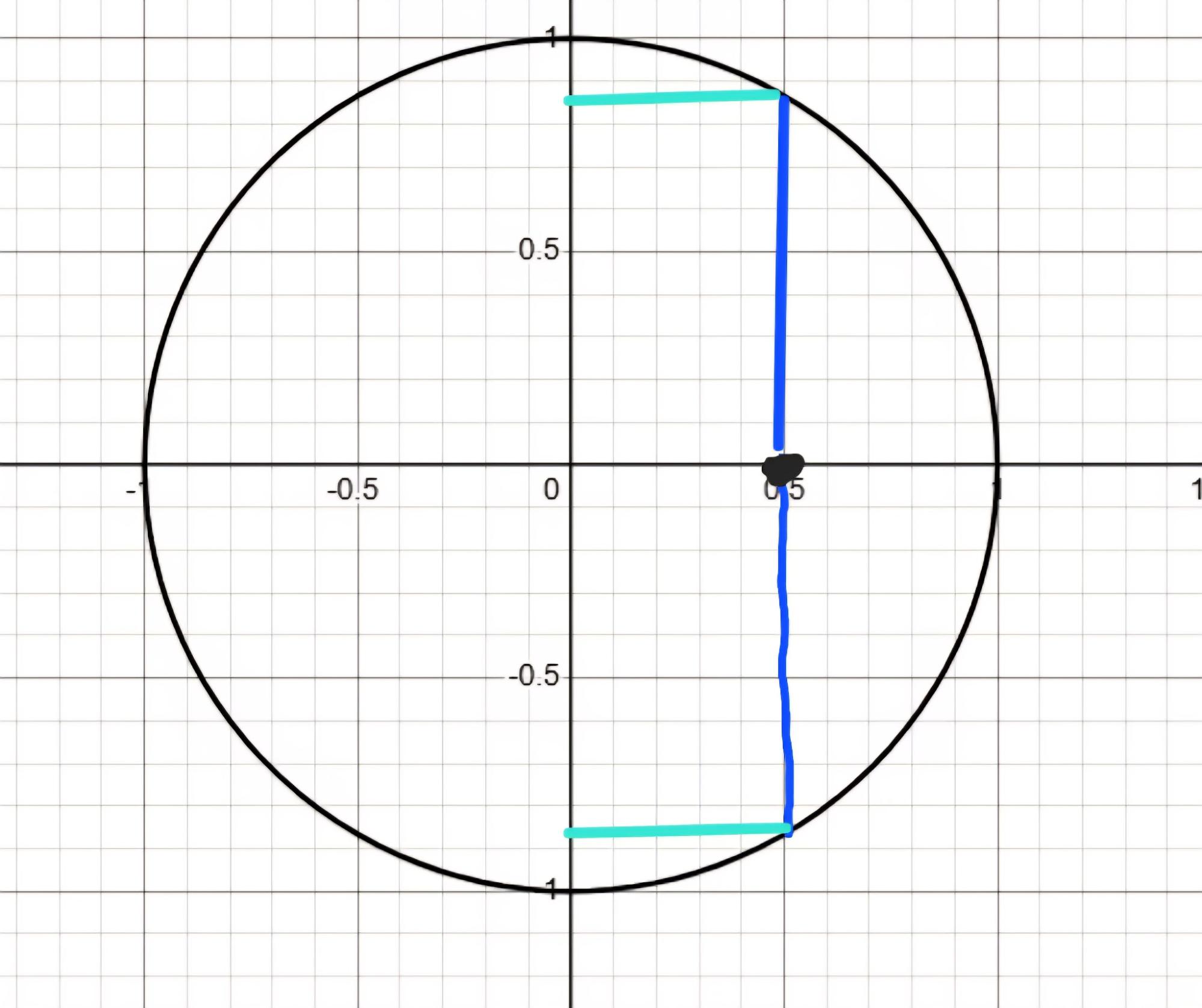
As you can see, this $x$ value corresponds to 2 different $y$ values. In other words, if I draw a vertical line at $x = 0.5$, I intersect the circle at 2 different points, hence $x^2+y^2=1$ is not a function.
Tip: Try the vertical line test (drawing a vertical line and seeing if it intersects your equation at more than one point) to see if the graph shown to you is a function or not.
There are some other terms that you are sometimes expected to know when you are look at graphs, such as (Note: The horizontal line test: draw a horizontal line to decide which type of graph are you looking at):
- One-to-one: 1 $y$ value corresponds to only 1 $x$.
Example:
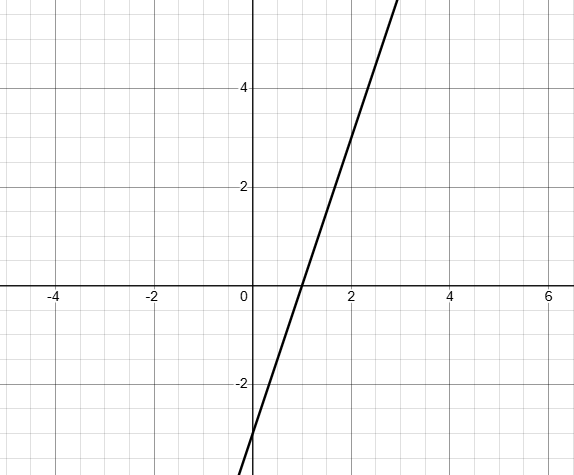 Pick any $y$ value, you will notice there is only 1 $x$ value that can give you that $y$ value.
 - Many-to-one: You can get the same $y$ value from 2 or more $x$ values (this is still a function).
Example:
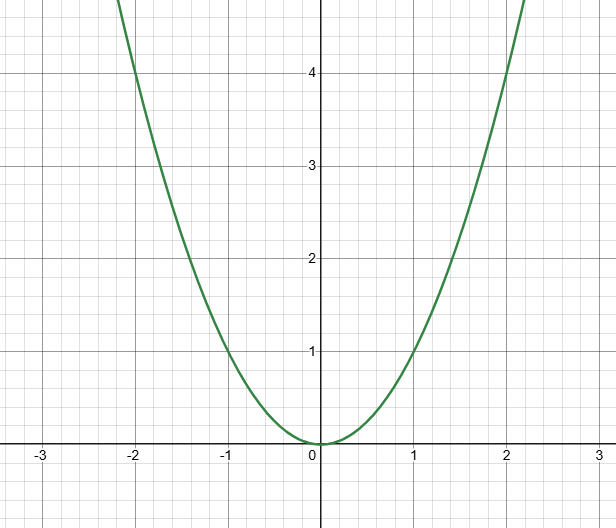 Pick a $y$ value (should be above 0 in this example), you will notice you can get it from 2 different $x$ values.
Draw a horizontal line. You will notice it intersects the curve at more than 1 point. However, this is still a function because it passes the vertical line test.
1.2 More stuff about functions
Assume that $f(x)=2x^2+3x+12$. What does $f(1)$ mean? It means that in the original expression of $f(x)=2x^2+3x+12$, everywhere you see an $x$, replace with a $1$.
So, $f(1)=2(1)^2+3(1)+12=2+3+12=17$.
This will get quite handy later on.
Keep in mind, a function can be made from several equations (called a piece-wise function, because it's broken into pieces). For example, I can say that when my $x$ values are less than $3$ (mathematically, written as $<3$), my function would have the equation $x^2$, but when my $x$ values are greater than or equal to $3$ (written as $\ge3$), my function would have the equation $x^3$.
This function would be written as
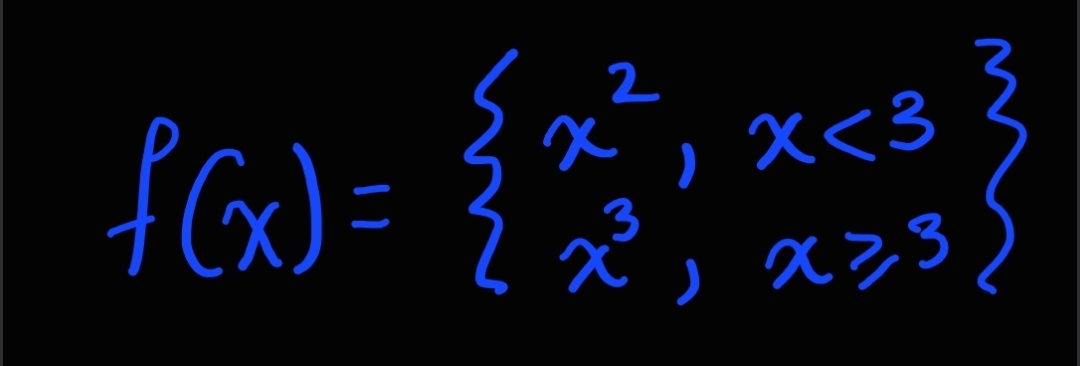
Note: It is not necessary that a function is depicted using $f(x)$, you can use any symbol instead of $f$, such as $g$, $h$, $v$, $a$, etc.
Moving on, you should know what a variableVariableA value that can change. We generally express variables in the form of letters. For example, the equation $f(x)=x+7$ has a lot of different answers depending on what $x$ is. If $x$ is $21$, then $21+7=28$. is.
More stuff about graphs, lines, and curves
Here are some examples of some common lines (if the line is not straight, it is called a curve) you will see throughout your math journey:
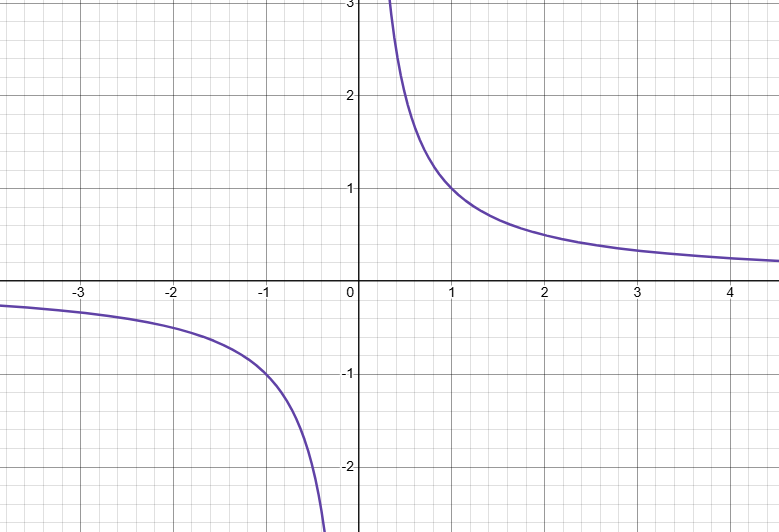
- $y=\frac{1}{x}$
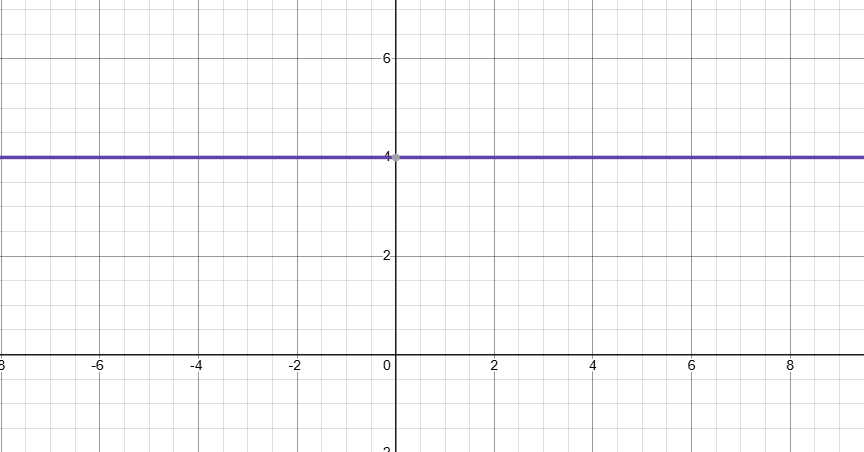
- $y=4$ (basically $y$ is equal to a constant value, something that doesn't depend on $x$)
The general expression of a straight line is as follows:
$$y=mx+b$$
- $m$ - represents the slope of the line
- $x$ - represents the $x$ value at a specific point
- $b$ - this is known as the $y$-intercept value - the $y$ value where the line intersects the $y$-axis
Keep in mind: in the equation $y=mx+b$, $y$ is called the subject of this equation because it is on 1 side completely separated from the rest.
1.3 Domain and Range
The domain is the $x$ values that you can input into your line or curve equation and the range is the possible $y$ values that you can get.
For example, I can input (domain) any $x$ value into the line equation $y = 2x$ and I will be able to get (range) any real number for $y$. Hence, the domain and range for this line equation is all the real numbers (which has the symbol $ℝ$).
If you input a specific value of $x$ and don't get a real number, the equation or line is said to be undefined at that point (in the sense that it won't give you a real number).
For example: $y=\frac{1}{x}$ is undefined when $x = 0$, since you can't divide by $0$.
Click to Load Limits MCQs
 Is there anything wrong with Kemo's statement: "This is a graph of a function because the graph passes the horizontal line test."
A) There is nothing wrong with the statement. ▼
Wrong! Kindly revise what the horizontal line test is and what are the conditions to be a function.
B) The graph doesn't pass the horizontal line test, so it can't be a graph of a function. ▼
Wrong! Why isn't it a function? What are the conditions to be a function?
C) The graph passes the horizontal line test, but it is still not a graph of a function. ▼
Wrong! How does it pass the horizontal line test? Try drawing a horizontal line at $y=1$, will that line intersect at more at one point?
Moreover, what test do you need to use to verify whether a graph is of a function or not?
D) The graph doesn't pass the horizontal line test, but it is a graph of a function. ▼
Correct! The graph doesn't pass the horizontal line test because drawing a horizontal line anywhere from $y=-1$ to $y=3$ will result in that line intersecting the graph more than once. Moreover, the horizontal line test isn't used to verify whether a graph is of a function or not. Instead, you should use the vertical line test. If you use the vertical line test, you will notice that drawing a vertical line anywhere in the graph will ensure that it intersects the graph only once, which means it is a function!
A) $-9$ ▼
Wrong! When negative numbers are squared, they become positive. So $-27$ is not possible from $(-3)^2$
B) $-6$ ▼
Wrong! You did 2 mistakes here. 1) You used the second part of the piecewise function: $f(x)=-2x$ which shouldn't have been used because $-3<0$, which means $f(x)=x^2$ is the appropriate piece, because $x=-3$ and $-3 < 0$. 2) Moreover, you omitted a minus from your calculation, because $-2(-3)=6$
C) $6$ ▼
Wrong! You used the second part of the piecewise function: $f(x)=-2x$ which shouldn't have been used because $-3<0$, which means $f(x)=x^2$ is the appropriate piece, because $x=-3$ and $-3 < 0$.
D) $9$ ▼
Correct! You used the first part of the piecewise function: $f(x)=x^2$, which was the correct thing to do because $x=-3$ is less than $0$. Lastly, $(-3) \times (-3) = 9$.
2. Limits
There's a lot of intuition that can be used to solve a question about limits. I will briefly go over how you can use intuition, and then show you other techniques or laws to solve such questions.
2.1 General intuition and what a limit is
First, get familiar with the symbol of limits:
$$\lim_{x \to a} f(x)$$
This means that you are taking the limit of some function, called $f(x)$, as $x$ is getting closer to the value "$a$" from both the left and right sides.
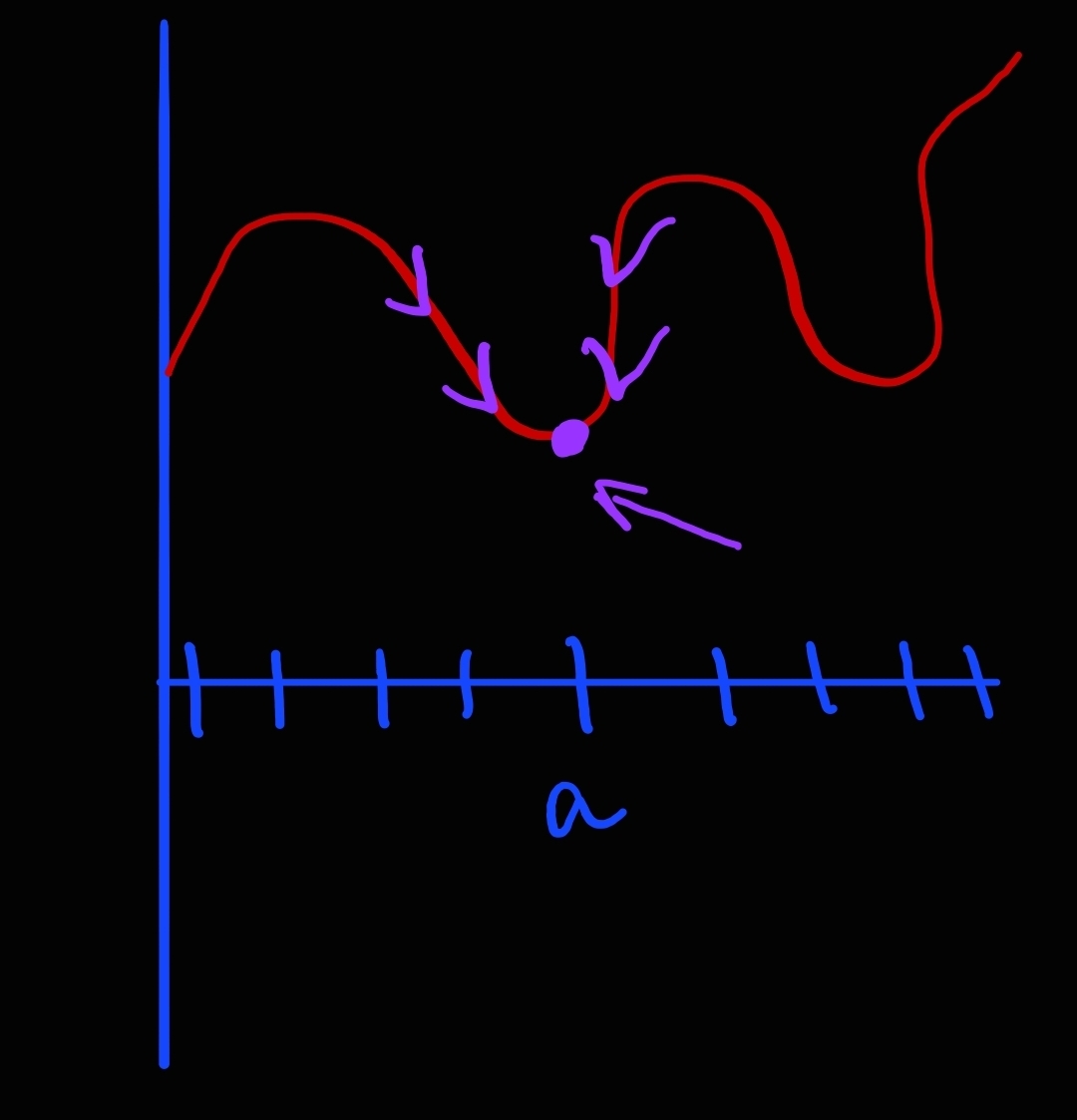
The purple dot is the value that $f(x)$ approaches as you get closer and closer to $x = a$.
So when we write $\lim_{x \to a} f(x)$, we are trying to find what the function $f(x)$ is approaching. Another thing to keep in mind is: we don't really care what happens at the point $x = a$, we only care what happens when we are coming close to it.
When you are trying to find a limit, you can always find it using the formal definition of a limit (even if it difficult for some problems), but I will not go into it in this notes. Keep in mind that there's a possibility a limit equals infinity, negative infinity, or maybe the limit doesn't exist at all.
Plenty of times, you can also find your answer by:
- using a graph (if you are given a graph or if the function is easy to graph)
- Plugging the value $x$ is approaching. Note that this doesn't always work. Typically you can do this if the function you are working with is continuousContinuousGraphically, it means that you can draw the function without needing to lift your pencil off the paper (in other words, it is completely connected). A more in depth explanation is provided below. in that specific interval of $x$ values. If you don't know if a function is continuous over that specific interval or not, just plug it in (this is not the best advice. You should know if a function is continuous or not. I went a little in depth to help you identify if a function is continuous or not). If it gives you a normal real number, congrats you probably found the limit. If you find yourself dividing by zero or breaking some of the laws of math, then this method won't help you.
Definition of a countinuous function: In more precise mathematical terms, it means that these 3 conditions are satisfied:
- plugging that $x$ value gives you a real number (it is defined).
- the graph must be approaching that real number you obtained from part 1 from both sides. Here is an example of what it should look like and what it shouldn't look like:
Example 1 (what it should look like):
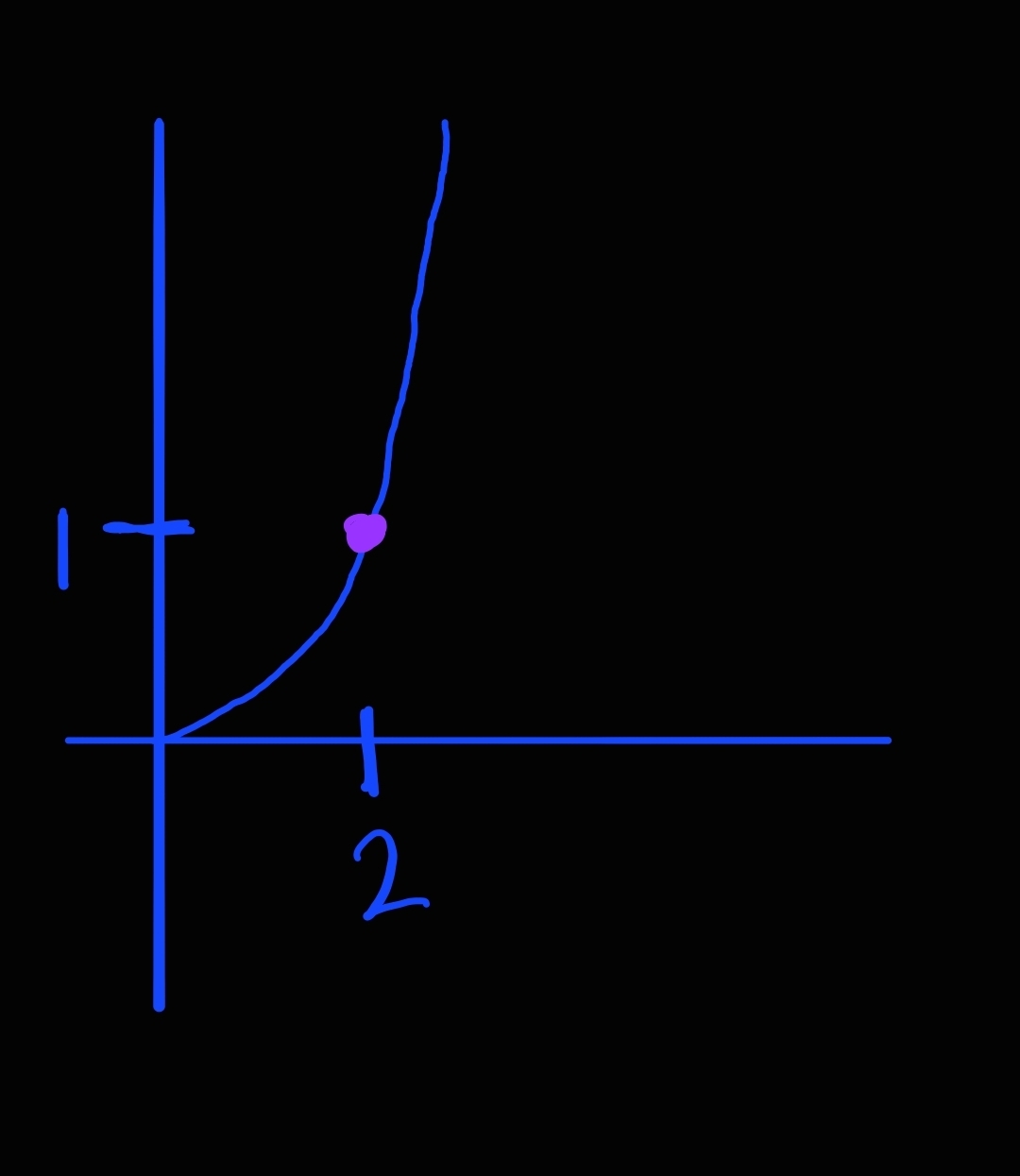 This is the graph of $f(x)=\frac{x^2}{4}$. It is defined everywhere across the real numbers, but I only drew the positive side. Notice that when you approach $x=2$ from the left side (meaning: going from the left side of the graph towards $2$), you are coming closer to the purple dot. Also, when you approach $x=2$ from the right side, you are still coming closer to the same purple dot. Hence, this condition is satisfied. If you are given a weird function that you just can't draw, try plugging in numbers just very slightly bigger than your target $x$ value and also very slightly smaller than your target $x$ value. For example, I would use $x=1.999$ and plug it in my function (so $\frac{1.999^2}{4}$) and maybe also $x=2.001$ and plug it in. The answers I get will be very close to $1$.
Example 2 (what it shouldn't look like):
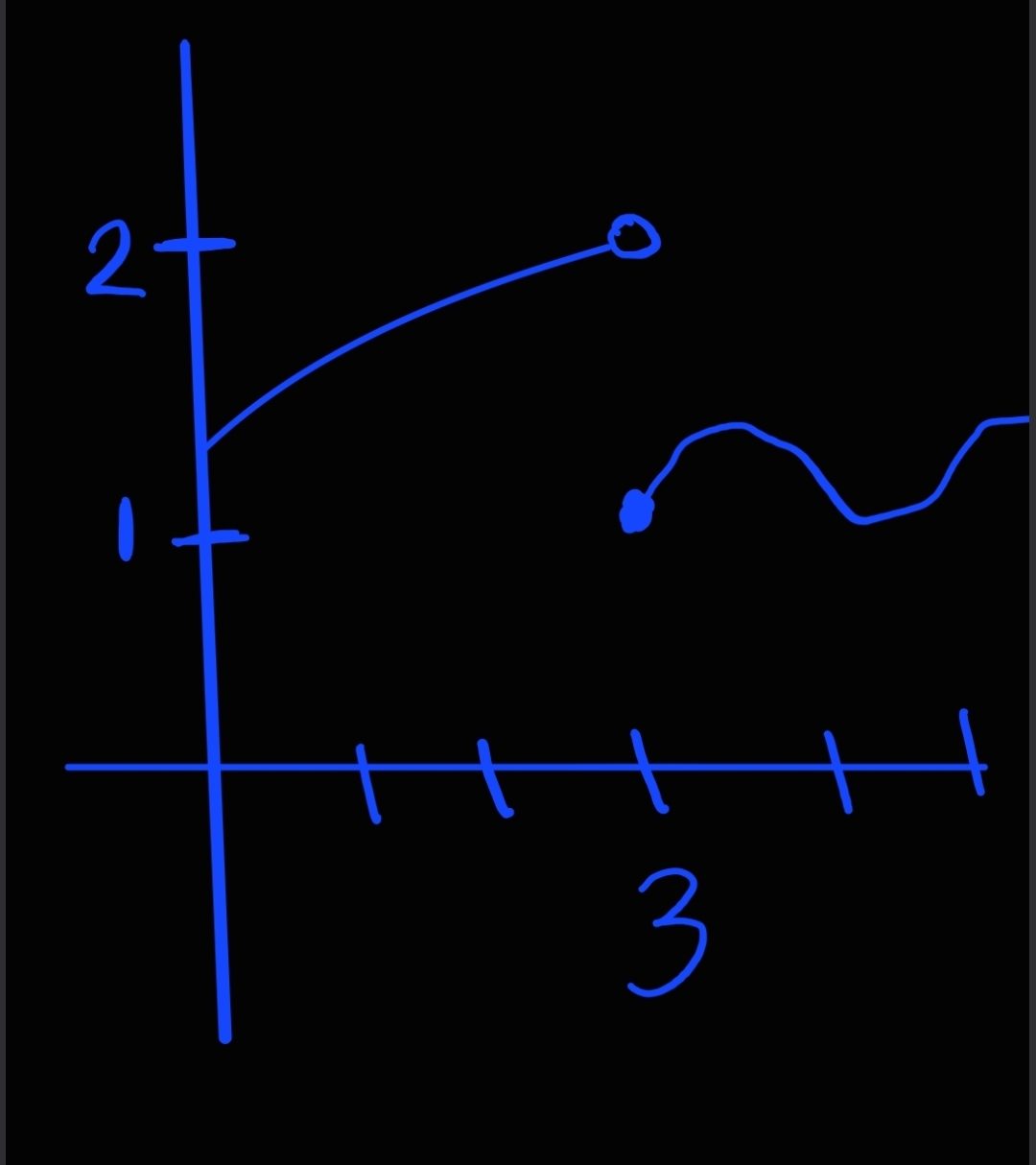 Here, I drew some arbitrary function, with a jump at $x=3$. Notice that when you are approaching $x=3$ from the left side, the function seems to be approaching the value $2$. However, when you are approaching $x=3$ from the right side, the function is approaching the value $1$. Hence, this condition is not satisfied and the function can not be continuous.
Looking at it, you can also tell that it's impossible to draw this function without lifting your pencil off the paper. - Finally, the function must equal the value you were approaching in the 2 previous parts when you plug in the corresponding $x$ value.
For example, here is the graph of the equation $f(x)=\frac{x^2}{4}$ again, but now when $x=2$, $f(x)$ would equal $3$ for some unknown reason.
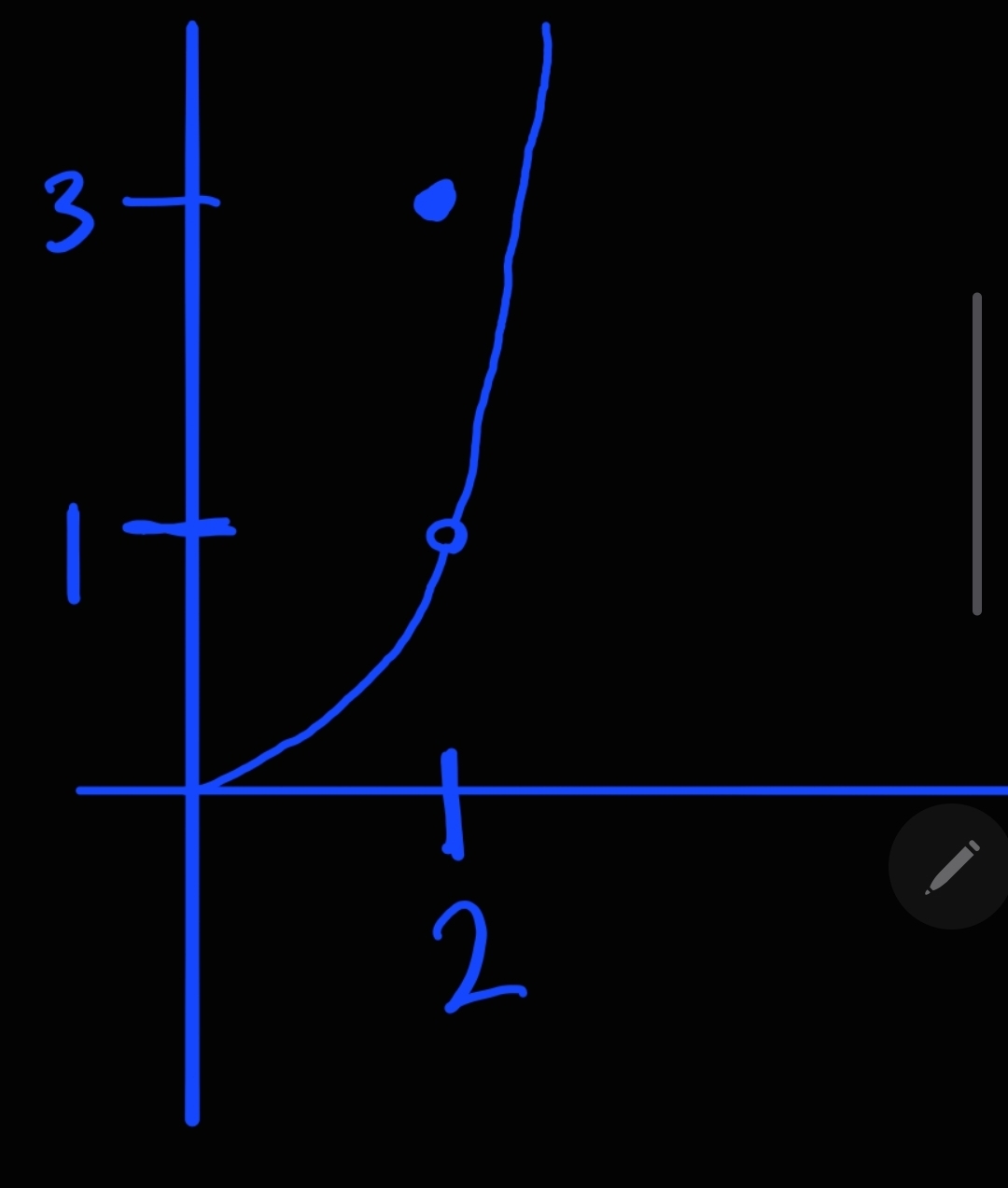 In this case, this is still not a continuous function because $f(x)$ doesn't equal $1$ when $x=2$.
For ease of find here are some equation types that are always continuous:
- Polynomials (such as $x$, $x^7+3$, $x^2+2x+1$, $(x+2)(x-1)$, etc.)
- Exponentials (such as $2x$, $e^x$, $\pi^x$, $7^x$, etc.)
- $sin(x)$, $cos(x)$.
- Root functions where they're defined (such as $\sqrt{x}$, $\sqrt[3]{x}$, $\sqrt[4]{x}$, $\sqrt[5]{x}$, etc.)
- Rational functions where the bottom isn't $0$ (such as $\frac{x^3+1}{x+1}$ where $x$ is NOT approaching a value that would make the bottom $= 0$. In this case, the scenario you want to avoid is when $x$ is approaching $-1$.)
So whenever you have some function $f(x)$, and the limit is asking you what would happen if you are getting very close to a specific value of $x$, try to imagine how the graph would look and judge from there (this is good when the function is relatively easy to imagine, such as $f(x)=x$ or $f(x)=5$, but when the function is ugly, you can't really do this and would have to resort to other techniques).
For example, here is this $\lim_{x \to 2} x^2$. It's asking you "When $x$ gets super close to $2$, what does $x^2$ get close to?" Well, look at the picture below:
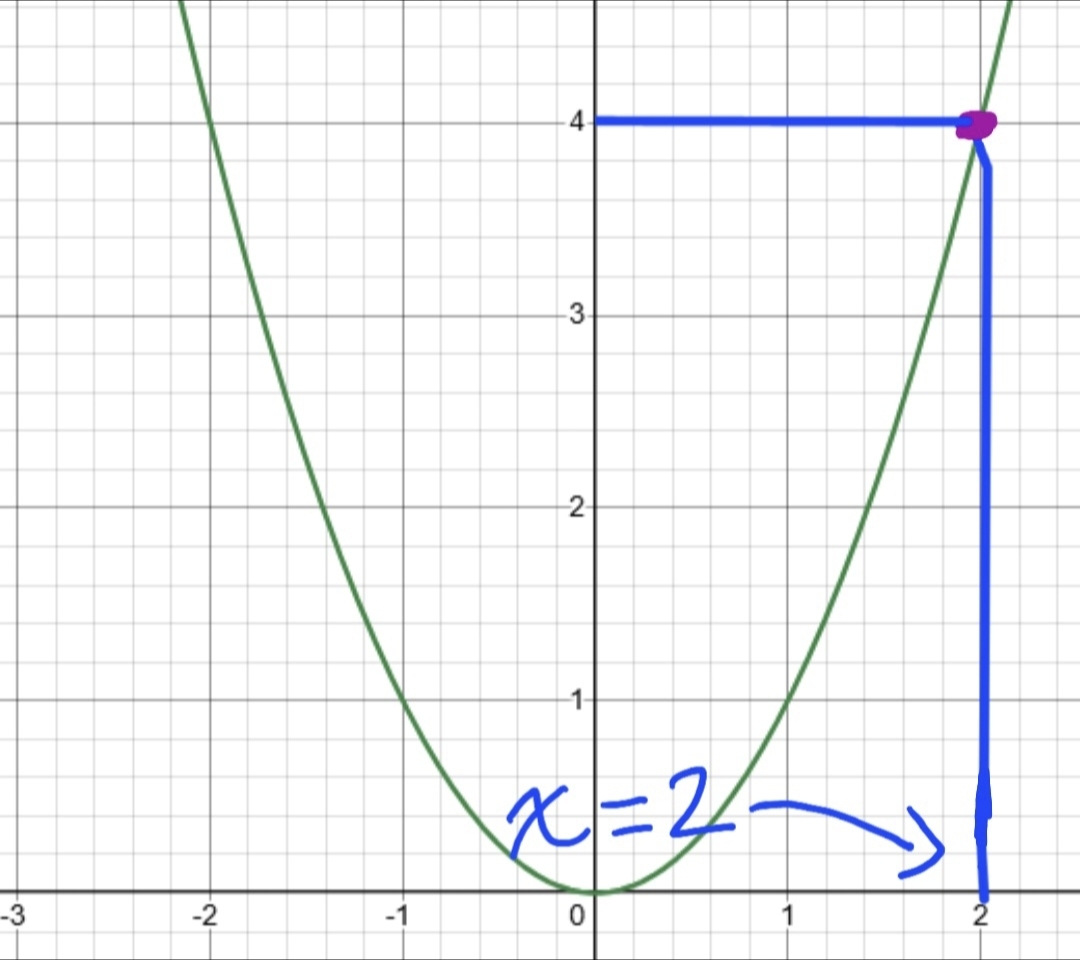
As you can see, as you get closer and closer to $2$, your $y$ value gets closer and closer to $4$. Hence, the answer is $4$.
2.2 Splitting limits
For example, consider the function $f(x)=x^2+2x-1$.
- $x+2\to$ terms: $x$, and $2$. They're separated by the $+$ sign.
- $2x^2+3x-77\to$ terms: $2x^2$, $3x$, $77$.
- $\frac{1}{x}-\frac{3}{7x}\to$ terms: $\frac{1}{x}$, and $\frac{3}{7x}$, separated by the $-$ sign.
- $x^3(x-3)+11\to$ terms: $x^3(x-3)$ and $11$. Notice that I can't split $x^3(x-3)$ into 2 terms, since they are being multiplied with eachother.
- $\frac{x^3}{x-3}+11\to$ terms: $\frac{x^3}{x-3}$ and $11$. Notice that I can't split $\frac{x^3}{x-3}$ into multiple terms, since they are being divided with each other. That $x-3$ also can't be split into two terms, since they are involved in division as a whole.
In our case, the terms are: $x^2$, $2x$, and $1$. So, we will split them apart and make 3 new limits. Then, we will add or subtract the new limits from each other according to the equation.
Original limit: $\lim_{x \to 3} x^2+2x-1$
New Limits: $\lim_{x \to 3} (x^2) +\lim_{x \to 3} (2x) +\lim_{x \to 3} (1)$
Happily, all these terms are continuous when $x=3$, so we can just input $x=3$ into all 3 limits to get: $(3)^2+2(3)-1=14$.
2.3 Moving constants
Look closely again at $\lim_{x \to 3} (2x)$. It is a constant (the number $2$) being multiplied by our variable $x$. The laws of limits allows us to do the following:
$$\lim_{x \to 3} (2x)=2\cdot \lim_{x \to 3} (x)$$
So basically, you can take the coefficient/constant outside.
Here is another example:
$$\lim_{x \to 3} 79(x^2-\frac{1}{x+3})=79\cdot \lim_{x \to 3} (x^2-\frac{1}{x+3})$$
You can also apply the previous splitting rule on $(x^2-\frac{1}{x+3})$, just remember that $79$ must multiply with all new limits.
2.4 Limits multiplying with each other
Consider $\lim_{x \to 2.5} (x-3)(x^2+2)$.
Well, this is a polynomial function, so you can just plug in $x=2.5$. But you can also do something else. The laws of limits allows me to do the following:
$$\lim_{x \to 2.5} (x-3)(x^2+2)=\lim_{x \to 2.5} (x-3)\cdot \lim_{x \to 2.5} (x^2+2)$$
In general, if you have multiple functions multiplying with each other, you can apply this law to just split it into multiple limits and multiply the resulting answer.
If the functions are dividing, you can still split into multiple limits but then just divide the answers instead. However, this is only the case if the bottom limit (the limit in the denominator) doesn't equal $0$.
2.5 Limits with powers
Consider $\lim_{x \to -10} (x^2-4)^3$. Well the laws of limits allows you to do this:
$$\lim_{x \to -10} (x^2-4)^3=[\lim_{x \to -10} (x^2-4)]^3$$
Basically, if your entire function is being raised to a positive power, you can take that power outside, find your limit without that power, and finally just raise your answer to the power you took outside.
2.6 Squeeze Theorem
This theorem is good when you have some weird trigonometric functions (you can use it in other types too, but I think this is the most common) such as $\lim_{x \to 0} xsin(\frac{1}{x})$. Here you can't just plug in $0$ because you would be dividing by $0$. To use the squeeze theorem:
- Check your original function and look for the part that you can easily figure out the maximum and minimum values of. In other words, look for the function that is stuck between 2 bounds.
In $xsin(\frac{1}{x})$, $x$ can take on any value you decide to give it, so it's not really stuck. $sin(\frac{1}{x})$ is a trigonometric function that is stuck between $-1$ and $1$ (this is based on your knowledge regarding trigonometry. If you feel unprepared in trigonometry, don't worry. You can learn as you go.) - Write the stuck equation between its maximum and minimum values.
In our case, you have to write: $-1 \le sin(\frac{1}{x}) \le 1$. - Your goal is to make the middle part of the inequality the same as your original function.
In our case, $sin(\frac{1}{x})$ is simply missing an $x$. So let us multiply everything by an $x$ (technically, the absolute value of $x$). Here is what we get: $$-1x \le xsin(\frac{1}{x}) \le 1x.$$ - Take the limit of the left, middle, and right inequalities as $x$ approaches the value in your original limit.
So in our case, $x$ was approaching $0$. So, our inequalities become:
$$\lim_{x \to 0} -1x \le \lim_{x \to 0} xsin(\frac{1}{x}) \le \lim_{x \to 0} 1x $$
we can easily evaluate $\lim_{x \to 0} -1x$ and $\lim_{x \to 0} 1x$. We can just input $x=0$ in each, giving us $0$ as the answer for both.
So our inequalities become:
$$0 \le \lim_{x \to 0} xsin(\frac{1}{x}) \le 0$$ - If the left and right inequalities are the same, then congrats you did it. You can now say: $\lim_{x \to 0} xsin(\frac{1}{x})=0$
I hope that you can now see that it's called the squeeze theorem because you squeezed your limit between 2 easier limits to get the answer.
2.7 Left and right handed limits
$\lim_{x^+ \to a} f(x)$ is the right handed limit because of the plus sign on the $x$ and $\lim_{x^- \to a} f(x)$ is the left handed limit because of the minus sign on the $x$.
Consider this limit $\lim_{x \to 0} \frac{1}{x}$. If we just input $x=0$, we will be dividing by $0$, which isn't allowed. What else do we know? Let's look at the graph of $\frac{1}{x}$, which I have shown you previously.
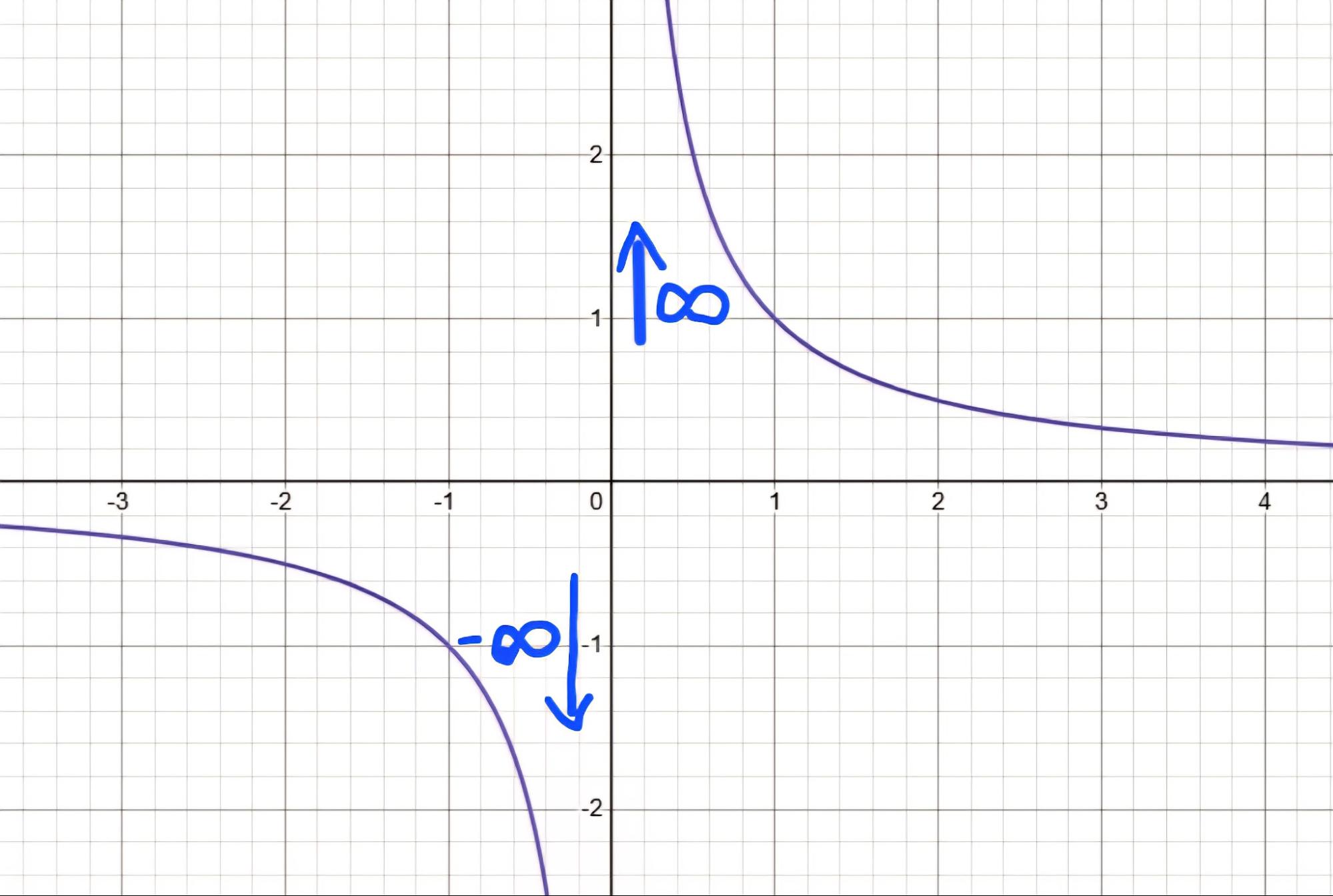
As we get closer to $0$ from the right side, we approach positive infinity. We can represent this using the limit $\lim_{x^+ \to 0} \frac{1}{x}=\infty$.
However, as we get closer from the left side, we approach negative infinity. We can represent this using the limit $\lim_{x^- \to 0} \frac{1}{x}=-\infty$.
When your left handed limit doesn't equal the right handed limit (in our case, positive infinity $\ne$ negative infinity), we say that limit does not exist (DNE). In our case, we represent this by $\lim_{x \to 0} \frac{1}{x}=DNE$.
Solving left and right handed limit uses the same laws as the usual limits.
3. Limits where $x$ approaches infinity
Sometimes, you need to see what happens when $x$ goes to positive or negative infinity. I will provide several cases for you to consider.
$\lim_{x \to \infty } f(x)$ where $f(x)$ is:
- Positive polynomial: A polynomial where the $x$ term with the greatest power$x$ term with the greatest powerHere are some examples to help you identify it:
- $x^4+2x-1$
$x^4$ has the greatest power, which is $4$. $2x$ has a larger coefficient than $x^4$ ($2x$ has a coefficient of $2$, while $x^4$ has a coefficient of $1$), but it has a power of $1$, which is less than $4$. - $-10x^7+3x^3$
$-10x^7$ has the greatest power, which is $7$. - $10000-x^2$
$x^2$ has the greatest power, which is $2$. That $10000$ term doesn't have an $x$, so it is not included.
Examples of $f(x)$: $x^2$, $x$, $x-100000$, $x^7-x^5-x^3$, $10x^3-20x$. - $x^4+2x-1$
- Negative polynomial: A polynomial where the $x$ term with the greatest power has a negative coefficient → the limit goes to negative infinity.
Examples of $f(x)$: $-x^2+3$, $-5x+100$, $-x$. - Positive top heavy: A rational function (basically a fraction) where the $x$ term with the greatest power is in the top and has a positive coefficient → the limit goes to positive infinity.
Examples of $f(x)$: $\frac{x^2+3}{x-100}$, $\frac{(x-4)(x-1)(x+5)}{x^2-3}$ (expand the top part to see why), $\frac{-x^2-x}{-1}$ (you can factor a $-1$ from the top and bottom and cancel), $\frac{11-x^3}{10-x^2}$ (same reasoning, factor a $-1$) - Negative top heavy: A rational function where the $x$ term with the greatest power is in the top and has a negative coefficient → the limit goes to negative infinity.
Examples of $f(x)$: $\frac{-2x^4+1}{x}$, $\frac{-11x^2+20x+100}{x^2+2x+1}$, $\frac{11-x^3}{x^2}$ - Bottom heavy: A rational function where the $x$ term with the greatest power is in the bottom → the limit goes to zero.
Examples of $f(x)$: $\frac{1}{x^2}$, $\frac{1}{x}$, $\frac{x^2+3x+1}{x^3+4x^2}$, $\frac{-x^2+x}{x^3}$
Note: Even if the limit is $\lim_{x \to -\infty } f(x)$, this would be true. - Top = bottom: A rational function where both the top and the bottom have the same greatest power for their $x$ term → the limit will be the fraction of the leading-term coefficients.
Examples of $f(x)$:
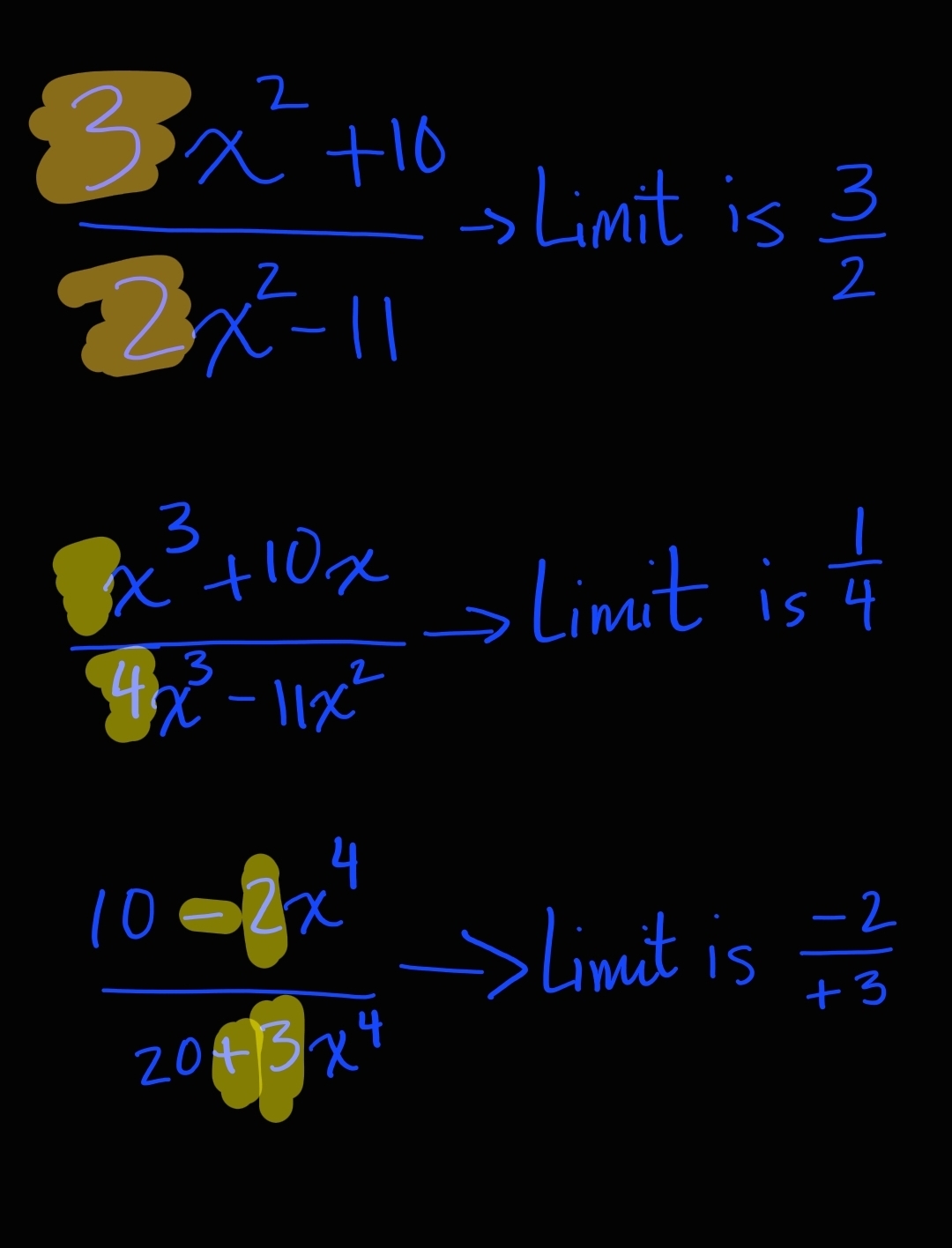
Note: Even if the limit is $\lim_{x \to -\infty } f(x)$, this would be true.
$x$ approaching negative infinity
It can be a little confusing in comparison to $x$ simply going to positive infinity, but it will hopefully be easier if you agree with the below statements:
- If $x$ is raised to an even power ($x^2$, $x^4$, $x^6$, $x^8$, ...), does it matter if $x$ is a positive or negative number? No. Why?
Let us suppose $x=3$. Then $x^2=3\cdot3=9$.
What if $x=-3$? Then $x^2=-3\cdot-3=9$
As you see, the answer is the same because the power is even. - If $x$ is raised to an odd power ($x$, $x^3$, $x^5$, $x^7$, $x^9$, ...), does it matter if $x$ is a positive or negative number? Yes. Why?
Let us suppose $x=3$. Then $x^3=3\cdot3\cdot3=27$.
What if $x=-3$? Then $x^3=-3\cdot-3\cdot-3=-27$
So it matters because the power is odd.
So in summary: It matters if $x$ is negative or positive only if the power is odd. If the power is even, the answer will always be positive.
You have to relate this back to the scenarios above, as the sign of your answer (whether the answer is $+$ or $-$) may need to be flipped. You must only consider the leading term. For rational functions, you must consider the leading terms for both the top and the bottom when you are deciding whether you have positive infinity or negative infinity as your answer.
I will show you 2 examples.
- $\lim_{x \to -\infty } -2x^3+2x^2+1$
- We only care about the leading term, which in this case is $-2x^3$
- Since we are going to negative infinity, then $x^3$ is getting more and more negative.
- So we have $-2$ getting multiplied by $-\infty$
- A negative times a negative is a positive
- The answer is positive infinity.
- $\lim_{x \to -\infty } \frac{x^4+3x^3+4}{x^3+10}$
- Again, we only care about leading terms. $f(x)$ is top heavy in this case, so we know our answer will either be $-\infty$ or $+\infty$
- Looking at the top, our leading term is $x^4$. The power is even (it's $4$), so we know that the top will be positive.
- Looking at the bottom, the leading term is $x^3$. The power is odd (it's $3$), so $x^3$ will be negative. Hence, the bottom is negative.
- So we have $\frac{positive}{negative}=negative$. So the answer is $-\infty$ or negative infinity.
You now must go back to the examples I gave you above (where $x$ was going to positive infinity) and check whether the answer changes if $x$ goes to $-\infty$.
4. Derivatives
All the talk about limits was to prepare you for the definition of a derivative and how to derive it using the definition. I will however not go into how to derive a derivative using the definition, and instead just present you with the normal laws and rules of differentiation, which you will be using in calculus 2 and most likely all the upcoming calculus that requires differentiating.
The best way to master differentiation is by practice. I will give you plenty of worked examples.
What does differentiation do? ▼
Differentiation allows you to figure out the gradient of a curve or a function. This will be useful in things like using the acceleration of an object to find its velocity at some point in time. It will also be useful if you wish to find the position of an object using its velocity.
Some notation to keep in mind. ▼
When you want to tell someone you are differentiating a function, you write it like this $\frac{d}{dx} f(x)$ or $f'(x)$. If you have a line/curve written like $y= ...$, then the derivative of that line will look like $\frac{dy}{dx}=...$.
4.1 Power rule
The basis of all differentiation. You use it when you want to differentiate anything in this form: $ax^n$ where:
- $a$ is just a number, like $1$, $2$, $3$, $54$, $\frac{1}{3}$, $e$, $\pi$, etc. (Basically any constant. Irrational numbers are included in this.)
- $n$ is any real number. $n$ is the power of $x$.
The derivative of $ax^n$ is $(a\cdot n)x^{n-1}$ (another way to write this: $\frac{d}{dx} (ax^n )=(a\cdot n)x^{n-1}$
- You multiply that $a$ by whatever the power was
- You subtract $1$ from the power of $x$
Examples:
- $x^2$
$\frac{d}{dx}=(1\cdot2)x^{2-1}=2x^1=2x$ - $3x^5$
$\frac{d}{dx} (3x^5)=(3\cdot5)x^{5-1}=15x^4$ - $\frac{7}{4}x^6$
$\frac{d}{dx}(\frac{7}{4}x^6)=(\frac{7}{4}\cdot6)x^{6-1}=\frac{7\cdot6}{4}x^5=\frac{42}{4}x^5=\frac{21}{2}x^5$. Keep in mind $(\frac{7}{4}\cdot6=\frac{21}{2})$ - $3\sqrt{x}$
First, can we rewrite this $\sqrt{x}$ in a more familiar way? Yes. Here is a picture to help you.
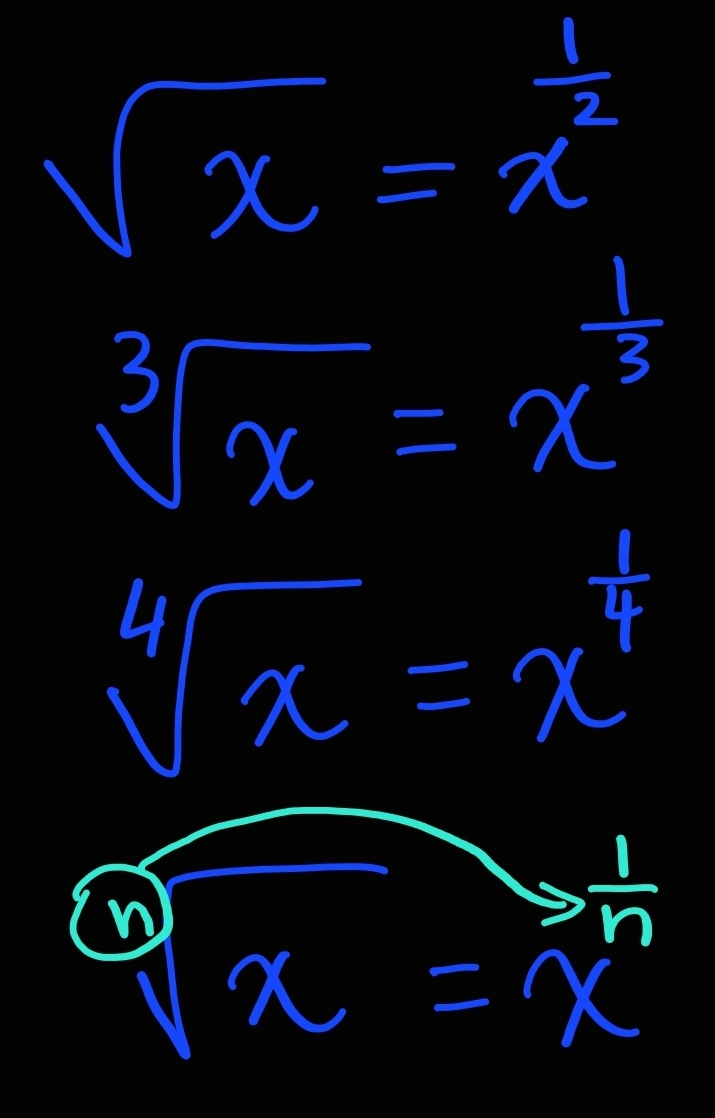
Note, if $x$ had some power, then this is how to express it: $\sqrt[n]{x^a}=x^{a\cdot\frac{1}{n}}$
So, we have $3\sqrt{x}=3x^{\frac{1}{2}}$
Now, $\frac{d}{dx}(3x^{\frac{1}{2}})=(3\cdot\frac{1}{2})x^{\frac{1}{2}-1}=\frac{3}{2}x^{-\frac{1}{2}}=\frac{3}{2x^{\frac{1}{2}}}$ - $\frac{10}{x}$
First, we want the $x$ to be up. We will raise it up and make the power negative.
We get $\frac{10}{x}=10x^{-1}$
Now, $\frac{d}{dx}(10x^{-1})=(10 \cdot -1)x^{-1-1}=-10x^{-2}=-\frac{10}{x^2}$
Some shortcuts:
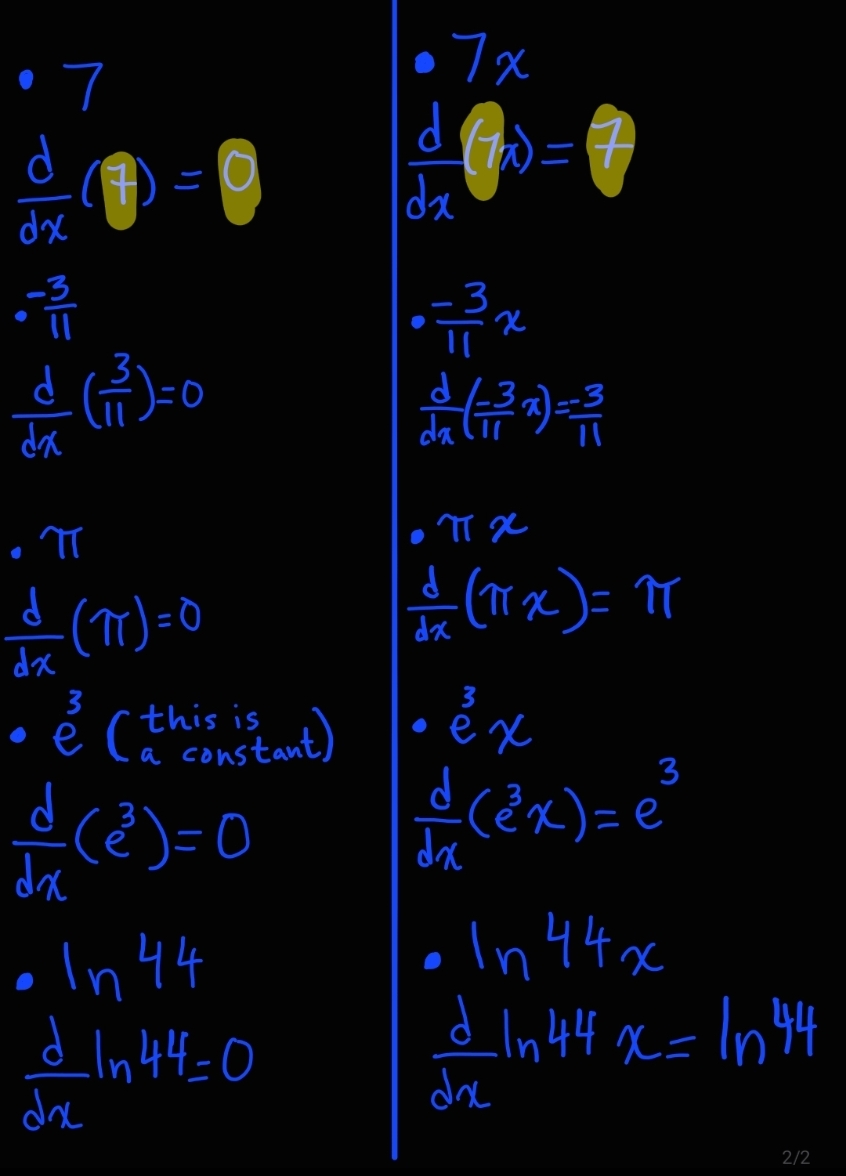
- If you have a constant all by itself like $10$, $3$, $1$, $\frac{3}{2}$, $40839$, ... The derivative of that will always be 0.
- If you have a term like $x$, $10x$, $344x$, $-13x$, ... (because $x$ has a power of $1$), the derivative of that will always be the constant next to the $x$.
The below image will provide you with some examples of these 2 shortcuts.
If you are uncomfortable with any of the algebraic steps done above, I recommend practicing until you get the hang of it. Exponentials can be quite confusing.
You can also separate the terms: Similar to how we separated the terms here in our previous sections, we can separate the terms of our derivative.
For example:
- $x^2+3x+1$
$\frac{d}{dx}(x^2+3x+1)=\frac{d}{dx}(x^2)+\frac{d}{dx}(3x)+\frac{d}{dx}(1)=(2 \cdot 1)x^{2-1}+3+0=2x^1+3$ - $17x^9-22x^3$
$\frac{d}{dx}(17x^9-22x^3)=\frac{d}{dx}(17x^9)-\frac{d}{dx}(22x^3)=(17 \cdot 9)x^{9-1}-(22 \cdot 3)x^{3-1}=153x^8-66x^2$
You can also separate constants (not variables) that are multiplying with the thing you want to differentiate by pushing that constant outside and ignoring it. After you are done differentiating, multiply with that constant.
For example, $\frac{d}{dx}(3x^2)=3 \cdot \frac{d}{dx}(x^2)$. I pushed that $3$ outside.
This is generally true for any function: $\frac{d}{dx}[a \cdot f(x)]=a \cdot \frac{d}{dx} [f(x)]$, where $a$ is just any constant.
Be careful as you may start multiplying stuff you aren't supposed to multiply. Always work step by step until you are confident.
4.2 Chain Rule
This is when you have a function inside another function.
The formula to differentiate such case is as follows:
$$\frac{d}{dx}f[g(x)]=f'[g(x)] \cdot g'(x)$$
It is easier to understand what this means using examples. If you didn't understand the explanation using the first example, try seeing the second example, maybe the picture helps.
Examples:
- $(x^2+3x+1)^4$
First, we need to identify our 2 functions.- Let's look at that big outside bracket. If we ignore everything in the inside, we can say that the outside function is $f(x)=x^4$.
- Now, we will make everything in the inside be our 2nd function. I will call this second function $g(x)=x^2+3x+1$
- Now, I want you first to refresh your memory by reading "More stuff about functions" section. After that refresher, we are going to find what $f[g(x)]$ means. It means that in my original $f(x)=x^4$, everywhere I see an $x$, I will replace it with the entire $g(x)$.
- So, $f[g(x)]=[g(x)]^4=(x^2+3x+1)^4$
- You will know you are doing a good job if you have managed to reach the original thing you are trying to differentiate using these steps.
- Now, we need to find 2 things: $f'[g(x)]$ and $g'(x)$
- To find $f'[g(x)]$, you will ignore what is inside the big brackets. Just treat it as if it was $x^4$. Using the power rule, you know that the derivative of $x^4$ is $(1\cdot 4)x^{4-1}=4x^3$.
Now, put back what you had inside those big brackets in place of $x$. You should get $4(x^2+3x+1)^3$ - Now, we need to find $g'(x)$. We know that $g(x)=x^2+3x+1$. So we need to differentiate that using the power rule.
$\frac{d}{dx}(x^2+3x+1)=\frac{d}{dx}(x^2)+\frac{d}{dx}(3x)+\frac{d}{dx}(1)=(2 \cdot 1)x^{2-1}+3+0=2x^1+3$ - We can finally use the formula $\frac{d}{dx}f[g(x)]=f'[g(x)] \cdot g'(x)$
Input $f'[g(x)]=4(x^2+3x+1)^3$ and $g'(x)=2x+3$
Final answer: $4(x^2+3x+1)^3\cdot (2x+3)$
- $(17x^9-22x^3)^5$
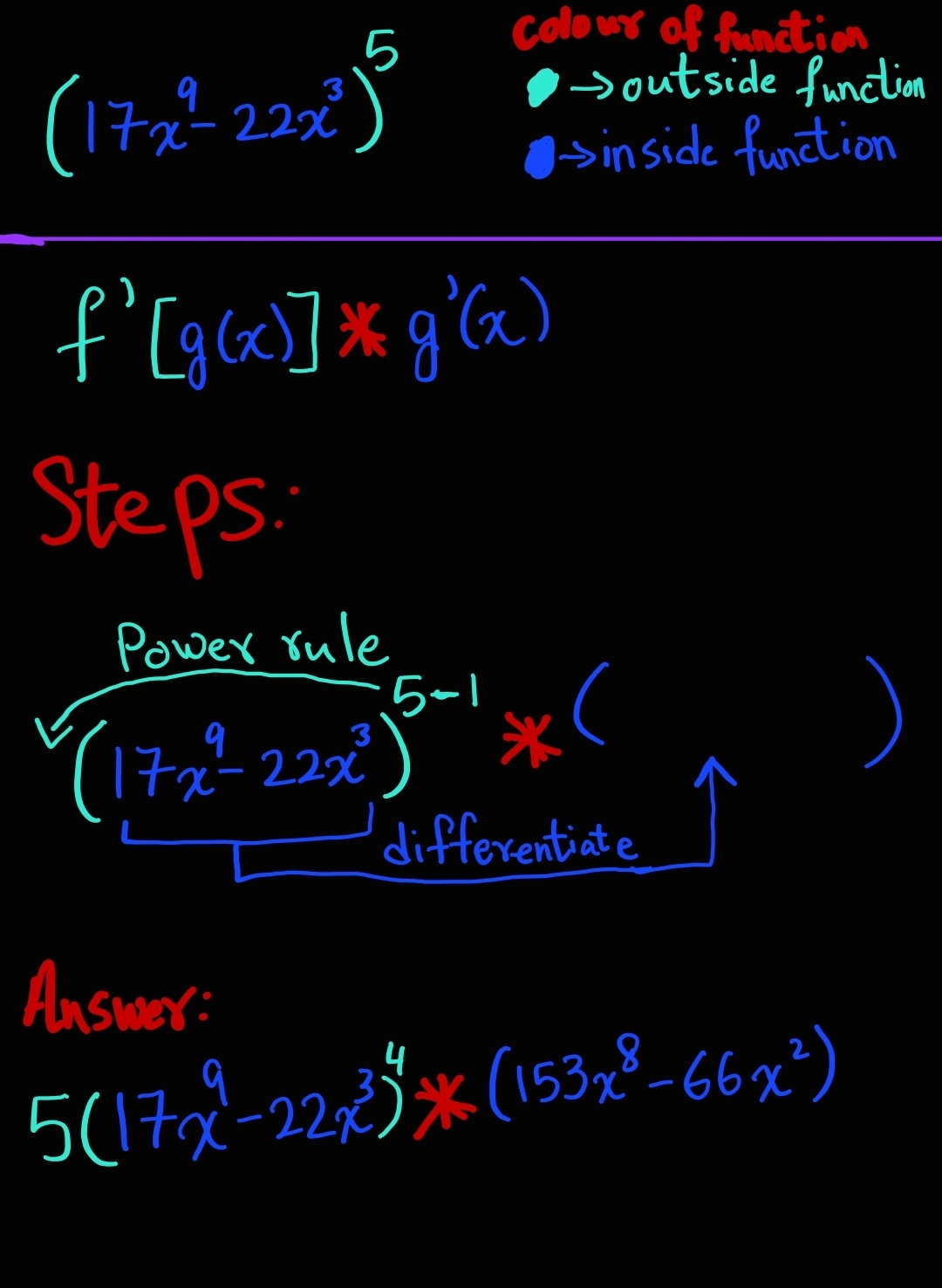
The steps to differentiate $17x^9-22x^3$ are shown in the power rule section above.
We will see more examples of the chain rule in combination with other rules.
4.3 Product Rule
You use this when you have two functions multiplying with each other. The formula to differentiate is:
$$\frac{d}{dx}[f(x) \cdot g(x)]=f'(x) \cdot g(x)+f(x) \cdot g'(x)$$
Examples: (second example has pictures)
- $(x^3-2x)(4x^2+3)$
- First, identify your 2 functions. As a good rule of thumb, look for 2 or more big things multiplying with each other. You can hopefully see that $(x^3-2x)$ is one big thing and $(4x^2+3)$ is another big thing.
- I will make $f(x)=(x^3-2x)$ and $g(x)=(4x^2+3)$
Note: It doesn't matter in the product rule if you flip them, making $f(x)=(4x^2+3)$ and $g(x)=(x^3-2x)$. - Now, find the derivative of $f(x)$ and $g(x)$ separately.
- To find $f'(x)=\frac{d}{dx}(4x^2+3)$ we will use the power rule and separate the terms from each other.
$\frac{d}{dx}(4x^2+3)=\frac{d}{dx}(4x^2)+\frac{d}{dx}(3)=(4 \cdot 2)x^{2-1}+0=8x$ - To find $g'(x)=\frac{d}{dx}(x^3-2x)$, we will do the same as step 4
$\frac{d}{dx} (x^3-2x)=\frac{d}{dx}(x^3)-\frac{d}{dx}(2x)=(1 \cdot 3)x^{3-1}-2=3x^2-2$ - We will now input the values in our formula
$\frac{d}{dx}[f(x) \cdot g(x)]=f'(x) \cdot g(x)+f(x) \cdot g'(x)$
$\frac{d}{dx}[(x^3-2x)(4x^2+3)]=(8x)(x^3-2x)+(4x^2+3)(3x^2-2)$
You can simplify if you wish.
- $(17x^9-22x^3)^5(x^2+3x+1)^4$
- Note: this one will require you to use all rules we went over so far.
- Our 2 big functions that are multiplying with each other are $f(x)=(17x^9-22x^3)^5$ and $g(x)=(x^2+3x+1)^4$.
- Let's find $f'(x)=\frac{d}{dx}(17x^9-22x^3)^5$. We need to use the chain rule. I will highlight the big outside function in $f(x)$ and also the inside function.
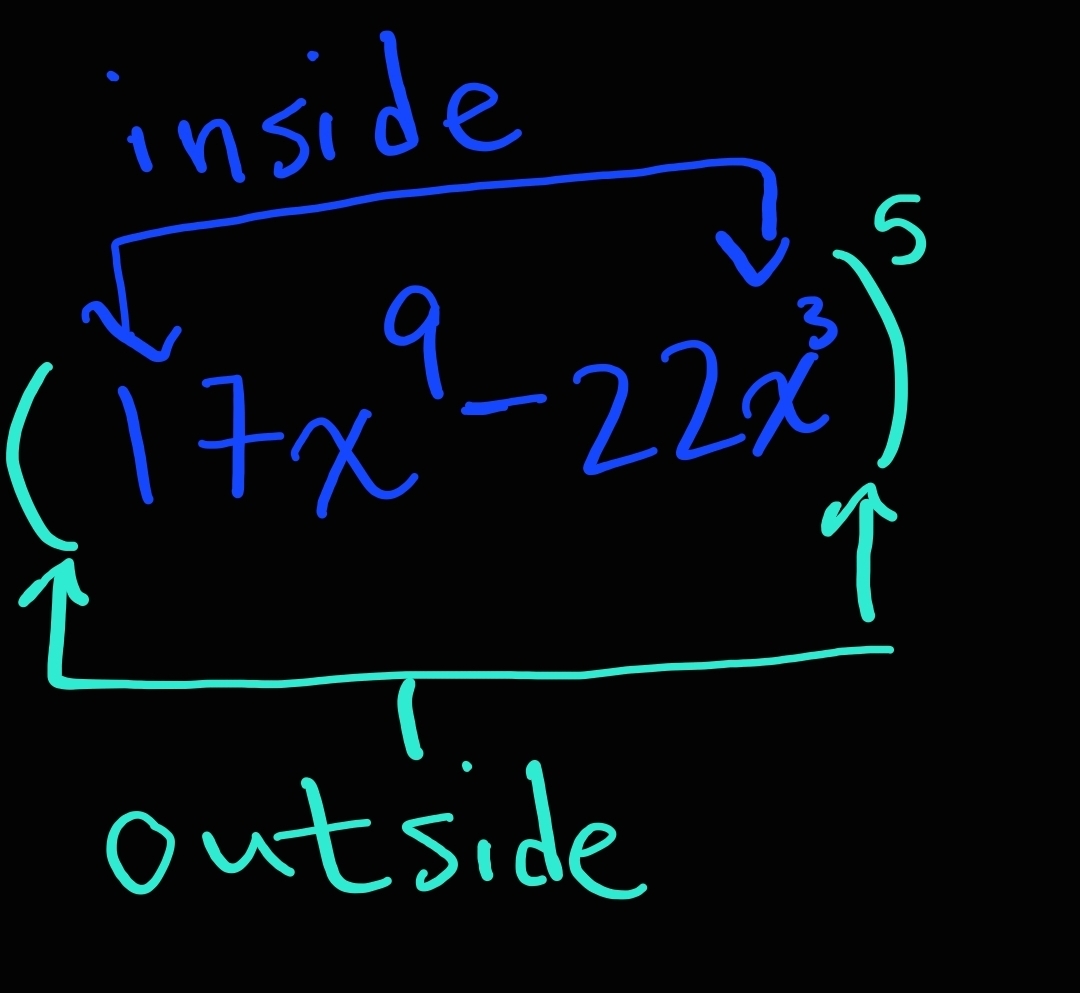
Remember, differentiate the outside while keeping the inside the same, and then multiply by the derivative of the inside.
$\frac{d}{dx}(17x^9-22x^3)^5=5(17x^9-22x^3)^4 \cdot (152x^8-66x^2)$
Steps to do this were done here. - Now, we need to find $g'(x)=\frac{d}{dx}(x^2+3x+1)^4$
We will once again use the chain rule. I will highlight the outside and inside functions.
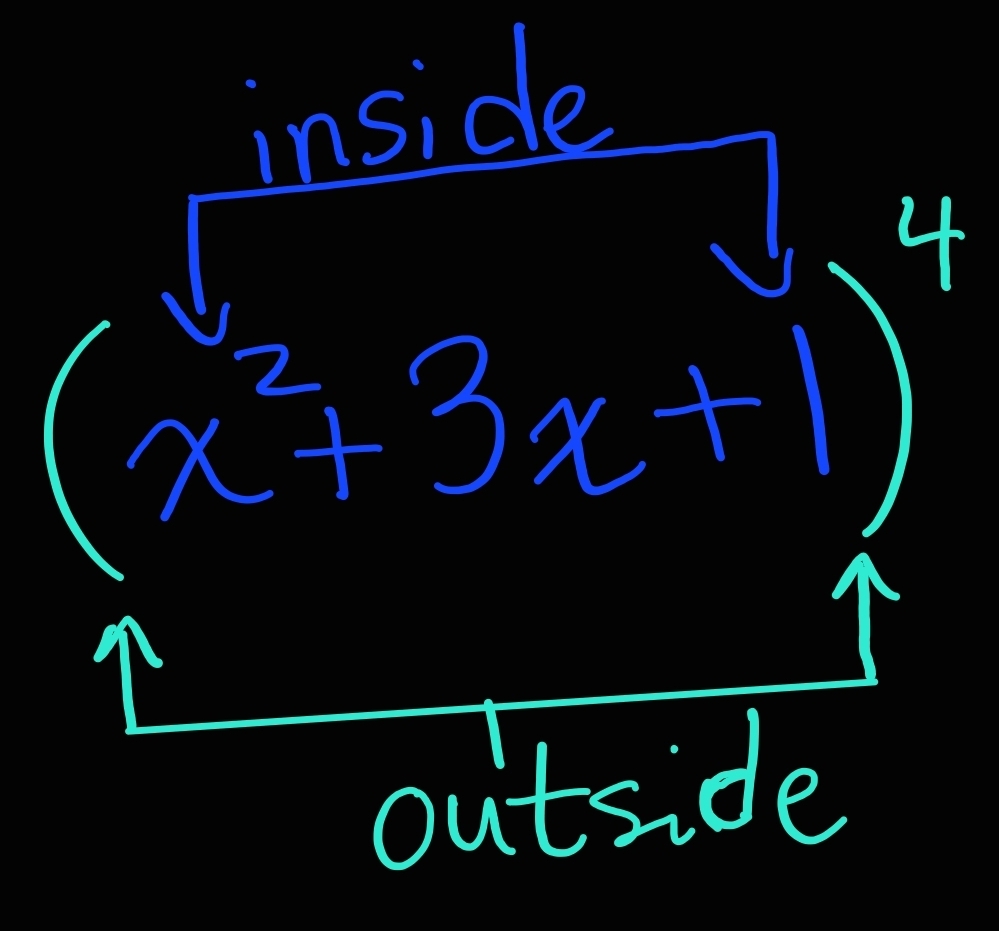
Now, take the derivative of the outside function while keeping the inside the same, and then multiply everything by the derivative of the inside.
$\frac{d}{dx}(x^2+3x+1)^4=4(x^2+3x+1)^3 \cdot (2x+3)$
If you want more detailed steps, go here. - We now have everything we need to plug into the formula of the product rule $\frac{d}{dx}[f(x) \cdot g(x)]=f'(x) \cdot g(x)+f(x) \cdot g'(x)$
- $\frac{d}{dx}[(17x^9-22x^3)^5(x^2+3x+1)^4]=$
$5(17x^9-22x^3)^4(152x^8-66x^2)(x^2+3x+1)^4+(17x^9-22x^3)^5 \cdot 4(x^2+3x+1)^3(2x+3)$
You can simplify if you wish, but I don't think it's worth it.
- $x(4x^2+1)$
- You can distribute the $x$ and just use the power rule if you wish.
I'm doing this example just to show you that the product rule doesn't necessarily require huge functions to be used on. In this case, our first big function is $f(x)=x$ and the second big function is $g(x)=4x^2+1$ - We need to find $f'(x)=\frac{d}{dx}(x)$. Remember from this section that it will just be the constant next to the $x$, which in this case is just an invisible $1$. So $f'(x)=1$
- To find $g'(x)=\frac{d}{dx}(4x^2+1)$ we will use the power rule and separate the terms.
- $\frac{d}{dx}(4x^2+1)=\frac{d}{dx}(4x^2)+\frac{d}{dx}(1)=(4 \cdot 2)x^{2-1}+0=8x$
The one disappeared because it's a constant, and the derivative of a constant is $0$. - We can now use the product rule.
$\frac{d}{dx}[x(4x^2+1)]=1(4x^2+1)+x(8x)=4x^2+1+8x^2=12x^2+1$
If you decide to distribute the $x$ and just use the power rule, you will get the same answer.
Typically, since distributing is relatively easier here, I would distribute and just use the power rule.
- You can distribute the $x$ and just use the power rule if you wish.
4.4 Quotient Rule
This is the last major rule in differentiation. You use it when you have 2 functions dividing with one another. The top function will always be $f(x)$ and the bottom function will always be $g(x)$.
Here is the formula:
$$\frac{d}{dx}\left(\frac{f(x)}{g(x)}\right)=\frac{g(x) \cdot f'(x)-g'(x) \cdot f(x)}{[g(x)]^2}$$
This rule should be the first thing that comes to mind (if you can't simplify) when you are asked to differentiate a fraction of 2 functions. I will do 1 example to help you see how to use it.
- $\frac{x^3+3x^2+5x+7}{\sqrt[4]{x}+\frac{3}{x^2}}$
- See a fraction that we want to differentiate? Think of the quotient rule.
The top of the fraction will always be your $f(x)$, the bottom will always be your $g(x)$. You need to find the derivatives of each to plug into your formula. - Our $f(x)=x^3+3x^2+5x+7$. To find $f'(x)=\frac{d}{dx}(x^3+3x^2+5x+7)$, we will use the power rule and separate the terms.
$\frac{d}{dx}(x^3+3x^2+5x+7)=\frac{d}{dx}(x^3)+\frac{d}{dx}(3x^2)+\frac{d}{dx}(5x)+\frac{d}{dx}(7)$
$=(3 \cdot 1)x^{3-1}+(3 \cdot 2)x^{2-1}+5+0=3x^2+6x+5$ - Our $g(x)=\sqrt[4]{x}+\frac{3}{x^2}$. Remember from here that to use the power rule, we need to express our terms in the form of $ax^n$.
Let's start with $\sqrt[4]{x}$. This is $x$ being raised to the 4th root. We can rewrite it as $x^{\frac{1}{4}}$.
Next, $\frac{3}{x^2}$. To remind you, if your $x$ is down and you want to raise it up, simply do so but turn its power negative. So, we can rewrite this as $3x^{-2}$.
So $g(x)=x^{\frac{1}{4}}+3x^{-2}$. We can now use the power rule.
$g'(x)=\frac{d}{dx}(x^{\frac{1}{4}})+\frac{d}{dx}(3x^{-2})=(1 \cdot \frac{1}{4})x^{\frac{1}{4}-1}+(3 \cdot -2)x^{-2-1}$
$=\frac{1}{4}x^{-\frac{3}{4}}-6x^{-3}$.
I will simplify:
$=\frac{1}{4\sqrt[4]{x^3}}-\frac{6}{x^3}$ - We finally have everything we need to plug into the formula
$\frac{d}{dx}\left(\frac{f(x)}{g(x)}\right)=\frac{g(x) \cdot f'(x)-g'(x) \cdot f(x)}{[g(x)]^2}$
Here is a picture of the answer with everything plugged in.
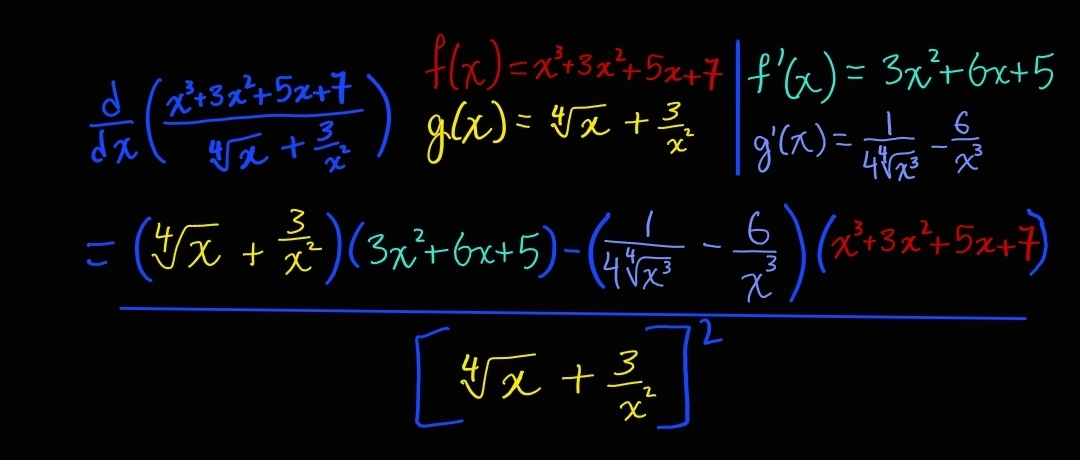
I don't recommend trying to simplify such expressions.
- See a fraction that we want to differentiate? Think of the quotient rule.
4.5 Differentiating trigonometric functions
We need to have these memorized. The picture below will have the derivatives and some tips to memorize them.
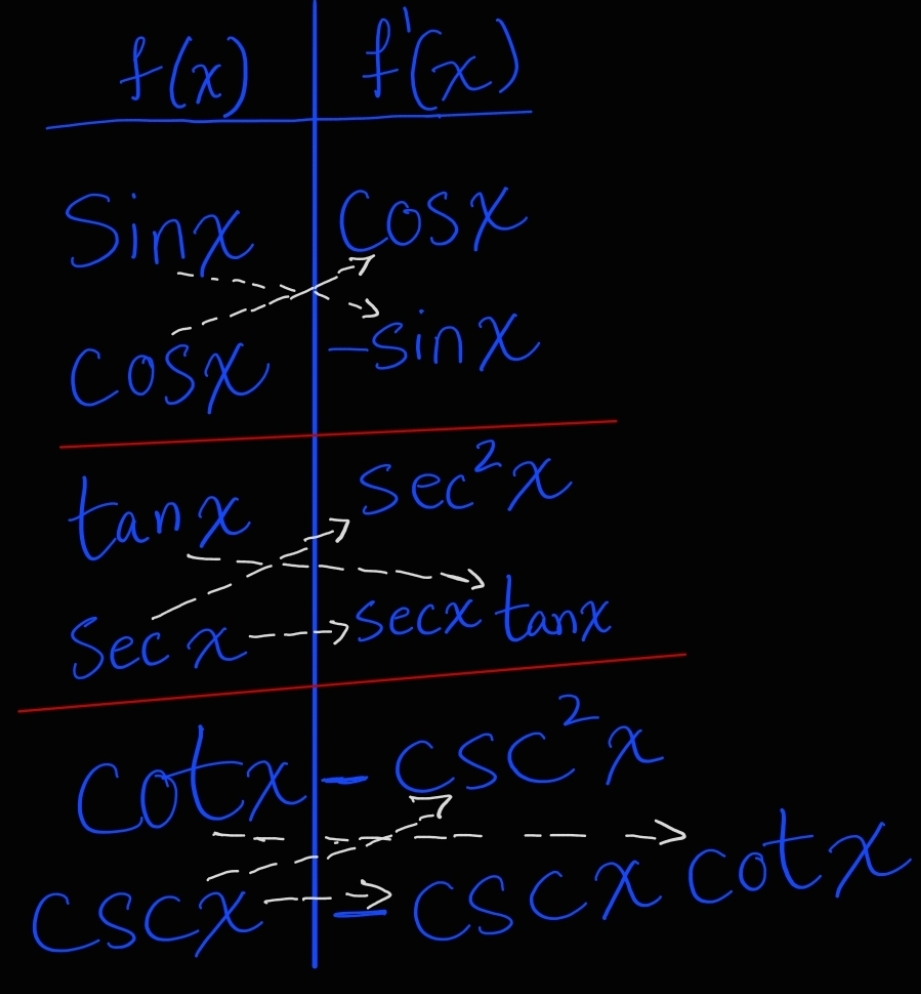
Note: Everything that starts with the letter c → its derivative will have a negative sign next to it!
Another note: I omitted the brackets that should be around the $x$. For example, $\sin x$ is the same as $\sin(x)$. Don't be confused. Also, the square you find on some of the derivatives is NOT on the $x$, but rather the function as a whole. For example, $\sec^2 x$ is the same as $[\sec x]^2$.
The most common trigonometric functions you will probably see are $\sin x$ and $\cos x$.
Remember that you will often need to use these derivatives in combination with the chain, product, or quotient rules.
4.6 Differentiation and logs
More stuff to memorize.
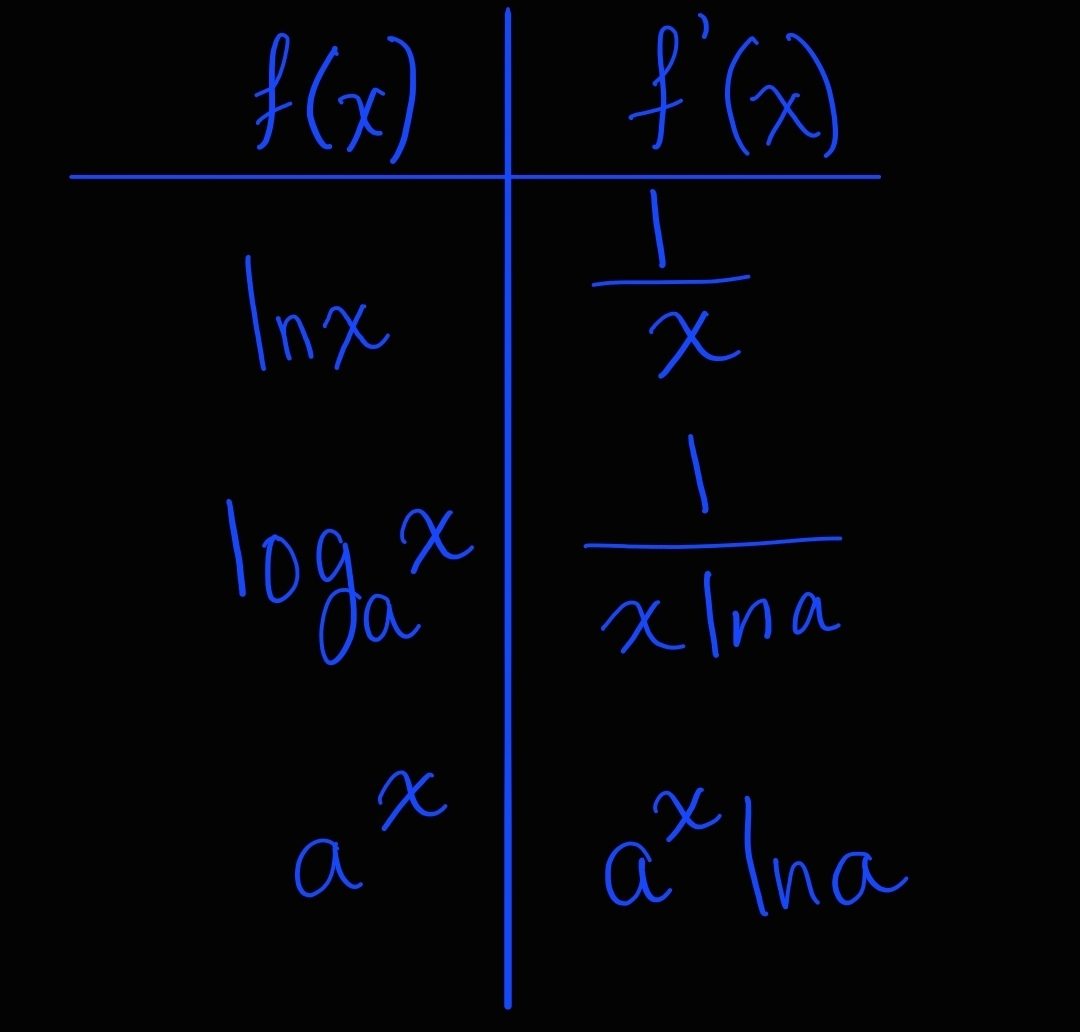
The letter $a$ represents any constant number that is bigger than $0$.
A special case for $\frac{d}{dx}(a^x)$ is when $a=e$. In this case, we have $\frac{d}{dx}(e^x)=e^x$.
Again, expect to use the chain, product, and quotient rules when dealing with those.
4.7 Implicit Differentiation
If I asked you to find $\frac{dy}{dx}$ for this $y=x^2+3x$ (remember, $\frac{dy}{dx}$ is just another way of saying: the derivative of this line $y=x^2+3x$), you can hopefully figure out the derivative using the tricks and rules I gave you. This is because the $x$ and $y$ are completely separated from each other, and the equation is given to you in the form $y=$ something with only $x$ as the variable.
What if I told you to differentiate $x^2+y^2=1$ without making it into the form $y= ...$. Can you do it using the rules I gave you above? Well… kinda.
Here are the rules for implicit differentiation. ▼
- You will differentiate both sides of the equation (the right and left hand side)
- If you are differentiating a term that has $y$ in it, first treat $y$ as if it's a regular function that you are used to differentiating (apply the rules you learned normally) and then multiply that derivative by $\frac{dy}{dx}$ (so coming back to the $y^2$ example, after applying the power rule, you get $2y$. After getting that, multiply it with $\frac{dy}{dx}$. So your final answer for the derivative of $y^2$ is $2y \cdot \frac{dy}{dx}$)
- If you are dealing with constants or $x$ variables, just do your work normally as you previously learned.
- After you are done with all your differentiation, you must express your equation in the form $\frac{dy}{dx}=...$. In other words, factor that $\frac{dy}{dx}$ and make it the subject of your equation.
It is very important you go step-by-step to avoid some silly mistakes.
Let's work on some examples.
- $x^2+y^2=1$
- I will first differentiate everything like we were previously taught using the rules above.
- Let's work on the left hand side.
Let's look at $x^2$. From the power rule, it will be $\frac{d}{dx}(x^2)=(2 \cdot 1)x^{2-1}=2x$
Ok, now the next term: $y^2$. As we said in the rules, I will treat it as if it's a normal function, so I will apply the power rule on it to get $2y$. But since I differentiated something with $y$, I must multiply that derivative by $\frac{dy}{dx}$. So in the end, we get $\frac{d}{dx}(y^2)=2y\frac{dy}{dx}$
So my left hand side becomes: $2x+2y\frac{dy}{dx}$ - The right hand side is just a constant, and as we previously said, constants simply become $0$.
- So our equation now looks like this: $2x+2y\frac{dy}{dx}=0$
- Separate $\frac{dy}{dx}$ and make it the subject.
$2x+2y\frac{dy}{dx}=0$
$2y\frac{dy}{dx}=-2x$
$\frac{dy}{dx}=\frac{-2x}{2y}=-\frac{x}{y}$ (I cancelled the $2$ from the fraction) - After you find that $\frac{dy}{dx}$ is now the subject of the equation, you have officially done it!
- $19x+\frac{2}{3}y^3 \cdot \sin x-4^x=\ln(x^2+4)$
- A terrible expression, indeed. I recommend looking at it and guessing the rules you have to use. Follow along and see if you guessed correctly.
- We will start from the left hand side. We will go term by term.
The first term is $19x$. Since $x$ has a power of $1$, we can just remove it, giving us $\frac{d}{dx}(19x)=19$ - The second term is $\frac{2}{3}y^3 \cdot \sin x$. This is 2 big functions getting multiplied together. We must use the product rule. Just so you don't get confused, I will call my first function $u$ and the second one $v$. I'm doing this to avoid some bad notation. My first function is $u=\frac{2}{3}y^3$ and the second one is $v=\sin x$.
I need to find the derivative of each. Let's start with $u'=\frac{d}{dx}(\frac{2}{3}y^3)$.
Again, I'm differentiating $y$, so I will treat it as if it's something normal, and then multiply by $\frac{dy}{dx}$.
$\frac{d}{dx}(\frac{2}{3}y^3)=(\frac{2}{3} \cdot 3)y^{3-1} \cdot \frac{dy}{dx}=2y^2\frac{dy}{dx}$
Now $v'=\frac{d}{dx}(\sin x)$. This is just testing your memory. It is $v'=\cos x$.
We can finally use the product rule now ($\frac{d}{dx}(uv)=uv'+u'v$)
$\frac{d}{dx}(\frac{2}{3}y^3 \sin x)=(\frac{2}{3}y^3)(\cos x)+(2y^2\frac{dy}{dx})(\sin x)$ - We move on to the third term. This is again just testing your memory. Recall this.
$\frac{d}{dx}(4^x)=4^x \cdot \ln 4$ - We have finally finished differentiating the left hand side. It is $19+\frac{2}{3}y^3\cos x+2y^2\sin x\frac{dy}{dx}-4^x \cdot \ln 4$
- Looking at the right side, it is both testing your memory and the chain rule, because you have a function inside a function. Look at the image below:
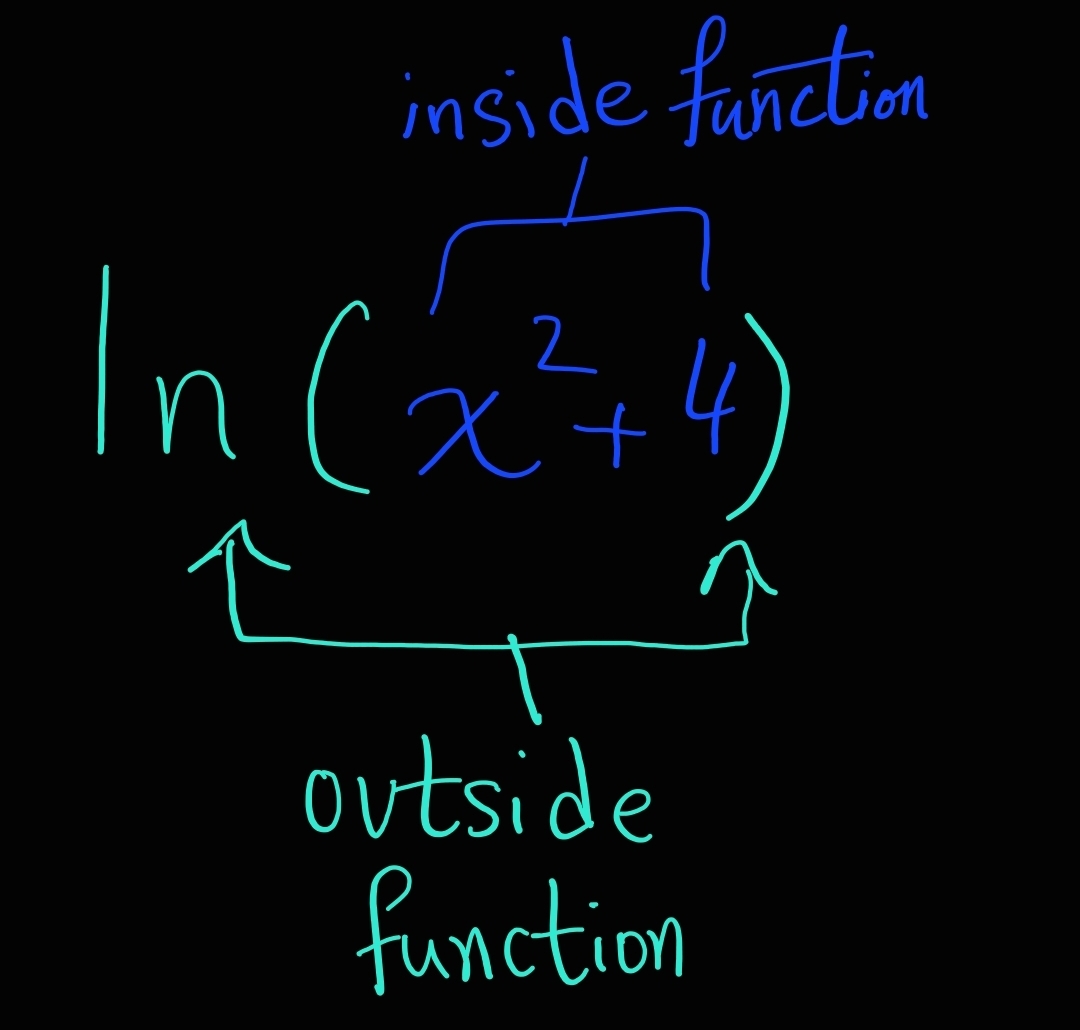
- We will differentiate the outside function, keeping the inside the same, and then multiply everything by the derivative of the inside.
Using your memory: the derivative of $\ln x$ is $\frac{1}{x}$ (so, wherever we see an $x$, we will replace it with $x^2+4$ to get the derivative of the outside function)
So, $\frac{d}{dx}[\ln(x^2+4)]=\frac{1}{x^2+4} \cdot \frac{d}{dx}(x^2+4)=\frac{1}{x^2+4} \cdot (2x)=\frac{2x}{x^2+4}$ - We are finally done differentiating everything. Our equation is $19+\frac{2}{3}y^3\cos x+2y^2\sin x\frac{dy}{dx}-4^x \cdot \ln 4=\frac{2x}{x^2+4}$
Our last step is to separate $\frac{dy}{dx}$. - $19+\frac{2}{3}y^3\cos x+2y^2\sin x\frac{dy}{dx}-4^x \cdot \ln 4=\frac{2x}{x^2+4}$
- $2y^2\sin x\frac{dy}{dx}=\frac{2x}{x^2+4}-19-\frac{2}{3}y^3\cos x+4^x \cdot \ln 4$
(in this step I moved everything that doesn't have $\frac{dy}{dx}$ to the other side, making sure to flip the sign) - $\frac{dy}{dx}=\frac{\frac{2x}{x^2+4}-19-\frac{2}{3}y^3\cos x+4^x \cdot \ln 4}{2y^2\sin x}$
(in this step I divided by $2y^2\sin x$ to completely separate $\frac{dy}{dx}$)
- $19+\frac{2}{3}y^3\cos x+2y^2\sin x\frac{dy}{dx}-4^x \cdot \ln 4=\frac{2x}{x^2+4}$
- $\frac{dy}{dx}$ is on its own, so we did it!
I understand that in these examples, you could probably separate $y$ to be on its own before differentiating. I have no problem with that and sometimes that's the best way to do it. But with some equations, it's either impossible or not a smart thing to do because the resulting function will be a nightmare to differentiate.
I hope this was good practice with derivatives. We will now move on to our last topic.
5. Integration
Integration is the reverse of derivatives. Imagine I was teaching you how to build a house using some bricks. Now, I'm teaching you to break down that house and give me my bricks back. A good rule of thumb is to remember your derivatives and think backwards.
Possible uses of integration. ▼
- To find the area under a curve. Here are some examples to help you imagine it.
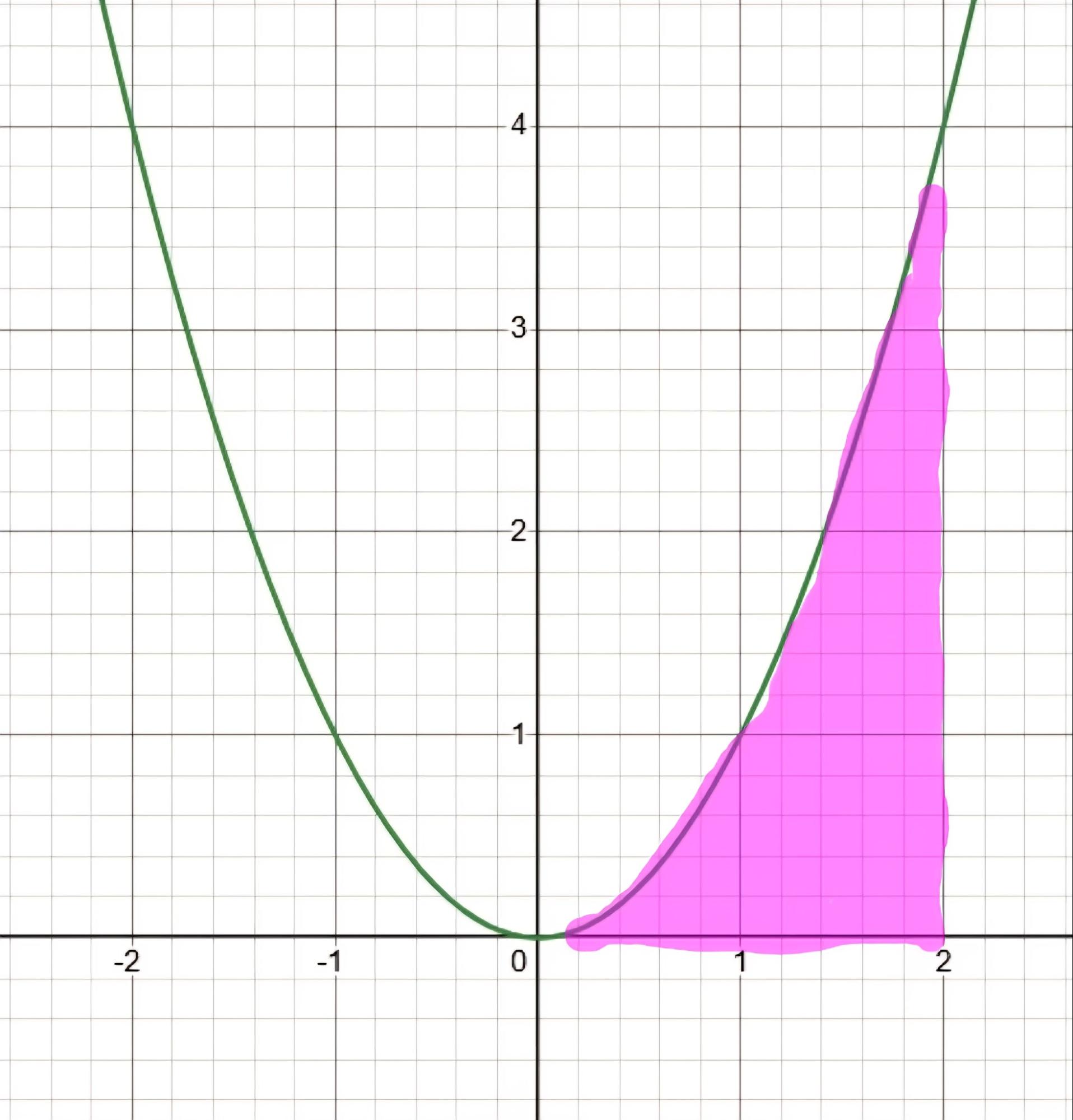
- Below is the graph of $y=x^2$. The pink highlighted area is the area under the curve from $x=0$ to $2$
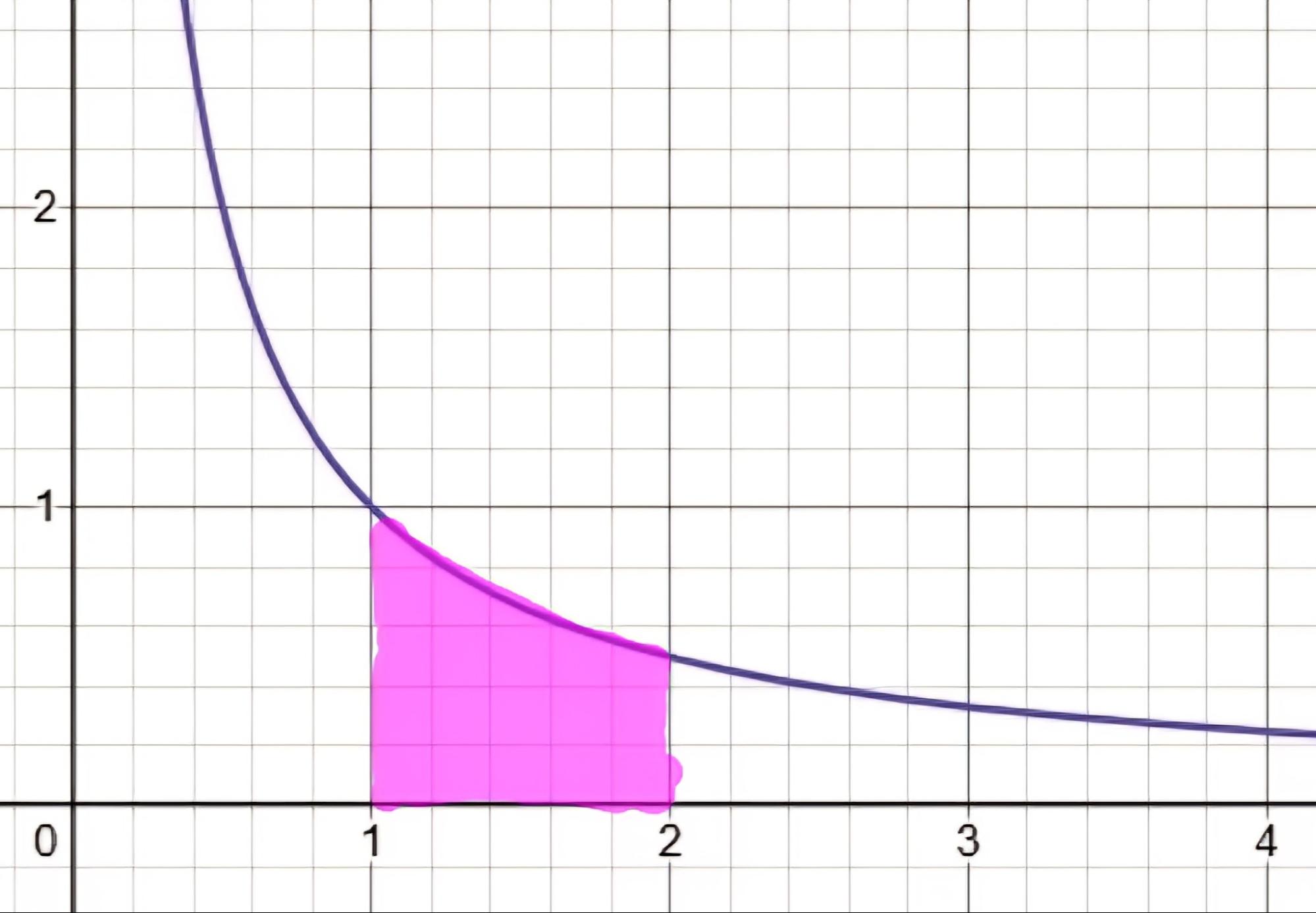
- Below is the positive portion of the graph $y=\frac{1}{x}$. The pink highlighted area is the area under the curve from $x=1$ to $2$.
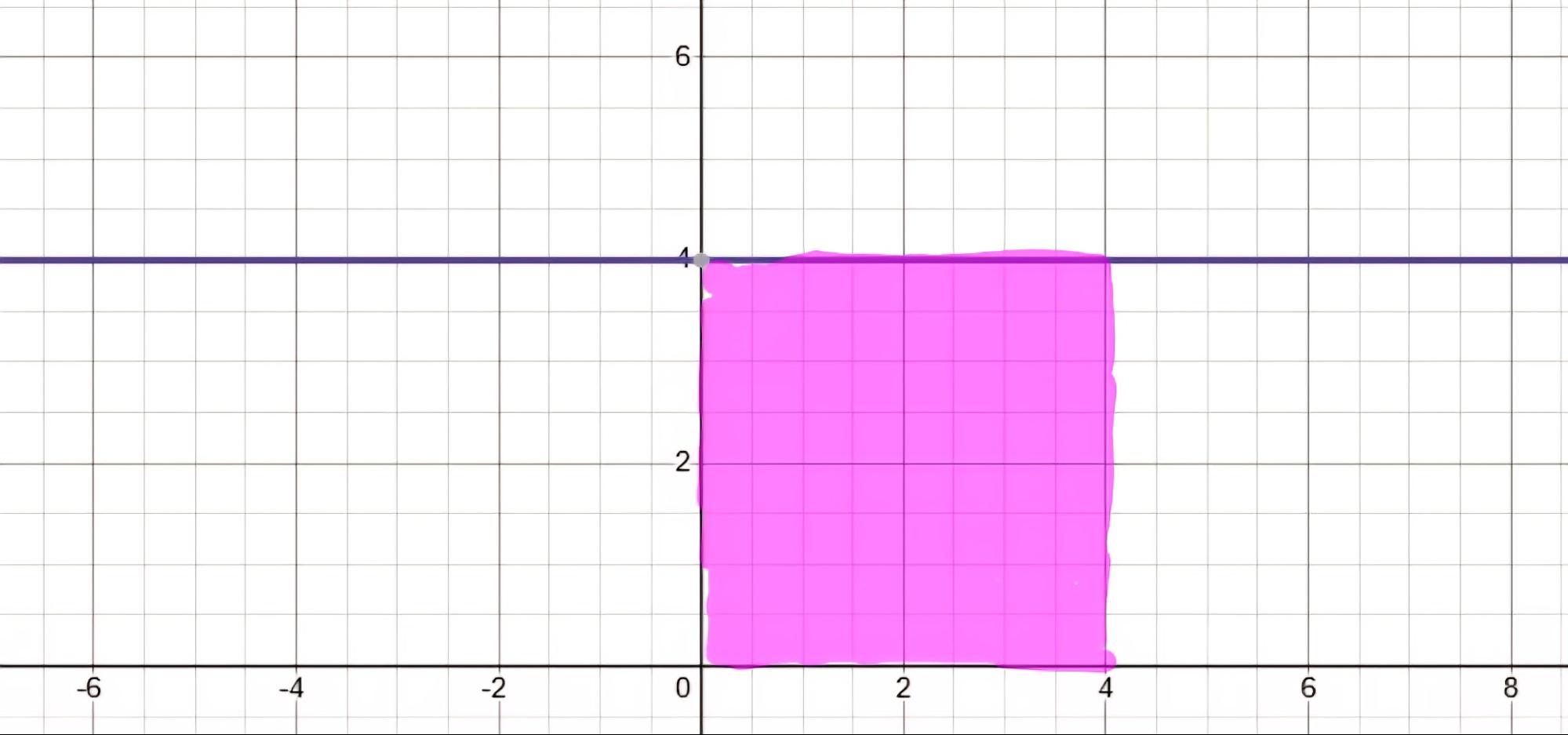
- Below is the graph for $y=4$. The highlighted area is the area under the curve from $x=0$ to $4$
- Below is the graph of $y=x^2$. The pink highlighted area is the area under the curve from $x=0$ to $2$
- Trace back the acceleration of an object based on its position graph and other known variables.
Symbol for integration:
$$\int f(x) \, dx$$ This is known as an indefinite integral. That swiggly line has nothing on it.
$$\int_a^b f(x) \, dx$$ This is known as a definite integral. The $a$ is usually the lower $x$ value and the $b$ is usually the bigger $x$ value. You will see this form when you are trying to find the area under the curve $f(x)$ from a specific interval. For example, in the first example in the "area under the curve" explanation, we were finding the area from the interval $0$ to $2$ (in this case $a=0$ and $b=2$), and our $f(x)=x^2$. Hence that highlighted area is equal to $\int_0^2 x^2 \, dx$.
Before I give you the first rule, let's try to work off what we already know about integration: it is the reverse of differentiation.
Consider this $f'(x)=2x$. We differentiated a function $f(x)$ and we got the derivative to be $2x$. What could $f(x)$ possibly be?
- Think of the power rule but in reverse. To remind you here is the power rule $\frac{d}{dx}(ax^n)=(a \cdot n)x^{n-1}$
- Let's start by looking at the power of $x$ in $f'(x)=2x$. We see that $x$ has a power of $1$ (which is invisible). The power rule decreases the power of $x$ by $1$, so to reverse the power rule: We must increase the power of $x$ by $1$. So the original power of $x$ was $2$.
- Good. Now in the power rule, we used to multiply the term by the original power. So to reverse the power rule, we must divide the term by the original power. Our original power was $2$ and we currently have $2x^2$, so after dividing we get $\frac{2x^2}{2}=x^2$.
- We have now completely reversed the power rule!
So, is our original $f(x)=x^2$? The answer is maybe.
Go back to the shortcuts I gave you in differentiation and recall this shortcut:
- If you have a constant all by itself like $10$, $3$, $1$, $\frac{3}{2}$, $40839$, ... The derivative of that will always be 0.
When I gave you $f'(x)=2x$, you have no way of telling whether I differentiated a constant or not. Hence, in order to overcome this mystery, you have to tell me "Your original $f(x)$ was $x^2$ + some constant." And yes, that constant could be $0$.
So, the official answer is $f(x)=x^2+C$ where $C$ is any real constant.
Don't believe me? Try to differentiate $f(x)=x^2+C$ and treat $C$ as any random number that comes to mind. You will return to $f'(x)=2x$, which I previously gave you.
5.1 Rule #1 - Reverse of the basic rules
$$\int ax^n \, dx = \frac{ax^{n+1}}{n+1}+C$$
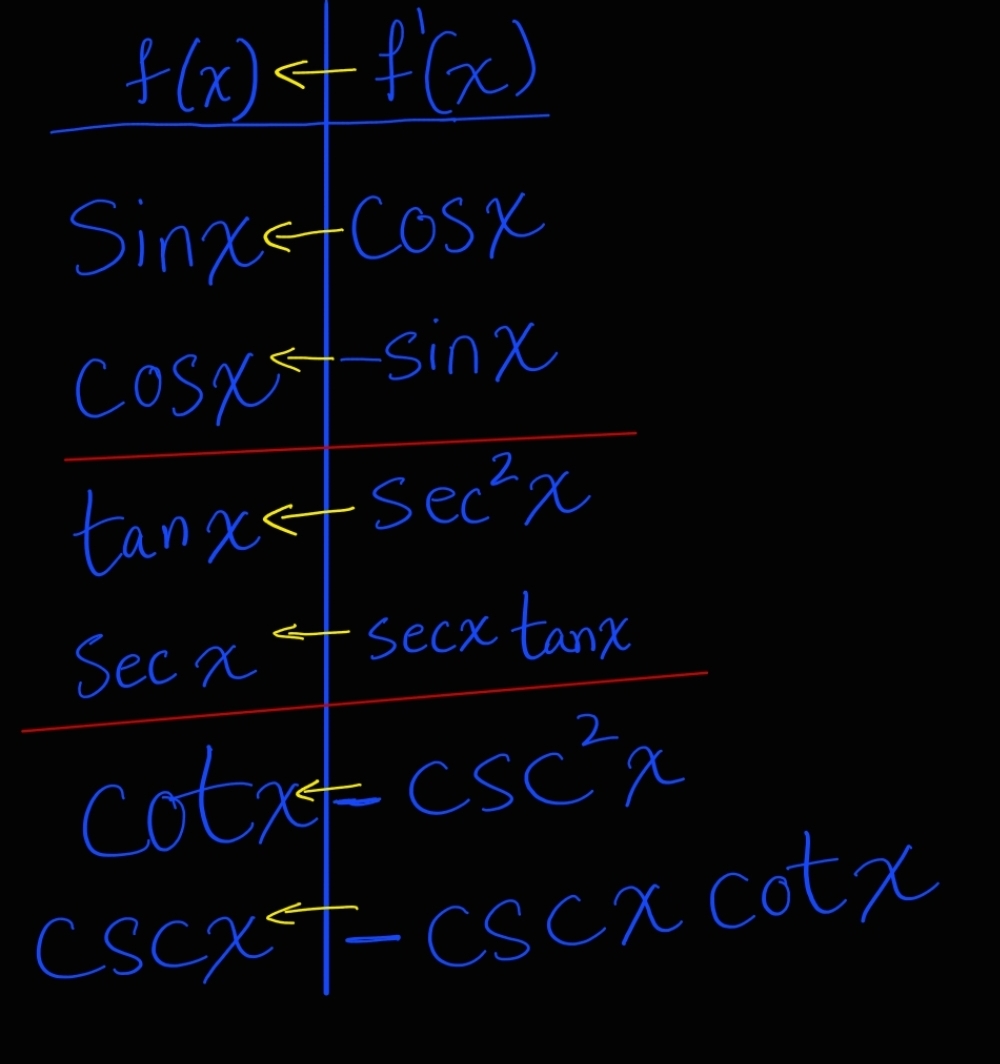
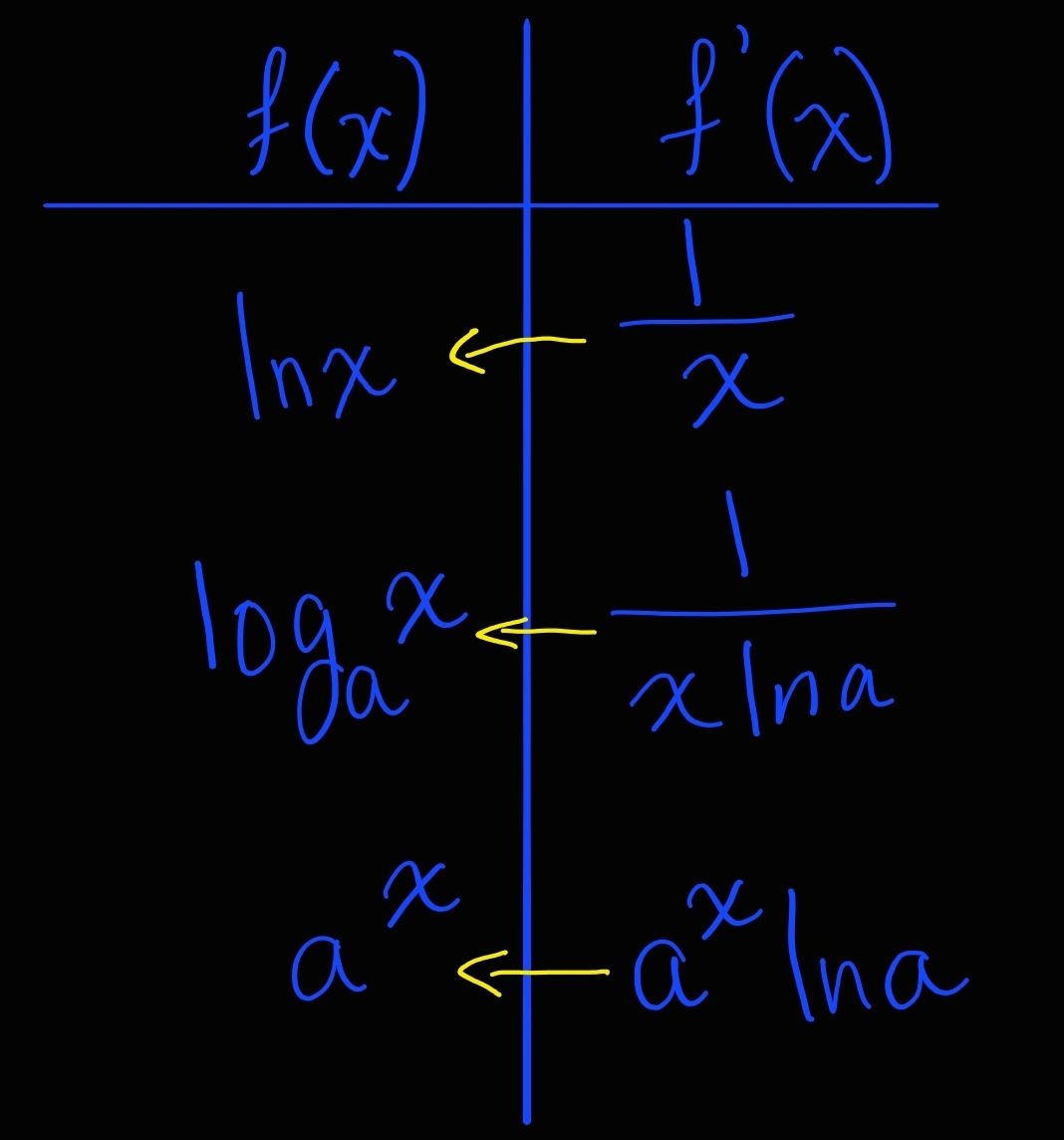
Again, there's a special case if you have $\int e^x \, dx = e^x+C$.
(Yellow arrow is the direction of the integration. I wanted to use the same picture to reinforce the idea of reversing differentiation)
For trigonometric functions, refer back to your differentiation rules and think backwards.
Examples:
- $\int 3x \, dx$
We will increase the power of $x$ by $1$ and divide by that new power.
$\int 3x \, dx=\frac{3x^{1+1}}{1+1}+C=\frac{3x^2}{2}+C$. Never forget your $+C$ in your indefinite integral. - $\int x^3 \, dx$
We will increase the power of $x$ by $1$ and divide by that new power.
$\int x^3 \, dx= \frac{x^{3+1}}{3+1}+C=\frac{x^4}{4}+C$. Never forget your $+C$ in your indefinite integrals. - $\int \cos x \, dx$
What is a function that when we differentiate we get $\cos x$? If you look back at your rules of differentiation, that function is $f(x)=\sin x$. So our final answer is $\int \cos x \, dx = \sin x + C$. - $\int \sin x \, dx$
What is a function that when we differentiate we get $\sin x$? Well, looking back at our rules of differentiation, we have $\frac{d}{dx}(\cos x)=-\sin x$. But we don't want that negative sign next to $\sin x$. Then we must multiply $\cos x$ by $-1$. Look: $\frac{d}{dx}(-1 \cdot \cos x)=-1(-\sin x)=\sin x$.
So our final answer is $\int \sin x \, dx=-\cos x+C$. - $\int \sec^2 x+\frac{3}{4x}-\frac{x^4}{2} \, dx$
Remember when I told you that you're allowed to separate the terms for differentiation? You can also do it for integration. So the above integral is equal to: $\int \sec^2 x \, dx +\int \frac{3}{4x} \, dx-\int \frac{x^4}{2} \, dx$
Let's go one by one.- $\int \sec^2 x \, dx$
This is testing your memory. What function do I differentiate to get $\sec^2 x$? That is $\frac{d}{dx}(\tan x)=\sec^2 x$.
So our final answer is $\int \sec^2 x \, dx=\tan x+C$. - $\int \frac{3}{4x} \, dx$
Well, hopefully you remember that $\frac{d}{dx}(\ln x)=\frac{1}{x}$. But what do we do with that $\frac{3}{4}$ on the top? Remember the property of differentiation where you can move constants outside? We can also apply it to integration.
So, $\int \frac{3}{4x} \, dx =\frac{3}{4} \cdot \int \frac{1}{x} \, dx=\frac{3}{4}\int \frac{1}{x} \, dx$
And we just said that we know that $\int \frac{1}{x} \, dx=\ln x$. So $\frac{3}{4}\int \frac{1}{x} \, dx=\frac{3}{4} \cdot (\ln x)+C=\frac{3}{4}\ln x +C$. - $\int \frac{x^4}{2} \, dx$
You can leave that $2$ in the bottom if you wish, but I will move it out to help you practice moving things.
$\int \frac{x^4}{2} \, dx=\frac{1}{2}\int x^4 \, dx$
Now we will use the reverse of the power rule.
$\frac{1}{2}\int x^4 \, dx=\frac{1}{2}\left(\frac{x^{4+1}}{4+1}\right)+C=\frac{1}{2}\left(\frac{x^5}{5}\right)+C=\frac{1 \cdot x^5}{2 \cdot 5}+C=\frac{x^5}{10}+C$.
- $\int \sec^2 x \, dx$
5.2 U-Substitution
This is a very powerful rule in integration. However, it may require some intuition to master. You will use this rule when you are given some function to integrate, and that function is somewhat close to one of your basic rules, but not in a way that allows you to use it. Hence, you will do some substitutions using the dummy-variable $u$ (it has nothing special to it, just convention) to make your integration fit the one you know.
You may try to use this rule when you see 2 things multiplying, dividing, or adding/subtracting in a way you can't separate. This rule may not always work. If it doesn't work, then you will have to learn Calculus II for more techniques and rules.
My only tip to use U-Sub is to see which part you can make $u$ equal to such that it cancels everything else that has an $x$ variable. This is ambiguous, I know, but practice will help. I will show you the correct way to do it in addition to the wrong way (in this video for this problem: $\int 2x(3x^2+4)^5 \, dx$)
Here are the steps for U-Substitution. ▼
- Pick your $u$
- Differentiate your $u$ so that you now have $du=(\text{something}) \, dx$
- Make $dx$ the subject of your equation
- Substitute that expression for your $dx$ into your original integral and also your $u$ into the original integral
- Make sure there is NO $x$ in your integral now. If there is, you have picked the wrong $u$.
- The integral should be easier to integrate now. Go ahead and integrate
- After you integrate, your answer will be in terms of $u$. Return your answer to the $x$ variable by re-substituting your value of $u$ that you picked.
Examples. (I'm still trying out how to put videos over here. Sorry)
- $\int \cos x \sin x \, dx$ (Please look in video comments)

- $\int e^{2x} \, dx$ (Please look in video comments)
- $\int 2x(3x^2+4)^5 \, dx$